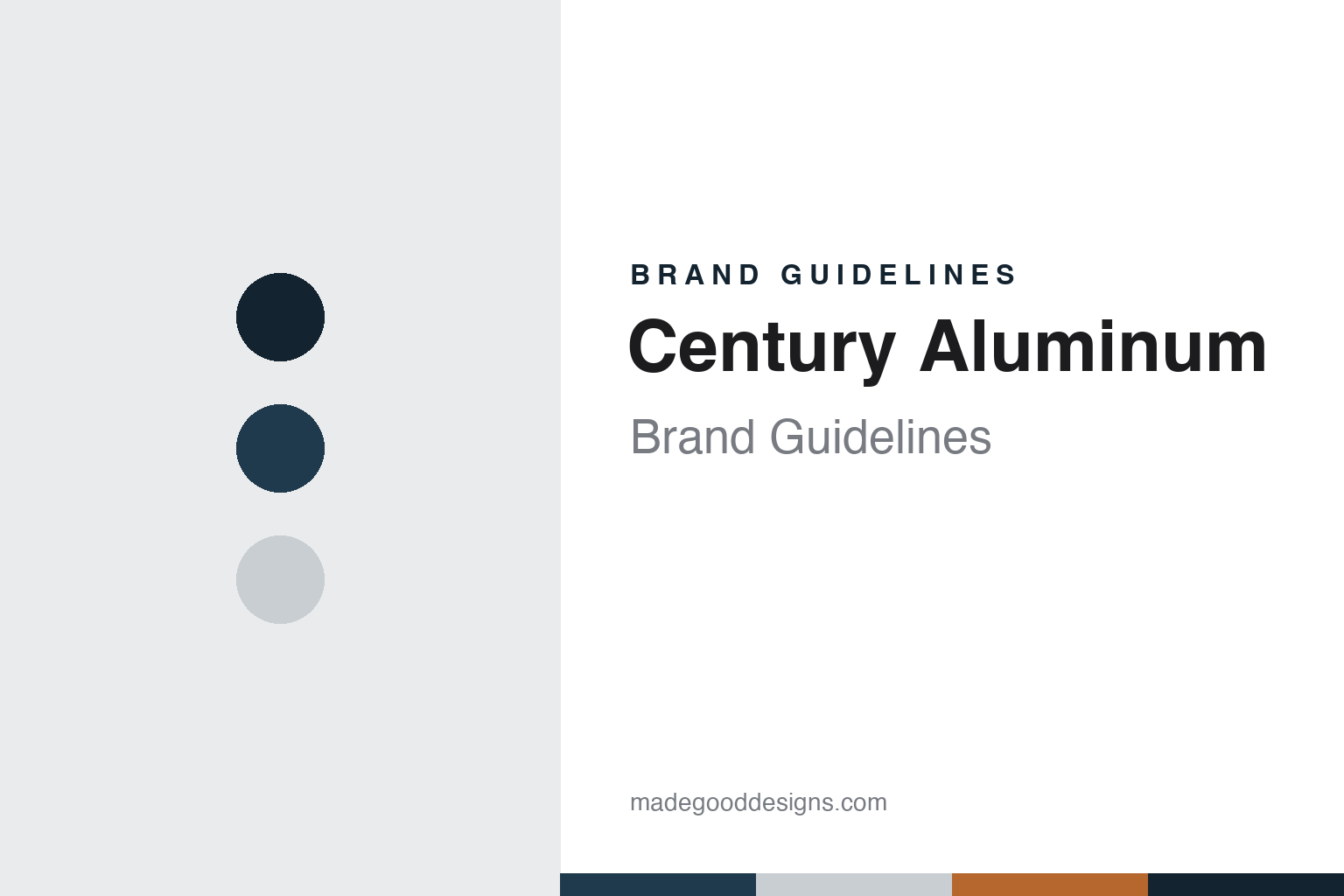
Century Aluminum Brand Guidelines
A Chicago smelter group built by buying plants, from Kentucky to Iceland.
Aa
Two constants: a navy, ingot grey and copper palette and an industrial sans register. Abstract homage — not a Century Aluminum product or mark; no ingot, logo or nameplate is reproduced.
Founded in 1995
A rolling mill, a share of a smelter and a stock listing.
Century Aluminum was founded in 1995. The company’s own history page says its first assets were Ravenswood Aluminum Corporation, which made rolled aluminum products at Ravenswood in West Virginia, and a 26.67 per cent share of a smelter at Mt. Holly, South Carolina. It launched an initial public offering in March 1996 and has been traded on NASDAQ ever since; English Wikipedia gives the same founding and listing years.
Its headquarters is in Chicago, at One South Wacker Drive, which English Wikipedia says the company moved to from California. The commodities group Glencore is closely tied to it: The Motley Fool reported in July 2025 that Glencore International held about 40 per cent of Century’s outstanding shares, directly and through a subsidiary, making it the largest shareholder. The same report said Glencore was also Century’s largest customer in 2024 and supplied part of its alumina.
Century grew by buying plants rather than building them. Its timeline lists a further 23 per cent of Mt. Holly in 2000; 80 per cent of the Hawesville, Kentucky smelter in 2001 and the remaining 20 per cent in 2003; the Grundartangi smelter in Iceland in 2004; a carbon anode plant at Vlissingen in the Netherlands in 2012; the Sebree, Kentucky smelter in 2013; and the rest of Mt. Holly in 2014.
Colour
Kentucky, South Carolina and Iceland.
Iceland gave Century its largest single plant. Icelandic Wikipedia says the Grundartangi smelter, run by the company Norðurál near Akranes in the west of Iceland, was started in 1998 with a capacity of 60,000 tonnes a year, raised to 90,000 tonnes in 2001, 220,000 tonnes in 2006 and 260,000 tonnes in 2007. It says Century bought Norðurál in April 2004 from Columbia Ventures Corporation of Vancouver, Washington. Century’s own timeline says Grundartangi reached about 320,000 tonnes of capacity in 2017. English Wikipedia adds that construction of a second Icelandic smelter, at Helguvik, has been halted since 2009.
Not every plant stayed open. English Wikipedia, citing the Associated Press, says Century announced the permanent closure of the Ravenswood plant in 2015, citing energy costs, and that in July 2022 it idled the Hawesville smelter, citing what the company called “soaring energy prices.” Century’s timeline says that in 2026 it sold the idle Hawesville site under an agreement to redevelop it as a digital campus. In late 2015, English Wikipedia says, Century reached an agreement with the South Carolina utility Santee Cooper under which Mt. Holly would run at half capacity; the company says it launched a restart of idle capacity there in 2025, adding 50,000 tonnes.
Today the company describes itself as vertically integrated. Its website lists two US smelters, at Sebree and Mt. Holly, the smelter at Grundartangi, the anode plant at Vlissingen, which it says supplies Grundartangi, and a bauxite mine and alumina refinery at Clarendon, Jamaica, through a 55 per cent interest in Jamalco acquired in 2023. It gives its annual primary aluminum capacity as about 770,000 tonnes. English Wikipedia, citing a 2018 US Department of Commerce report, calls Century the largest producer of primary aluminum in the United States.
Its products are plain commodity forms. Century lists billet in diameters from seven to fourteen inches, made in the US and Iceland; sow and standard ingot, made in the US; primary foundry alloy made in Iceland; and Natur-Al, a line it launched in 2020 and describes as certified low-carbon aluminum, made in Iceland. It says it serves the automotive, aerospace, defense, consumer goods and energy industries.
Typography
How aluminium companies present themselves.
Aluminium companies sell a grey metal that most people never see in its raw form, so their imagery leans on the moments when it glows. The potline, a long hall of electrolytic cells, and the casthouse, where molten metal is poured into ingots, slabs and billets, are the scenes that recur in annual reports and recruitment pages: orange light, heat-resistant suits and stacked bars of silver metal.
Further down the chain, the pictures change to finished forms. Rolling mills show coils of sheet and foil; marketing pages turn to beverage cans, window frames, aircraft panels and car bodies, the places where buyers meet the metal. Producers also photograph the smelter itself from a distance, sometimes beside the dam, hydro station or power plant that feeds it, since smelting is done by electrolysis and runs on a steady supply of electricity.
Over the past decade, low-carbon metal has become a brand category of its own. Producers give named labels to aluminium made with hydropower or other low-emission electricity and publish carbon figures alongside them; Rusal markets metal under the ALLOW name and Alcoa uses its Sustana family, the companies say. Recycling programmes, scrap collection and remelting are presented in the same frame, and sustainability reports, with their landscapes, maps and charts, have become one of the main design documents these companies publish.
For a designer, the category is a study in contrast: heavy industry, huge sites and molten metal on one side, and on the other a clean, technical language of labels, figures and finished products used to present it to buyers and the public.
Aa
An industrial sans for a metals producer. (Specimen set in Barlow, a sans STAND-IN; NOT the Century Aluminum logo.)
Century Aluminum
A planned smelter in Oklahoma, with EGA.
Century’s next plant is planned with a partner. In 2024 the US Department of Energy selected Century for an award towards a new “green” smelter, Canary Media reported, and the company had named northeastern Kentucky as its preferred site. In January 2026 it changed course: Century and Emirates Global Aluminium announced that they would jointly build a smelter near Tulsa, Oklahoma, at the Tulsa Port of Inola, according to Canary Media and the UAE business newsletter EnterpriseAM. Both reported that EGA would own 60 per cent and Century 40 per cent, and that the plant was planned to produce 750,000 tonnes a year, which Canary Media said would more than double current US primary aluminum output.
The project was a plan, not a plant, at the time of those reports. The companies said construction was set to start by the end of 2026, with production slated for the end of 2030, EnterpriseAM reported in January 2026, and negotiations for a long-term power contract with the Public Service Company of Oklahoma and the state were still under way. Century’s own timeline now lists the Inola smelter as a joint project with EGA.
The brand itself is low-key. Century’s website leads with the line “Responsibly Producing the Aluminum the World Needs” and lists four values: care, agility, responsibility and excellence. It does not publish a set of brand colours or a corporate typeface, and its products are sold as ingot, sow and billet to manufacturers rather than to the public.
For a design guide, Century Aluminum shows how a company built by acquisition presents a set of far-apart plants as one producer. Compare Glencore, its largest shareholder, and EGA, its partner in Oklahoma. For this guide we use a deep navy, an ingot grey and a muted copper with a sans, an unofficial interpretation; no product or logo is reproduced.
Explore & save
Keep Century Aluminum’s identity on hand — save it to a board in the Made Good inspiration library.
Century Aluminum identity set
Pin the Century Aluminum navy, ingot grey and copper palette and the industrial sans register to your own board.