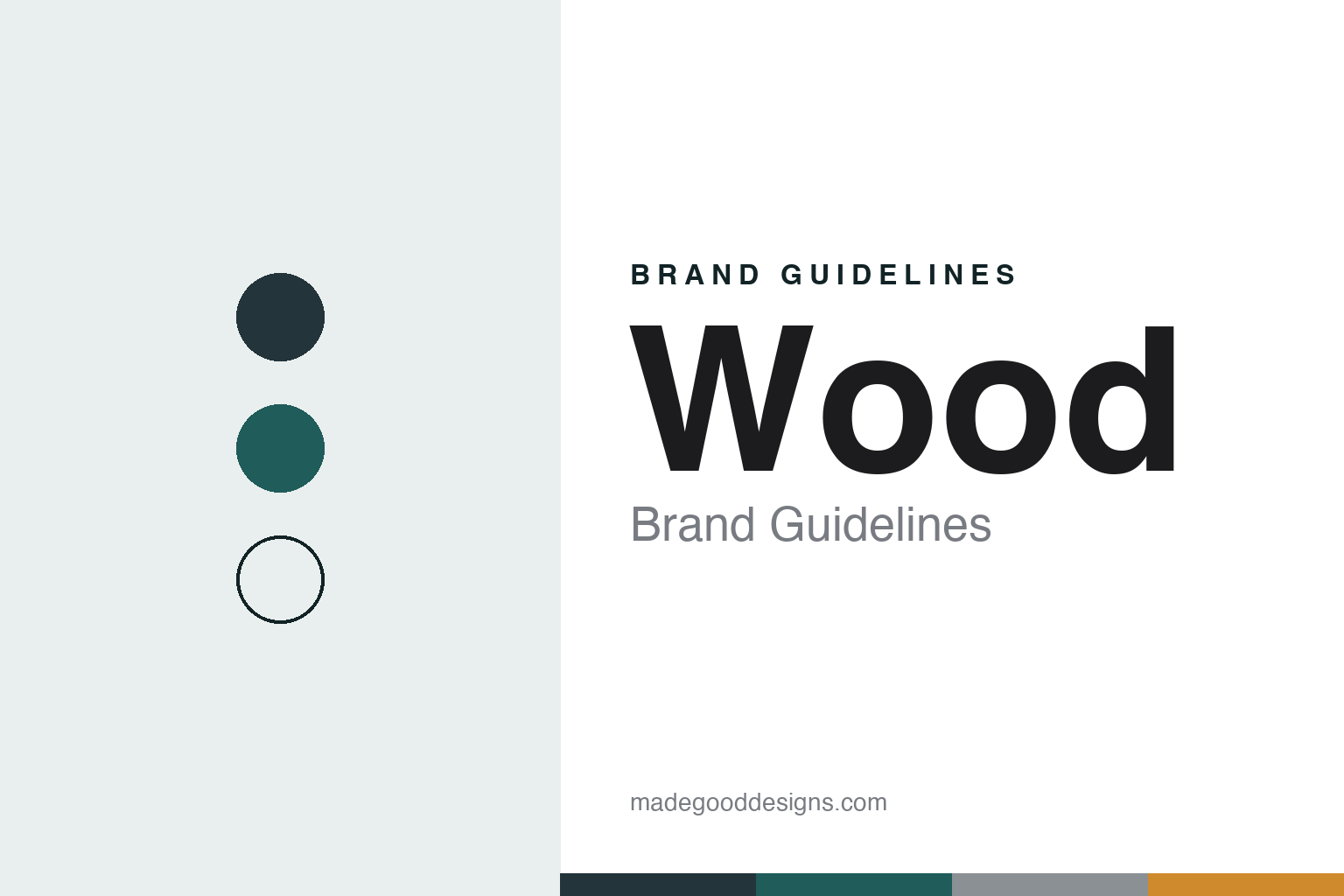
Wood Brand Guidelines
The Aberdeen ship repairer that grew up with North Sea oil.
Aa
Two constants: a slate, teal and granite palette and an engineering sans register. Abstract homage — not a Wood product or mark; no logo or nameplate is reproduced.
Wood & Davidson
A ship repair yard, a fishing fleet and the North Sea.
Wood’s story begins in the harbour of Aberdeen. According to the city’s museum collection, which quotes the historian Richard Perren’s essay in Aberdeen 1800–2000, the group took shape in 1955, when John Wood bought out the other shareholders in the Aberdeen ship repair company Wood & Davidson. Through acquisitions and fresh investment the firm built three divisions in the 1960s and early 1970s — fishing, engineering and general industries — and by 1974 it ran more than 50 trading companies with about 1,750 employees, which the essay counts among the largest private industrial companies in Scotland.
That base mattered when oil arrived. Perren describes the Wood businesses as one of the few Aberdeen companies with the economic weight to take full advantage of the services market that North Sea oil opened after 1970. English Wikipedia says the family holding company, JW Holdings — which it calls the largest fishing company in Scotland — decided to diversify into energy services at the start of the North Sea industry in the early 1970s, and that the oil business benefited greatly from that early move.
Ian Wood joined the family business after university and became managing director in 1967, according to English Wikipedia. In 1982 the energy services business split away from JW Holdings as the John Wood Group, with Ian Wood as chief executive until 2006 and chairman until 2012. The BBC, reporting in November 2025, summed up the arc as a family firm built up “from its roots in fishing boat repair.” Wikipedia adds that the Wood family, through charities and trusts, at one point held as much as 40 percent of the shares, giving it considerable say in the company’s direction.
Colour
From Aberdeen to Houston, and a takeover of a rival.
The group spent the next two decades spreading out from the North Sea. In September 2000 it bought Mustang Engineering, a Texas engineering business that became Wood Group Mustang and kept operating as a subsidiary, English Wikipedia says. In 2002, after years of speculation, John Wood Group listed its shares on the London Stock Exchange. In 2011 it sold its well support division to General Electric, and in 2016 it bought Enterprise Engineering, an Aberdeen firm that had gone into administration.
The largest step came in 2017. In March of that year Wood Group agreed to take over Amec Foster Wheeler, the BBC reported, bringing together two of the UK’s largest energy services companies; Amec Foster Wheeler itself had been formed three years earlier by the merger of Amec and the American firm Foster Wheeler, and the combined business served oil and gas, chemicals and mining customers. After clearance by the Competition and Markets Authority the deal completed on 9 October 2017, according to English Wikipedia, and parts of the acquired business, including its North Sea oil and gas interests and a North American nuclear operation, were later sold.
The BBC describes the years that followed as a push to diversify — beyond services for oil and gas production into engineering for refineries and chemical plants, urban design and renewable energy. Wikipedia lists the reshaping that went with it: the nuclear division, including decommissioning work at Sellafield, went to Jacobs in 2020, and the built environment consulting business went to WSP in a sale completed in September 2022. Along the way the company came to present itself simply as Wood, while remaining formally the John Wood Group, the BBC notes.
English Wikipedia describes its work as consulting, asset management and engineering for the energy and materials sector, and the BBC reported in November 2025 that it gave its workforce as about 35,000 people in more than 60 countries.
Typography
Design and documentation.
Oilfield service companies sell work that most people never see. Their customers are oil and gas producers, and the jobs happen thousands of metres underground, on remote well pads or on the seabed. So the way these firms present themselves leans on a small set of recurring pictures: crews in branded coveralls and hard hats on a rig floor, frac fleets of pump trucks lined up on a well pad, and service trucks parked at a wellsite with the company name on the door.
Offshore, the pictures change but the method is the same. Remotely operated vehicles hang from launch frames, supply and support vessels sit in a harbour or alongside a platform, and seismic ships tow their streamers across open water. Onshore and offshore alike, the firms photograph their engineering and manufacturing centres too: test bays, laboratories and workshops where pumps, tools and chemicals are made or checked before they go to the field.
Much of the communication is technical. Companies publish papers through industry bodies, case studies that set out a customer’s problem and the tool used to solve it, product data sheets and long catalogues of named technologies. Product names tend to be coined words or trademarks attached to a function — a drilling system, a lift pump, a monitoring service — and many firms keep the names of companies they bought alive as product brands.
Two further registers sit alongside the technical one. Safety pages describe procedures, training and reporting in the industry’s own vocabulary, and investor presentations explain backlogs, contracts and market cycles to shareholders. For many of these firms, mergers, spin-offs and restructurings are part of the history, so the name on the coveralls may be newer than the tools the crew is using.
Aa
An engineering sans for an engineering group. (Specimen set in IBM Plex Sans, a sans STAND-IN; NOT the Wood logo.)
Wood
From a London listing to a Dubai owner.
The independent listed company did not last. English Wikipedia records that the American private equity firm Apollo walked away in 2023 after several rejected approaches, and that in May 2024 Wood rejected an offer from Sidara, the Dubai-based engineering and design group. In 2024 Wood ordered an independent review of its finances by Deloitte, The Guardian reported, which found inappropriate management pressure to keep existing financial reports despite problems on legacy lump-sum projects. In May 2025 its shares were suspended in London after it failed to file its accounts on time, Wikipedia says; those accounts were eventually published on 30 October 2025, according to the BBC.
Sidara returned. Wood and Sidara announced agreed terms for a cash acquisition on 29 August 2025, and shareholders approved the scheme on 17 November 2025, according to a stock exchange announcement; the BBC reported that 88 percent of votes cast backed it. The Court of Session in Edinburgh sanctioned the scheme on 6 March 2026, and it became effective on 10 March 2026, the announcement says, with Wood’s London listing due to be cancelled the next day. Wood is now part of Sidara. In the same month, on 4 March 2026, the Financial Conduct Authority fined John Wood Group for publishing inaccurate financial results between January 2023 and November 2024, The Guardian reported; the regulator reduced the penalty after the company agreed with its findings.
The name is set to change back. The BBC reported that the company, formally the John Wood Group, would return to that branding under Sidara, and that Sidara intended to develop the Wood brand as its engineering and materials division.
For a design guide, Wood shows how a name can travel from a harbour yard to a global engineering group and back to its full form. Compare Petrofac, another UK oil and gas contractor reshaped in the 2020s, and TechnipFMC, an engineering group formed by a merger. For this guide we use slate, a deep teal and granite grey with a sans, an unofficial interpretation; no product or logo is reproduced.
Explore & save
Keep Wood’s identity on hand — save it to a board in the Made Good inspiration library.
Wood identity set
Pin the Wood slate, teal and granite palette and the engineering sans register to your own board.