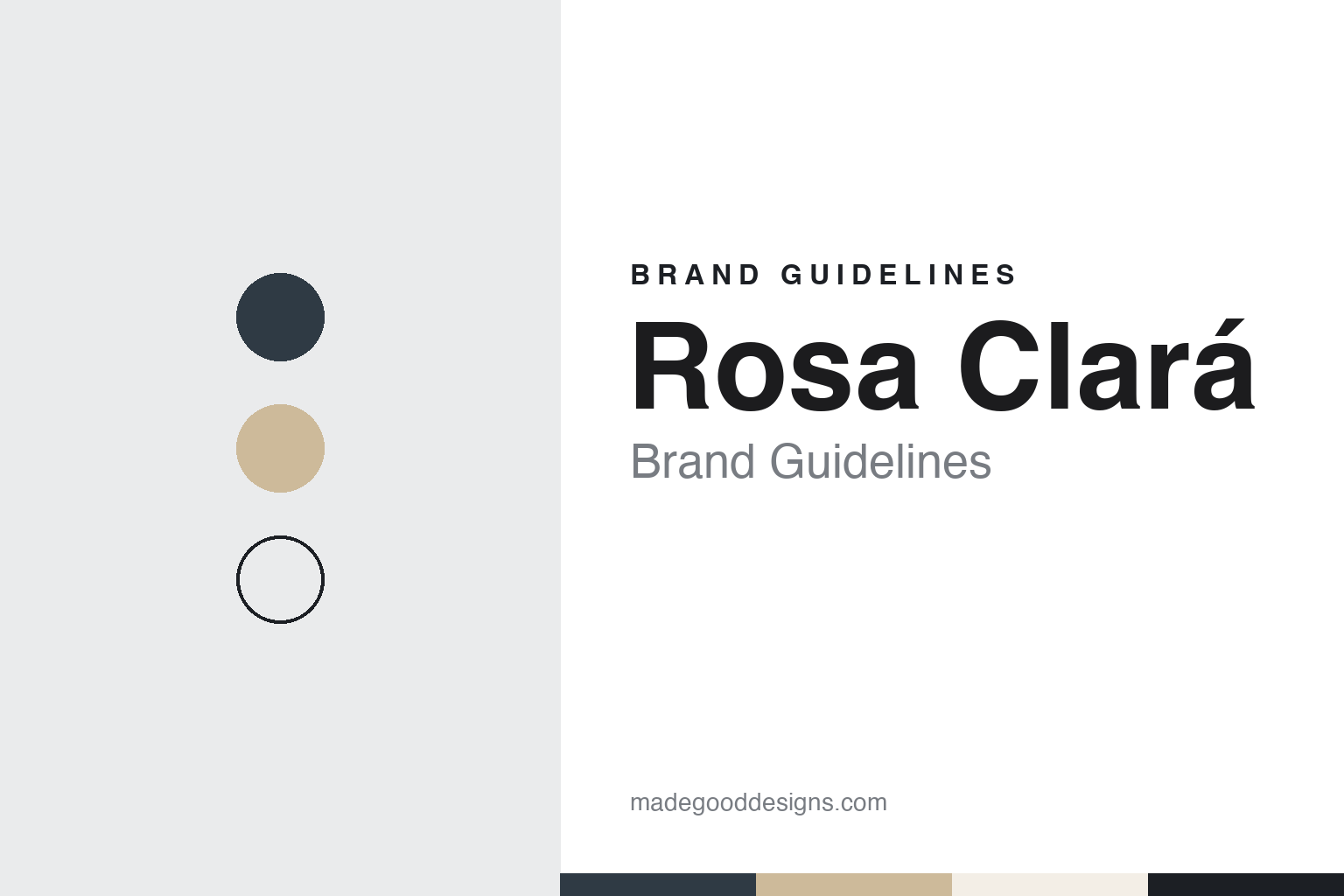
Rosa Clará Brand Guidelines
The Barcelona bridal house built from one Paseo de Gracia shop.
Aa
Two constants: a Rosa Clará slate, champagne and ivory palette and a Fashion serif register. Abstract homage — not a Rosa Clará product or mark; no gown, logo or label is reproduced.
Paseo de Gracia
One shop, then three within a year.
Rosa Clará is both a person and a house. The brand dates from 1995, when she opened her first wedding-dress shop on Paseo de Gracia in Barcelona, Forbes España reported in 2024. She told the magazine that she had started a law degree and dropped it for the textile trade, then worked for a company that kept her constantly travelling, and decided to set up her own business. Merca2 reported in 2018 that she had worked at Pronovias alongside Alberto Palatchi before leaving to start her firm, and that disputes between the two sides later reached the courts.
The shop multiplied fast: within a year, she told Forbes, she had three. Looking back in an interview with the EFE news agency in 2010, she said she had been clear from the start that there was a gap for quality dresses that brought in fashion. Franchising paid for much of the early spread. She told Forbes that building a shop network from nothing was close to impossible, and that franchises had been a way to grow without investment.
The turn towards international recognition came in the early 2000s. In 2002 the firm began its first collaboration with an international designer, Christian Lacroix, followed by work with Karl Lagerfeld and Zuhair Murad, according to Forbes and a 2020 anniversary feature in Ireland’s Wedding Journal. That same year, the group has said, its logistics and production centre opened in L’Hospitalet de Llobregat, next to Barcelona.
The Wedding Journal dates the next steps to 2003: the first shops in Portugal and Mexico, and the first show at Barcelona Bridal Fashion Week, an event whose schedule the house then opened each year. The Spanish actress Paula Echevarría became its first bride to appear in the media in 2006, and in 2007 it added an occasionwear line, Rosa Clará Cocktail, for guests as well as brides. By the time EFE interviewed her in May 2010, the house counted 120 shops and 1,800 points of sale, and had begun bridesmaids’ collections.
Forbes lists several awards for her, among them the Entrepreneur of the Year award from Ernst & Young and IESE in 2003, the Marie Claire Prix de la Moda for her business career in 2006, and the Creu de Sant Jordi from the Generalitat de Catalunya in 2017.
Colour
A family group with many labels.
Rosa Clará is now the name of a group as well as a label. A 2024 report by FashionUnited, drawing on a company statement, says the group also runs Aire Barcelona, Alma Novia and Luna Novias, and covers segments from luxury to more accessible dresses. A 2025 trade-fair release added Adriana Alier and Rosa Clará Couture among its bridal lines, and Aire Fiesta and Dani’s Party among its occasionwear lines. FashionUnited reported in February 2025 that the group was showing 16 bridal collections and seven cocktail collections.
On the founder’s account, ownership has stayed in her hands. FashionUnited described Rosa Clará in 2025 as founder, president and creative director, with her son Daniel Clará as vice-president and Manuel Cano as chief executive. In her 2024 Forbes interview she spoke of holding all of the company’s shares, said she receives offers constantly, and said that her son’s decision to join the business changed her view on selling. She also said that she had delegated many areas of the company to Cano.
On production, the documented picture is of a business run from Catalonia. Forbes reported four centres of activity in Spain, from which the production and distribution of the collections are managed. FashionUnited reported more than 500 direct employees and 1,000 indirect ones in October 2024. The site in L’Hospitalet is described as a logistics and production centre of 5,000 square metres. Rosa Clará told Forbes that her company has an outstanding school of pattern cutters, trained in-house, and that the choice of fabric comes first. In 2011 the wedding site Polka Dot Wedding described each gown as cut to order, with the group holding no stock and a gown taking about three months.
The way the house sells has also shifted. She told Forbes in 2024 that new shops are almost all company-owned, and that franchises are being converted as their owners retire. The house was not selling through its website at that point: she argued that a bride wants the experience of trying one on with her family beside her. Reports in 2024 and 2025 gave the network as 140 shops, owned and franchised, and about 4,000 points of sale in 83 countries, with subsidiaries in markets including Brazil, Mexico, Germany and the United States.
Typography
Gowns, lace and showrooms.
Bridal houses sell a single garment that most customers will wear once, and their images tend to reflect that. The dress usually comes first, shown whole on a stand or a model, with the room, the light and the type kept quiet around it. Pages often stay pale and uncluttered, so that white, ivory and blush can be told apart.
Close-ups do much of the remaining work. Lace, tulle, beading and hand finishing are hard to read at full length, so lookbooks and websites move in on a sleeve, a hem or a bodice seam. These details carry the claims about workmanship, and they give a designer’s pattern or a house’s lace a recognisable surface.
The runway calendar sets the rhythm. New York Bridal Fashion Week and Barcelona Bridal Fashion Week give houses a fixed moment to show a season, and many present a named collection with its own theme, set and printed material. The show then feeds the photography, film and social posts that follow it through the year. Backstage pictures, fittings and the walk down the runway all give a house more ways to show how a gown moves.
The shop is the other stage. Showroom mirrors, fitting platforms, soft seating and rails of samples are all part of how a label appears to a bride, and a garment bag or printed lookbook may be the piece of the brand that she takes home. For a designer, that makes the category a useful study in restraint: a small set of tones, a quiet typeface and careful photography, repeated from the catalogue to the fitting room.
Aa
A fashion serif — the register of a Barcelona bridal house. (Specimen set in Cormorant Garamond, a serif STAND-IN; NOT the Rosa Clará logo.)
Rosa Clará
A house that moved its own calendar.
For two decades the Barcelona runway was central to how the brand presented itself. That changed in February 2024, when EFE reported that the group would not take part in Barcelona Bridal Fashion Week for the first time. It had brought its 2025 collections forward to a convention of its own with clients, held at its showroom in Sant Just Desvern, just outside the city. The group acquired that 5,000-square-metre showroom in 2011. FashionUnited reported in February 2025 that its 30th-anniversary meeting there drew more than 1,300 retail clients from 42 countries. The group then showed its 2026 collections at European Bridal Week in Essen, Germany, in March 2025, according to a release.
The other long project is the United States. The Miami shop opened in 2013 and Chicago followed in 2023, FashionUnited reported, and the group has kept an expansion office in New Jersey for almost 15 years, Rosa Clará told Forbes. In February 2025 the company announced plans for company-owned shops in Houston, Atlanta and Los Angeles, the last beginning with a flagship in Beverly Hills.
A new headquarters is meant to support that. In October 2024 the group announced the purchase of a 4,000-square-metre plot beside its L’Hospitalet site, for a 12,000-square-metre building holding corporate services and a design and production centre. It was expected to be operational in 2026, with total space of 22,000 square metres counting the showroom.
Its best-documented public moment came through a client. Forbes and the Wedding Journal both name Antonela Roccuzzo’s 2017 wedding dress, and Rosa Clará told Forbes that nothing else had matched the attention it brought the label’s Instagram account.
For a design guide, Rosa Clará shows how a founder’s own name can stretch across a group of labels while one city stays at its centre. Compare Pronovias, the other large Spanish bridal group, and Maggie Sottero, another bridal name that runs several labels. For this guide we use a slate, a champagne and an ivory with a serif, an unofficial interpretation; no product or logo is reproduced.
Explore & save
Keep Rosa Clará’s identity on hand — save it to a board in the Made Good inspiration library.
Rosa Clará identity set
Pin the Rosa Clará slate, champagne and ivory palette and the Fashion serif register to your own board.