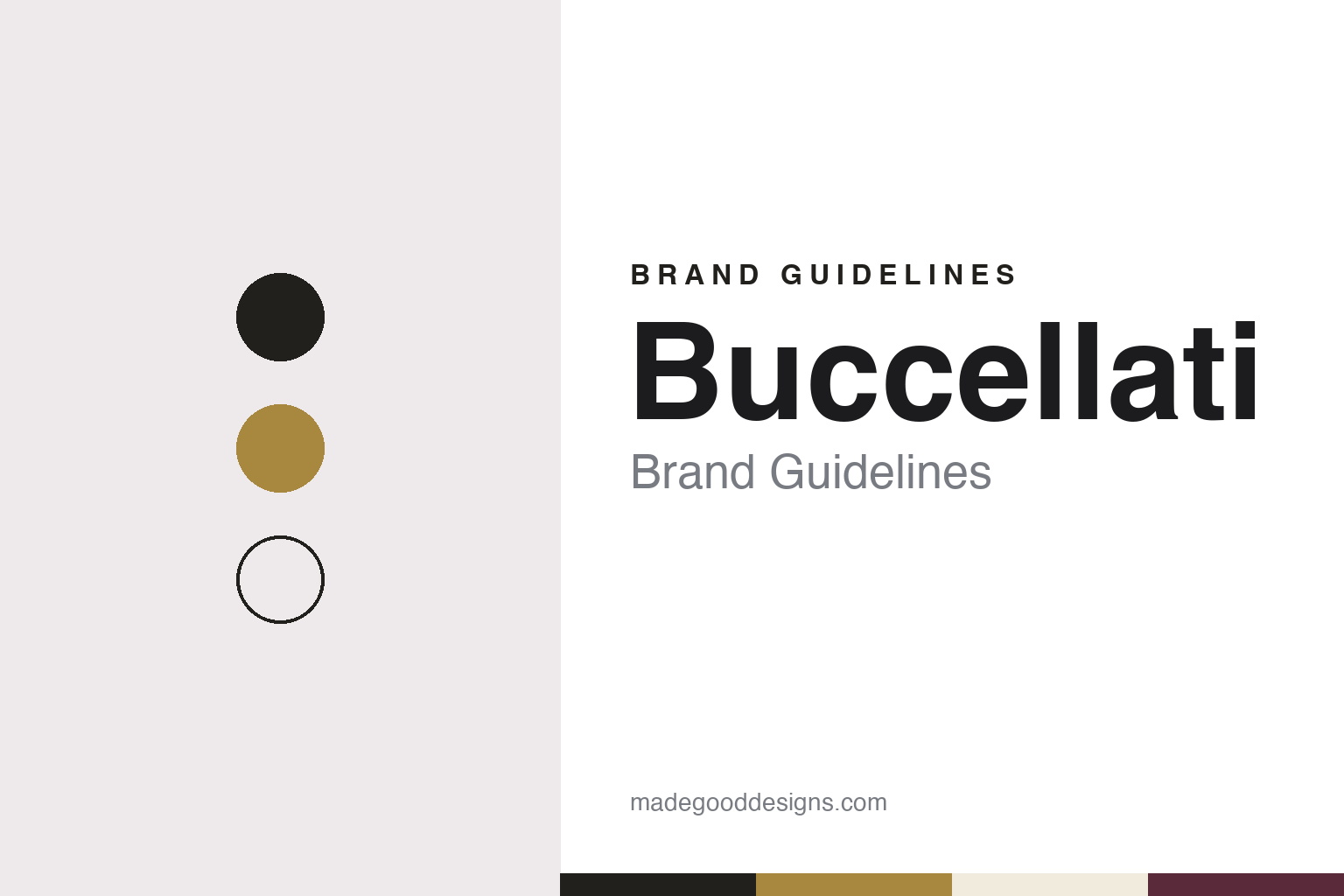
Buccellati Brand Guidelines
The Milan goldsmith that engraves gold to look like cloth.
Aa
Two constants: a Buccellati gold, ivory and plum palette and a Renaissance serif register. Abstract homage — not a Buccellati product or mark; no jewel, logo or engraving is reproduced.
The Prince of Goldsmiths
A Milan apprentice and a poet.
Buccellati was founded in Milan in 1919 by Mario Buccellati, Richemont and the trade paper National Jeweler both said in 2019. The company’s own history adds that he had trained at the goldsmiths Beltrami and Besnati and took over their business at the end of the First World War. English Wikipedia places the first shop beside La Scala.
Growth came through the family. The company says Mario opened a store in Rome with his brother Carlo in 1925 and a third in Florence, supported by another brother, Melchiorre, four years later. The auction house Dreweatts also records him exhibiting in Madrid in 1921.
He was known for one client in particular, the poet Gabriele d’Annunzio. The company dates their friendship to a chance meeting outside the shop in August 1922 and counts 83 letters written between then and 1936. National Jeweler reported in 2024 that d’Annunzio gave Mario the title “The Prince of Goldsmiths” in 1936, and Il Giornale reported in December 2025 that he ordered gifts by letter. The phrase has since become the title of the house’s retrospective.
War shortages left a mark too. The company says that in the 1940s Mario turned to tombac, a copper-based alloy, for cigarette cases and compacts, worked with the same care as finer metals; Dreweatts describes copper plated with “Dutch gold,” and old or chipped stones set upside down to look like cabochons.
After the war his sons joined him. The company says Gianmaria took the creative side while Lorenzo and Federico handled commercial expansion in Italy, and that the eldest, Luca, took the brand to the United States. Dates for the American stores differ: the company gives 1951, Italian Wikipedia 1952, and English Wikipedia 1954 for the Fifth Avenue store.
Colour
Gold that reads as cloth.
What makes a Buccellati piece recognisable is its surface. Richemont, announcing its purchase in 2019, described creations “evoking silk, damask, tulle and linen.” The company names four main engraving techniques. Rigato uses many fine parallel lines for a silky sheen. Segrinato uses crossed, overlapping strokes for a soft, velvet-like light. Telato crosses lines at right angles to suggest linen or canvas. Ornato echoes the patterns of brocade, damask and lace.
The company ties that vocabulary to the Renaissance, and says the burin used for rigato has been in use since then. Dreweatts reports that Mario was determined that no jewel should bear “untouched gold.” Il Fatto Quotidiano named two further signature techniques, “millefili” and “ricciolo,” in its 2024 report on the Venice retrospective.
The collections carry those techniques forward. Dreweatts says Gianmaria created Macri in the early 1980s, named from the first syllables of his daughter Maria Cristina’s name; the company calls it the peak of the rigato technique. Andrea Buccellati, Gianmaria’s son, conceived Étoilée in the 1990s, with four hand-wrought gold chains that interlace around small lilies, the company says. Opera, launched in 2015, takes its floral motif from the logo and from Renaissance architecture.
Silver is the second half of the story. The company says Mario’s Boscoreale cups of the 1920s and 1930s followed a Roman treasure found near Pompeii in 1895, and Maria Cristina Buccellati told Il Giornale in 2025 that he saw that treasure at the Louvre. The firm’s later silver includes table services and life-size animals, and in 1984 Gianmaria put the silver company Clementi in the hands of his son Gino, the company says.
Its photography has its own record, with the company listing advertising campaigns by Maria Mulas, Helmut Newton and Peter Lindbergh.
Typography
Velvet, sketches and windows.
Fine jewellery is sold on small things seen closely, so its houses present themselves through a settled set of images. Loose stones appear on grey velvet, a surface that gives the eye nothing to compete with. Pearl strands are laid out and sorted by tone, a way of showing that matching is itself the work.
Drawing comes next. Many houses show gouache design sketches, painted on paper so that a jewel can be judged at full size before any metal is cut. These sheets often go into archives and exhibitions alongside the finished pieces, because they show the design as a decision rather than an object. Chaumet’s nickel-silver mock-ups and Gianmaria Buccellati’s remark that he made a design so that a craftsperson could make it belong to the same habit.
Then the bench. Workshop photographs of hands, burins, wooden workbenches and half-set stones have become part of the category’s standard vocabulary. They show that a person made the piece, and they suit a trade in which skills are passed down at the bench.
Finally, there is the box and the street. Red and navy boxes make a purchase recognisable before the jewel is seen. On Place Vendôme in Paris, small windows and restrained frontages do the same job at the scale of a square: a handful of pieces, carefully lit, under a name in plain lettering. The guides in this set look at how each house uses those habits, and at who has owned each name along the way.
Aa
A Renaissance serif for a house that looks back to Renaissance goldwork. (Specimen set in EB Garamond, a serif STAND-IN; NOT the Buccellati logo.)
Buccellati
One name, several owners.
The name divided before it was reunited. Italian Wikipedia says four of Mario’s sons ran the firm from 1965 and worked together until 1969. In 1971 Gianmaria launched his own Gianmaria Buccellati brand, and Federico also started his own. For about 40 years the branches competed. Gianmaria’s side reached Japan through a 1972 agreement with Wako in Ginza and opened on Place Vendôme in 1979, the company says. In 2011 the Mario Buccellati and Gianmaria Buccellati businesses came together as Buccellati Holding Italia, English and Italian Wikipedia say. Federico Buccellati pieces still appear under that separate name at auction, Dreweatts’ sales show.
Outside money followed quickly. The private equity fund Clessidra took a majority in 2013. In December 2016 the family and Clessidra agreed to sell 85% to China’s Gangtai, and Italian Wikipedia dates the formal transfer to 1 August 2017. The company says its first shop in China opened in Shanghai in 2017. National Jeweler reported that Reuters sources said in October 2018 that Richemont was again in talks, after restrictions on investment abroad caused difficulties for Gangtai.
Richemont acquired 100% in a private transaction that closed on 26 September 2019. It said Buccellati’s pieces are handcrafted in four in-house workshops, all in Italy. The company says its watches are “conceived in Italy and made at our site in Switzerland.” Richemont now lists Buccellati among its Jewellery Maisons, and the family stays involved. Andrea Buccellati was described in 2024 as honorary chairman and creative director; the company says his daughter Lucrezia began working beside him in 2013, and Il Giornale named Maria Cristina Buccellati as communications director in 2025.
The archive now travels. “The Prince of Goldsmiths, Rediscovering the Classics” ran at Officine 800 on Venice’s Giudecca from 18 April to 18 June 2024, curated by Alba Cappellieri with staging by Balich Wonder Studio, then reached Shanghai in a new version in December 2025. The company also records a Smithsonian exhibition in 2000 and one at the Moscow Kremlin Museums in 2008.
For a design guide, Buccellati shows how a surface can do the work of a logo. Compare Cartier and Van Cleef & Arpels, its fellow jewellers at Richemont. For this guide we use an engraved gold, an ivory and a plum with a serif, an unofficial interpretation; no product or logo is reproduced.
Explore & save
Keep Buccellati’s identity on hand — save it to a board in the Made Good inspiration library.
Buccellati identity set
Pin the Buccellati gold, ivory and plum palette and the Renaissance serif register to your own board.