Messika Brand Guidelines
The Paris house that set diamonds in motion.
Aa
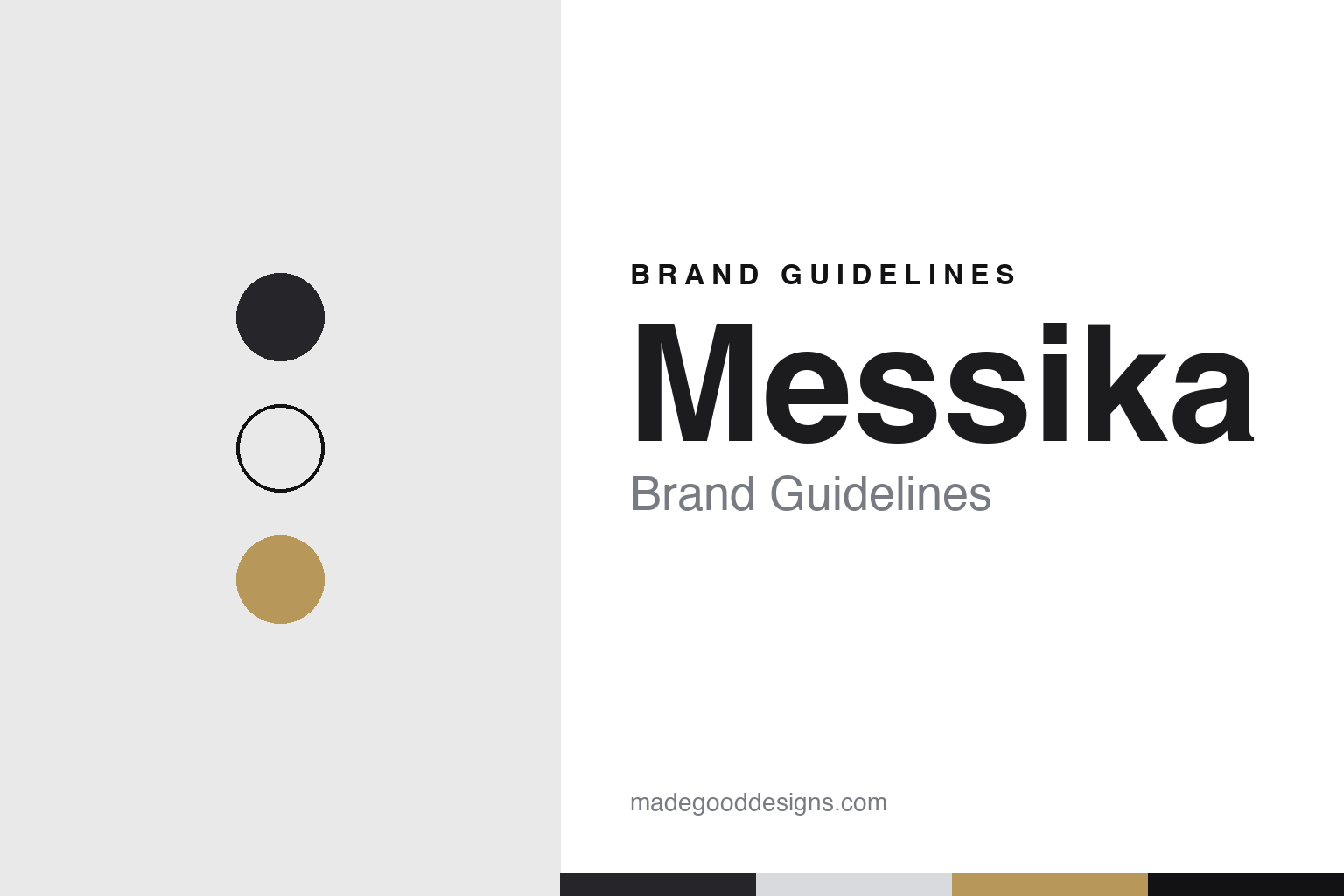
Two constants: a graphite, pale stone and gold palette and a geometric sans register. Abstract homage — not a Messika product or mark; no jewel or logo is reproduced.
A diamond merchant’s daughter
Diamonds as an everyday accessory.
Messika was founded in Paris in 2005 by Valérie Messika, and the house’s story starts a generation earlier. Her father, André Messika, has been a diamond merchant since 1972, Europa Star reported in April 2026, and she learned to tell gems apart as a child under his guidance. She told The Sybarite in January 2026 that her first real attraction to diamonds came at 12, when she found an envelope of tiny stones in his office.
Her route into the trade ran through fashion. After communication studies at CELSA, part of Sorbonne University, she joined the marketing team of Chanel’s watch and jewellery division in 1999, Europa Star says, before joining the family firm. She told Luxury London in 2019 that working at Chanel taught her the importance of a brand’s DNA, and that if she launched her own label she would need her own story.
The turning point, in her telling, was her father’s move abroad. In 2003 André Messika moved overseas to expand his business by becoming a sightholder, Europa Star reports, and two years later she set up her namesake brand. She told the magazine that had they carried on working together she would never have taken the plunge.
The founding idea was generational. Messika told Europa Star she wanted to create jewellery for women her own age, because she saw diamonds as formal and reserved for special occasions, and because Place Vendôme did not appeal to her at 20. She spotted, she told The Sybarite, a gap between big houses offering serious, classical pieces and brands selling consumer jewellery without precious stones. She also said her marketing background made her want to create an entire world, not only design jewels. Luxury London recorded the nickname that followed, “diamond disruptor,” for light, modern pieces that broke with what she called a heavy, sanitised jewellery of the time.
The Comité Colbert, which the house joined in 2025, calls it a French, family-owned and independent company, and Europa Star also describes her as a woman at the head of an independent jewellery company. The offices are in Paris’s Golden Triangle.
Colour
Three diamonds on a rail.
Move is the design Messika herself names as the one that best sums up her journey: diamonds that slide along a rail inside an oval, she told Europa Star. National Jeweler reported in June 2017 that the collection was founded in 2007 on three “floating” channel-set diamonds that move back and forth, a symbol of love yesterday, today and tomorrow. The Comité Colbert also gives 2007. Luxury London, by contrast, said in 2019 that she launched a debut Move collection at Baselworld in 2005.
The origin is a childhood habit. NUVO wrote in July 2025 that the design came from memories of watching her father move diamonds between his fingers, and Messika told The Sybarite that when she first created it diamonds were static and she developed a new system to set them moving. The motif has spread well beyond a single bracelet: the Comité Colbert counts more than 270 designs. National Jeweler described 2017 anniversary editions that drew on the sculptor and designer Ron Arad and the architect I. M. Pei.
A second technical idea followed. The Skinny line, which Luxury London said was dubbed “elastic gold,” threads diamonds on a flexible wire so that a bracelet slips onto the wrist like a hair tie.
High jewellery came later, and in-house. Messika’s Paris high jewellery atelier opened in 2015, The Sybarite reported, with the creative team working under the same roof. The company described the space in 2021 as sitting beneath the roof of a Parisian building, equipped with a draw bench and a forge, and she said at the time that she chose Paris so she could stay close to the craftspeople while collections were created.
Colour arrived only at the 20-year mark. She told Europa Star she had stayed true to one stone for 20 years. In July 2025 in Paris she presented Terres d’Instinct, which Europa Star calls the first high jewellery collection to feature coloured precious stones alongside the house’s diamonds: emeralds, rubies and sapphires, with coloured fine stones. Messika told the magazine that its Zebra Luhlaza necklace won the Design award at the Grand Prix de la Haute Joaillerie in Monaco, an event whose first edition took place in October 2025. For the anniversary she also reworked Move in pavé diamonds, as a necklace, bracelet and earrings; only 30 sets were made, each in a black lacquered-wood case with gouache design sketches, NUVO reported.
Then, in March 2026, came Moderniste, a collection of jewellery and fine jewellery built on an octagonal form. She told Europa Star that it was informed by the clean lines of modernist architecture, and that she wanted to explore gold in its own right.
Typography
Stones, sketches and shop windows.
Fine jewellery is sold on small things seen closely, so its houses present themselves through a settled set of images. Loose stones appear on grey velvet, a surface that gives the eye nothing to compete with. Pearl strands are laid out and sorted by tone, a way of showing that matching is itself the work.
Drawing comes next. Many houses show gouache design sketches, painted on paper so that a jewel can be judged at full size before any metal is cut. These sheets often go into archives and exhibitions alongside the finished pieces, because they show the design as a decision rather than an object. Chaumet’s nickel-silver mock-ups and Gianmaria Buccellati’s remark that he made a design so that a craftsperson could make it belong to the same habit.
Then the bench. Workshop photographs of hands, burins, wooden workbenches and half-set stones have become part of the category’s standard vocabulary. They show that a person made the piece, and they suit a trade in which skills are passed down at the bench.
Finally, there is the box and the street. Red and navy boxes make a purchase recognisable before the jewel is seen. On Place Vendôme in Paris, small windows and restrained frontages do the same job at the scale of a square: a handful of pieces, carefully lit, under a name in plain lettering. The guides in this set look at how each house uses those habits, and at who has owned each name along the way.
Aa
A clean geometric sans for a young Paris house. (Specimen set in Jost, a sans STAND-IN; NOT the Messika logo.)
Messika
Fashion, not heritage.
Messika’s image leans on fashion and celebrity more than on archive. The founder told National Jeweler in 2018 that her goal was to treat the diamond with “a more fashion attitude.”
The moment the name travelled came from Beyoncé. Luxury London dates the first encounter to 2014 and Europa Star’s interview to 2015: the singer saw a Glam’Azone ring in a display at Le Royal Monceau hotel in Paris and later posted a picture of it. A few years on, her office asked to borrow pieces, and Beyoncé wore the Persian Drops suite in front of the Mona Lisa in the 2018 video for Apes**t. Messika told Europa Star the jewels were sent without a guard.
Gigi Hadid came next, as a formal partner. National Jeweler reported in September 2018 that she modelled the first collaboration and helped design the second, My Soul, and linked the partnership to a push into the US market, including the Couture trade show and wholesale accounts. Messika told Europa Star that Hadid liked being more than a face, because they designed a collection together. Kate Moss fronted the Christmas 2025 campaign, the magazine says, and had modelled the Lucky Move line by 2019, according to Luxury London.
Retail came in stages. The first boutique opened in December 2013 on Rue du Faubourg Saint-Honoré, and the Comité Colbert says it is still there. She told Luxury London that when she launched, Place Vendôme was a male-dominated world. The Comité Colbert’s current figures put the house in more than 85 countries, with more than 600 points of sale, 100 of its own boutiques and 500 employees, including subsidiaries in China, Hong Kong, the Middle East, the United States and Japan.
Messika has also said the design language is about freedom rather than status. She told Europa Star that, leaving aside high jewellery, the brand’s defining element is diamonds that move freely and can be worn as the customer likes, and that some established brands’ pieces carry connotations strong enough to overshadow the wearer. She told The Sybarite she keeps each diamond’s identity when working a stone, and that the design begins with the stones themselves.
For a design guide, Messika shows how a single mechanism can serve as a signature. Compare Chopard, another family-run jeweller, and De Beers, another name built on diamonds. For this guide we use graphite, pale stone and gold with a sans, an unofficial interpretation; no product or logo is reproduced.
Explore & save
Keep Messika’s identity on hand — save it to a board in the Made Good inspiration library.
Messika identity set
Pin the Messika graphite, pale stone and gold palette and the geometric sans register to your own board.