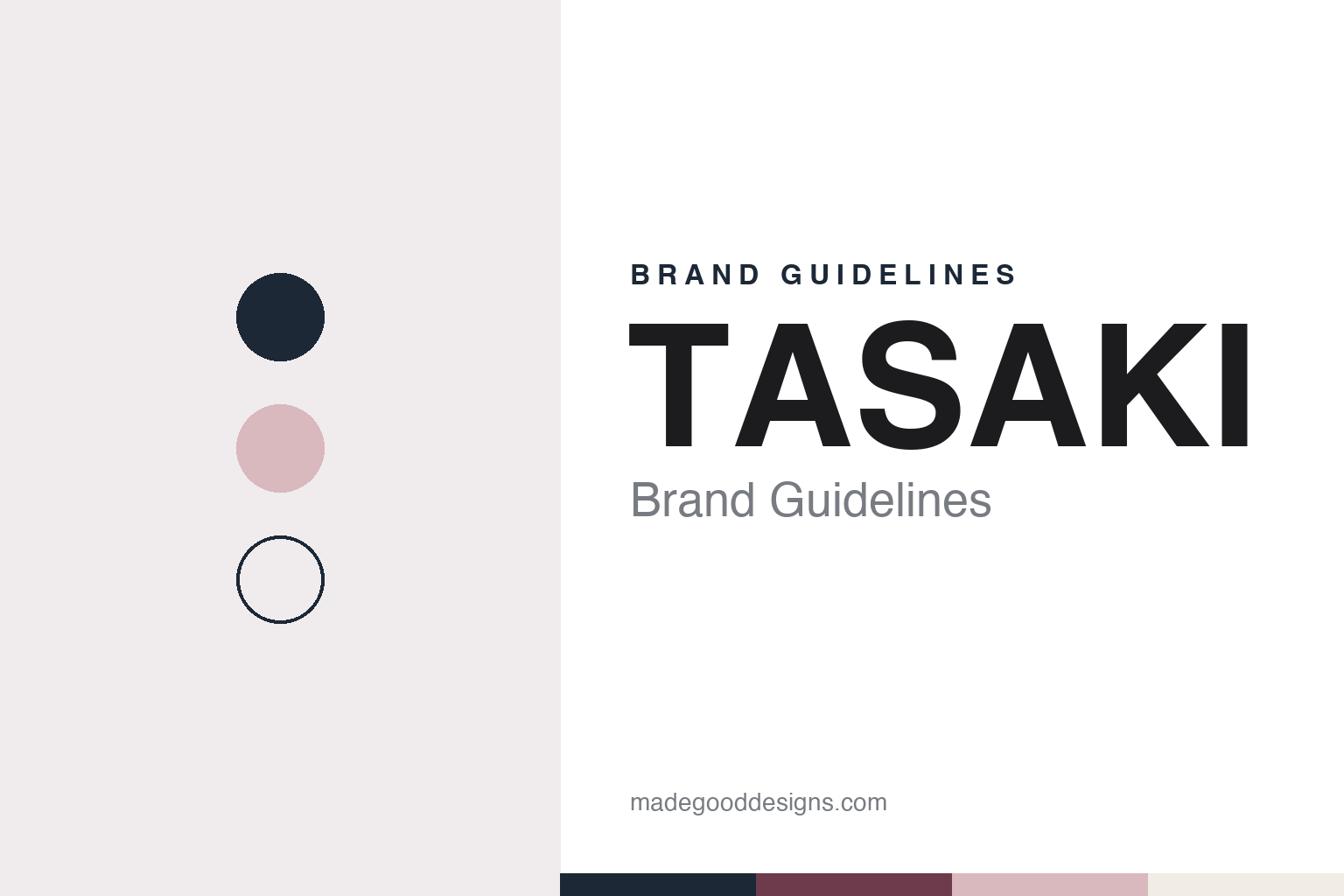
TASAKI Brand Guidelines
The Kobe pearl company that lined five pearls on a gold bar.
Aa
Two constants: a TASAKI harbor ink, deep rose and nacre palette and a Geometric sans register. Abstract homage — not a TASAKI product or mark; no jewel, logo or nameplate is reproduced.
Tasaki Shinju
A family pearl farm and a business in Kobe.
TASAKI began in Kobe in January 1954, when Shunsaku Tasaki started processing and selling cultured pearls, the company says. Its roots lie further west: its history records that his father opened a pearl farm in Nagasaki Prefecture in 1933, and Rapaport, writing in June 2024 about the company’s Rizzoli book, Tasaki: Balance, says the founder helped his parents run their farm in the 1930s. FinanceAsia also gave 1954 as the start in 2008. The business became a limited company in 1956 and a joint-stock company, Tasaki Shinju, in December 1959. Shinju is Japanese for pearl.
Pearl technique shaped its early reputation. In 1970, the company says, it achieved the world’s first artificial collection of mabe oyster spat, the young shellfish; it adds that mabe pearls had been known as “phantom pearls” until then. FinanceAsia reported in 2008 that Tasaki brought the semi-spherical mabe pearl into production in 1970, and that in 1983 it mass-produced South Sea pearls in Japan’s sub-tropical waters. The company opened its Kujukushima farm in Nagasaki in 1979, and Japanese Wikipedia says it has won the agriculture minister’s prize at the national pearl competition seven times.
It then moved into diamonds. Tasaki began polishing rough stones itself in 1988, and in 1989 completed a Jewelry Building in Kobe for diamond polishing and a jewelry atelier. In July 1994 it became a De Beers sightholder, which gave it the right to buy rough diamonds directly; Japanese Wikipedia says it was the only one in Japan. The company’s history notes that the contract ended in June 2026.
The company grew in public. It listed on the Osaka Securities Exchange in 1985 and on the first section of the Tokyo Stock Exchange in 1993. Its Ginza store in Tokyo opened in October 1997, FinanceAsia reported. Japanese Wikipedia also records side businesses in restaurants and tour buses, and the name was carried by a Kobe women’s football team, TASAKI Perule FC.
Colour
From Tasaki Shinju to TASAKI.
Control changed hands in 2008. In December 2007, Japanese Wikipedia says, its largest shareholder, Sakha Diamond, with a little over 11%, proposed that one of its own directors join the board, and the company opposed it. In August 2008 FinanceAsia reported that the private equity firm MBK Partners would invest to become the controlling shareholder through new convertible preferred shares, subject to a shareholder vote. The company’s history records the investment in October 2008, and Japanese Wikipedia says the founding family then left.
A rebuilt brand followed. In September 2009 the brand name changed from Tasaki Shinju to TASAKI, and the designer Thakoon Panichgul became creative director. The English company name became TASAKI & Co., Ltd. in January 2010, Japanese Wikipedia says, and the Japanese name followed in February 2012. Toshikazu Tajima had been chief executive since 2009, The French Jewelry Post reported in 2018. The Ginza store reopened in April 2010, alongside Thakoon’s first Collection Line.
That line produced the icon. balance, spelled in lower case, set pearls in a straight line on a gold bar; the company says it was inspired by balance balls, and that its signature ring holds five pearls. It also says only 1% of pearls meeting its own quality standard pass for balance. It registered a three-dimensional trademark for the balance signature ring in June 2019. Thakoon also made pearls with diamond “fangs,” Rapaport says, and the company’s danger range includes a danger fang line.
Other work came through material and guests. SAKURAGOLD, the company’s own gold alloy, was named for cherry blossom and launched in March 2011 after about 18 months of trials, the company says; it describes the color as softer than standard pink gold. Mélanie Georgacopoulos has designed M/G TASAKI since 2012, The French Jewelry Post reported, with pearls cut in two to show their layers, and Marie-Hélène de Taillac designed TASAKI by MHT. The same report describes a collection made with the Ritz Paris hotel.
Prabal Gurung became creative director in September 2017, launching the high-jewelry TASAKI Atelier, the company’s history says. Later guests included Fiona Krüger in 2021 and Niccolò Pasqualetti in June 2025. The range also moved beyond jewelry, with watches in 2015, leather goods in 2016 and a fragrance collection in October 2025.
Typography
Fine jewellery and pearls.
Fine jewellery is sold on small things seen closely, so its houses present themselves through a settled set of images. Loose stones appear on grey velvet, a surface that gives the eye nothing to compete with. Pearl strands are laid out and sorted by tone, a way of showing that matching is itself the work.
Drawing comes next. Many houses show gouache design sketches, painted on paper so that a jewel can be judged at full size before any metal is cut. These sheets often go into archives and exhibitions alongside the finished pieces, because they show the design as a decision rather than an object. Chaumet’s nickel-silver mock-ups and Gianmaria Buccellati’s remark that he made a design so that a craftsperson could make it belong to the same habit.
Then the bench. Workshop photographs of hands, burins, wooden workbenches and half-set stones have become part of the category’s standard vocabulary. They show that a person made the piece, and they suit a trade in which skills are passed down at the bench.
Finally, there is the box and the street. Red and navy boxes make a purchase recognisable before the jewel is seen. On Place Vendôme in Paris, small windows and restrained frontages do the same job at the scale of a square: a handful of pieces, carefully lit, under a name in plain lettering. The guides in this set look at how each house uses those habits, and at who has owned each name along the way.
Aa
A geometric sans — for a brand built on five points in a straight line. (Specimen set in Jost, a sans STAND-IN; NOT the TASAKI logo.)
TASAKI
Private equity, three times.
MBK’s involvement came in two stages. In July 2015 an MBK-linked vehicle, Ocean Pearl Investment, sold TASAKI shares through a secondary offering, the company’s history records. Two years later MBK returned: a tender-offer notice of March 24, 2017 shows that Stardust, a company ultimately held by MBK Partners Fund III, offered to buy all of TASAKI’s shares. Japanese Wikipedia says it held 83.77% of the votes by May, and the shares left the Tokyo Stock Exchange in July 2017. In January 2018 TASAKI took control of the jewelry brand Ahkah, and in January 2019 it opened its European flagship on New Bond Street in London.
Ownership moved again in late 2024. On December 2, 2024, Jing Daily reported, the private equity firms FountainVest Partners and Unison Capital announced their purchase of TASAKI from MBK, FountainVest’s first investment in Japan. In March 2026, FashionUnited reported, Richard Collasse, who became president of Chanel Japan in 1995, was named president and global CEO, with Tajima moving to chairman of TASAKI Holdings and Kentaro Odagiri becoming chief executive in Japan from April 1. The company’s website today names TASAKI & Co., Ltd., based in Kobe, as a subsidiary of TASAKI Holdings.
Where things are made is central to what the company says about itself. It says culturing, sorting, design and processing of pearls are all done in-house, a claim echoed in The French Jewelry Post, which reported in 2018 that it controlled the process “from A to Z.” It lists three farms: Kujukushima in Nagasaki, opened in 1979, with about a million shells; Ise-Shima in Mie, opened in 2016, for small baby pearls; and Uwajima in Ehime, opened in 2024. Japanese Wikipedia lists earlier farms that it no longer holds, from Saga and Kumamoto to Amami, and a former research station in Tokushima. Rapaport reported in 2024 that the company’s sorters grade up to 20,000 pearls a day. For diamonds, the company says that it handles everything from buying rough stones to polishing and setting, with its own staff.
For a design guide, TASAKI shows how a heritage material can be reset by a single gesture: a traditional pearl, placed on a straight line and given a lower-case name. Compare Mikimoto, another Japanese pearl house, and De Beers, whose sightholder it was from 1994 to 2026. For this guide we use a harbor ink, a deep rose and a nacre with a sans, an unofficial interpretation; no product or logo is reproduced.
Explore & save
Keep TASAKI’s identity on hand — save it to a board in the Made Good inspiration library.
TASAKI identity set
Pin the TASAKI harbor ink, deep rose and nacre palette and the Geometric sans register to your own board.