Repossi Brand Guidelines
A Turin jewellery family that set up on Place Vendôme and took its cues from architecture.
Aa
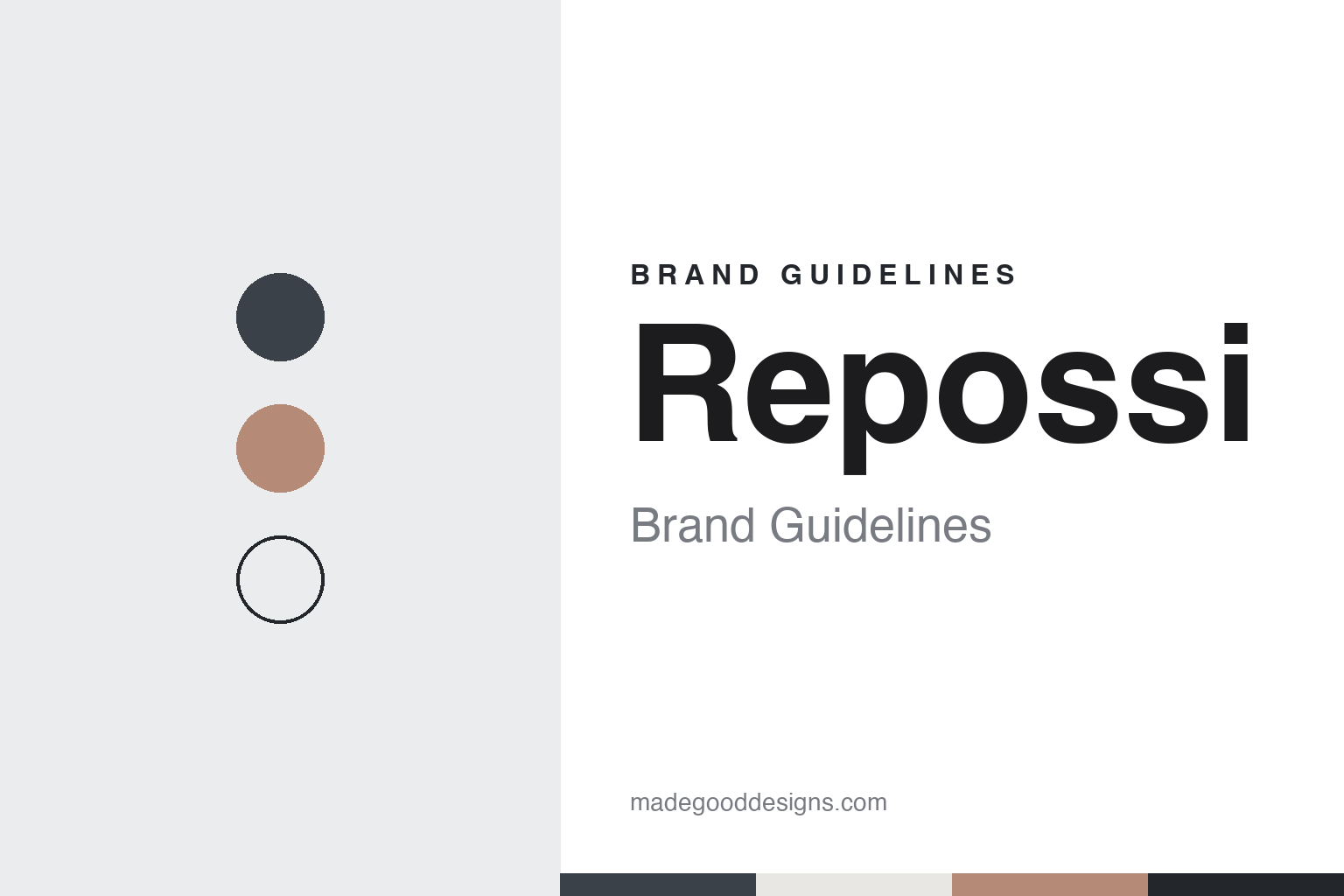
Two constants: a steel grey and rose metal palette and an Architectural sans register. Abstract homage — not a Repossi product or mark; no jewel, logo or nameplate is reproduced.
Two founding dates
A Turin family, dated two ways by its own owner.
Repossi’s starting date depends on who is telling the story. LVMH’s house page says today that the family’s jewellery tradition dates to Turin in 1957, when Constantino Repossi, after studying industrial design, opened his first boutique, and it counts three generations. Both English and French Wikipedia give the same year and spell him Costantino. Yet LVMH’s own press release of 30 November 2015 said the house was founded in Turin in 1920, called Alberto Repossi the founder’s grandson and described his daughter Gaia as the fourth generation.
Other sources follow one version or the other. Madame Figaro wrote in January 2017 that Gaia’s great-grandfather created the firm in the 1920s in Turin, making furniture and jewels and drawing cars for Fiat, and that his son Constantin then specialised in jewellery. Architectural Record called the house “century-old” in 2016, and ABC-Luxe gave 1920 in 2019, while National Jeweler wrote “the 1940s” in 2020. AD Magazine, in a 2023 feature made with the brand, used 1957. Wikipedia says Constantino took over his father’s workshops before founding the brand.
Alberto Repossi took the house abroad. English Wikipedia says he became director in 1974 and opened a boutique on Monte Carlo’s Square Beaumarchais in 1978; LVMH says he moved to Monte Carlo at the end of the 1970s and became official jeweller to the Monegasque royal family. Madame Figaro dates that title to 1991, while both Wikipedia versions say 1994. In 1986 the house opened at 6 Place Vendôme in Paris, the address it still uses in its website title. Alberto recalled to Madame Figaro that the boutiques once had silk-lined walls and Louis XV armchairs.
In 2007 Gaia Repossi became creative director. She had studied at the Beaux-Arts and studied archaeology at the Sorbonne, Madame Figaro reported, and her father first tested her with a large ruby. “My daughter reset everything,” he told the magazine, in our translation, “and that is good.”
Colour
Three lines and an idea of the void.
Gaia Repossi’s collections turned from that glamour towards art and architecture. AD Magazine names three pillars of the house: Berbere, Antifer and Serti sur Vide. Berbere, dated to 2011 by Wikipedia and marked with a ten-year edition in 2021, is sold in rows, such as a three-row ring, on the house’s website. It was the line LVMH singled out as iconic in 2015, along with the multi-piercing earring. Gaia told Madame Figaro in 2017 that Berbere was one of her most successful collections, probably because it told stories.
Antifer, launched in 2013, is described by AD Magazine as a plain band topped with a point. Its anniversary pieces came in rose gold, some with rows of pavé diamonds. French Wikipedia, citing Vogue France in 2026, describes a “black gold” version in the line: 18-carat white gold coated in ruthenium and pavé-set with diamonds.
Serti sur Vide, launched in 2014, means “setting on the void.” LVMH says diamonds sit on a hidden structure and float above the skin as if suspended. Madame Figaro wrote that the void was Gaia’s guide and opulence her enemy; she told it she wanted pieces “as light as stalactites,” with stones placed in the hollows of an ear or between the fingers. National Jeweler called the house an early champion of ear cuffs and midi rings. English Wikipedia, citing Elle UK, says she won best jewellery designer at the 2013 Elle Style Awards.
Her references are named in public. Gaia cited Cy Twombly, Alexander Calder and Franz West to Madame Figaro, and Architectural Record added tribal tattoos and Le Corbusier. Repossi was a sponsor of the Donald Judd retrospective at MoMA in 2020, Vogue reported, and Gaia called herself drawn to his symmetry and repetition. A 2021 collection drew on jewels worn by Robert Mapplethorpe, using the archives of his foundation and of the Getty Research Institute, The French Jewelry Post reported.
The studio works in a modern way too. Madame Figaro reported in 2021 that its young design team tests new variations by 3D printing, and changed the resin colour from grey to green and gold so that prototypes read better. Since 2022 the Chromatic Sapphires line has used stones from Moyo Gems, an association of women miners in Tanzania, with full traceability from mine to jewel, ELLE Luxembourg reported in 2025.
Typography
How jewellers present themselves.
Fine jewellery is sold on small things seen closely, so its houses present themselves through a settled set of images. Loose stones appear on grey velvet, a surface that gives the eye nothing to compete with. Pearl strands are laid out and sorted by tone, a way of showing that matching is itself the work.
Drawing comes next. Many houses show gouache design sketches, painted on paper so that a jewel can be judged at full size before any metal is cut. These sheets often go into archives and exhibitions alongside the finished pieces, because they show the design as a decision rather than an object. Chaumet’s nickel-silver mock-ups and Gianmaria Buccellati’s remark that he made a design so that a craftsperson could make it belong to the same habit.
Then the bench. Workshop photographs of hands, burins, wooden workbenches and half-set stones have become part of the category’s standard vocabulary. They show that a person made the piece, and they suit a trade in which skills are passed down at the bench.
Finally, there is the box and the street. Red and navy boxes make a purchase recognisable before the jewel is seen. On Place Vendôme in Paris, small windows and restrained frontages do the same job at the scale of a square: a handful of pieces, carefully lit, under a name in plain lettering. The guides in this set look at how each house uses those habits, and at who has owned each name along the way.
Aa
A plain grotesque for a house that speaks through architecture. (Specimen set in Archivo, a sans STAND-IN; NOT the Repossi logo.)
Repossi
A boutique in aluminium, and a new owner.
The clearest statement of the brand is a room. In 2016 Gaia Repossi rebuilt the Place Vendôme flagship with Rem Koolhaas and Ippolito Pestellini Laparelli of the architecture firm OMA. Architectural Record reported in October 2016 that the 970-square-foot shop, over three levels, avoided the wood, carpet and leather usual in jewellery showrooms. Its surfaces use aluminium, resin and acrylic, the stair treads are aluminium foam filled with resin that looks like terrazzo, circular cases are galvanised copper, and the lower salon has Donald Judd furniture. The magazine said the materials reflect the colours of the jewellery, from steely grey to soft pink and rose gold. Both Wikipedia versions say Flavin Judd redesigned the Monaco boutique in 2020.
The shop has since become a stage. For its 40th anniversary, hube magazine reported in January 2026, Repossi gave Harry Nuriev’s Crosby Studios a free hand to make an installation in Paris, with boxes of poker chips, dice, mirrors and buttons. Wikipedia also records mirrors by Sabine Marcelis based on Antifer in 2026.
LVMH arrived in 2015. Its release of 30 November announced a minority stake, with Gaia Repossi saying the group’s support would help develop the distribution network. ABC-Luxe, citing The Business of Fashion, reported on 27 May 2019 that the stake had gone from about 42% to 69% after LVMH quietly raised it from 2018. A September 2026 report by the Brazilian site EQI instead dates LVMH’s control to 2022, the year English Wikipedia says the house joined its Watches and Jewelry division. Anne de Vergeron, of LVMH’s business development team, became chief executive in 2020, National Jeweler reported. On 23 September 2026 MF Fashion reported that Matthieu Soudan, from Bulgari, had replaced her as managing director, based in Paris and reporting to Stéphane Bianchi. Madame Figaro placed the headquarters on the Left Bank in 2021.
LVMH’s house page says pieces are “exclusively handcrafted in France and Italy” and that the house has worked with the same Italian workshops for generations, and it lists Gaia Repossi as Limited Editions Artistic Director.
For a design guide, Repossi shows how a jewellery brand can take its identity from a building and a body of art rather than from a logo. Compare Chaumet, another LVMH jewellery house, and Bvlgari, also an LVMH jeweller with Italian roots. For this guide we use a steel grey and a rose metal tone with a sans, an unofficial interpretation; no product or logo is reproduced.
Explore & save
Keep Repossi’s identity on hand — save it to a board in the Made Good inspiration library.
Repossi identity set
Pin the Repossi steel grey and rose metal palette and the Architectural sans register to your own board.