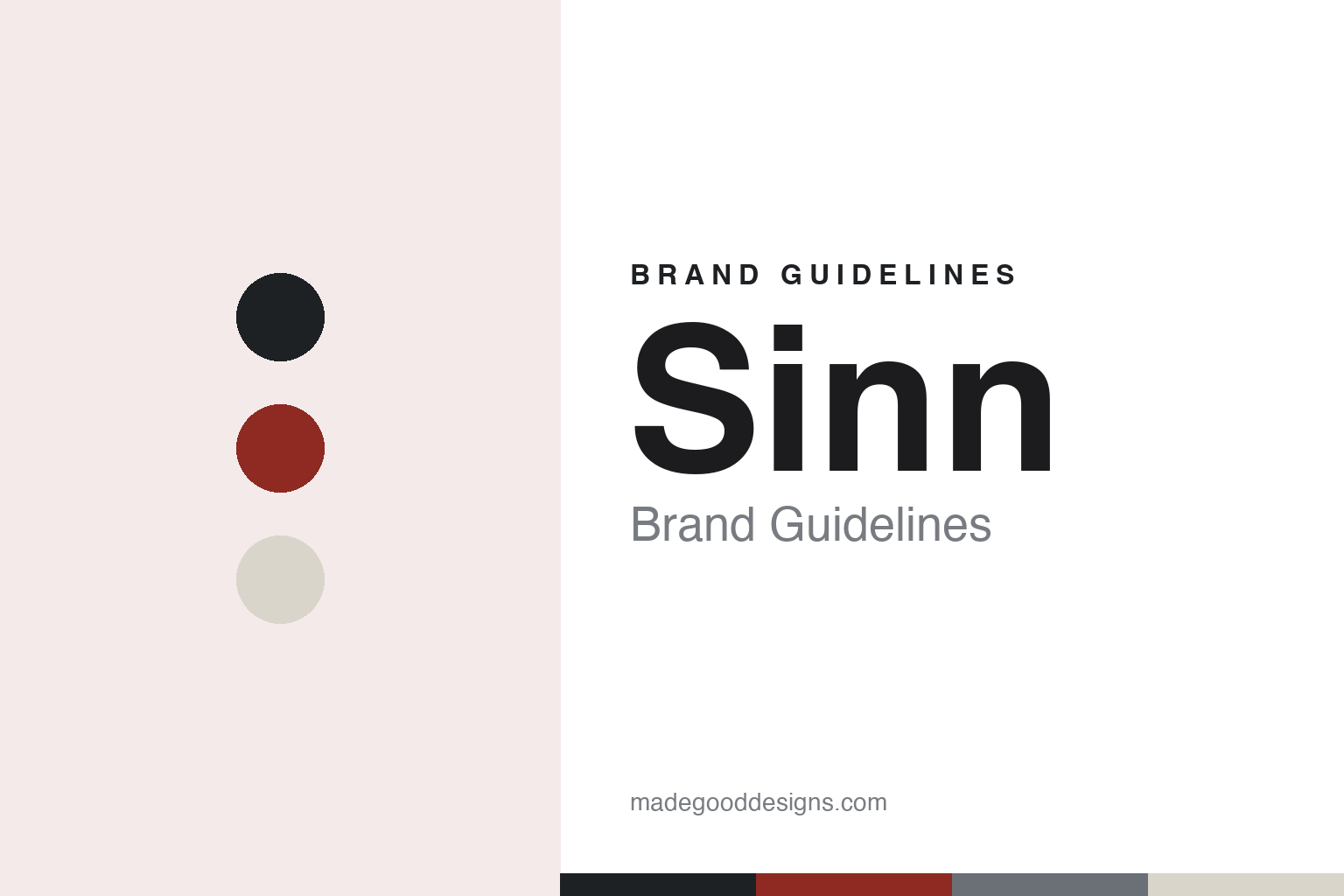
Sinn Brand Guidelines
A pilot’s watch company, rebuilt by an engineer.
Aa
Two constants: a Sinn black, red and steel palette and an Instrument sans register. Abstract homage — not a Sinn product or mark; no watch, logo or nameplate is reproduced.
The Instructor
A pilot who sold watches to pilots.
Sinn is named after its founder, Helmut Sinn, a pilot and blind-flying instructor who set up Helmut Sinn Spezialuhren in Frankfurt am Main in 1961. His path there ran through the war. German Wikipedia says he joined the Luftwaffe in the 1930s, took his pilot’s licences between 1936 and 1938, served in a reconnaissance unit in the Second World War, later worked as a flying instructor, and was held as a prisoner of war in 1945. With flying banned for Germans after the war, it says, he turned to trade, selling Black Forest cuckoo clocks to Americans and building up a watch business in Frankfurt by the end of the 1940s.
The same article dates his first pilot’s chronograph, modelled on aircraft cockpit clocks, to 1956, five years before the company took his name. It also says he made cockpit clocks for the Bundeswehr after winning a tender against Junghans, and that Lufthansa aircraft later carried them.
His business model was direct selling. He sold to customers, professional pilots among them, without retailers in between, and his flying career helped those sales, German Wikipedia says. The sources differ on how the early watches were made. German Wikipedia says they were produced to his specifications as a private label in Switzerland; WatchTime wrote in April 2026 that they were assembled at his Frankfurt company.
Swisswatches reported in December 2025 that the physicist and astronaut Reinhard Furrer wore a 140 S with a Lemania 5100 movement on the Spacelab D1 mission in 1985, proving that an automatic could run in weightlessness; German Wikipedia’s article on the founder names the model as the 142 S. Europa Star adds that Helmut Sinn also helped launch Bell & Ross.
Colour
Lothar Schmidt and the engineered case.
The mechanical engineer Lothar Schmidt bought the company on 1 September 1994, and Europa Star wrote in 2019 that he effectively re-established it. Schmidt had joined IWC in Schaffhausen in 1981 and, from 1990, led the production build-up at the re-established A. Lange & Söhne. He told WatchTime in March 2024 that he first contacted Helmut Sinn in 1983, began there as a freelancer on 1 September 1993, and took over fully a year later. The founder expected to stay involved, German Wikipedia says, citing a 2012 FAZ interview; the two fell out, the matter went to court, and their public accounts differ. Helmut Sinn went on to run the Guinand and Jubilar names.
Under Schmidt, WatchTime says, Sinn quickly became an engineer’s brand. His first watch, the 244, had a pure titanium case, and in 1995 he opened the first depot at a retailer, alongside direct sales. The technologies followed, with dates given by Swisswatches: Hydro in 1996, which fills a diver’s case with clear oil and works only with quartz movements; Ar-Dehumidifying Technology in 1998, which pairs special seals, a protective gas and a copper-sulphate drying capsule that changes colour; Diapal in 2001, which removes oil from the pallets; and Tegiment in 2003, a surface hardening of the case. Schmidt told WatchTime that the Hydro idea had stayed in his drawer at IWC, where it was seen as too hard to service worldwide.
Schmidt also wanted a case supplier of his own. He co-founded the case maker Sächsische Uhrentechnologie (SUG) in Glashütte, on 17 December 1998 according to WatchTime, in 1999 according to Swisswatches. After the 2002 flood wrecked its plant, WatchTime reported, he financed the rebuilding and raised his stake to 74 percent.
Movements come from outside. Swisswatches names Sellita, La Joux-Perret and Conzepto as suppliers, with Sinn’s own modifications marked SZ; the SZ04 of 2006, for the 6100 Regulateur, is based on the Unitas 6498. New watches are produced at the Frankfurt-Sossenheim headquarters, occupied in September 2017, and a service and assembly branch opened in Dresden in May 2022.
Typography
Design and documentation.
Watch makers sell objects small enough to hide in a closed hand, so their pictures work at a different scale from the product. The usual image is a macro shot: a dial filling the frame, with the printing, the applied markers and the texture of the surface all larger than life. Brushed and polished steel is lit so that the two finishes separate, and a crystal is angled so that the eye sees through it rather than a reflection on it.
A second set of pictures moves to the bench. A watchmaker’s loupe, a pair of tweezers and an open movement on a work mat are the trade’s shorthand for skill, and they appear in catalogues whether a brand makes many of its own parts or few. Those images show a craft; they do not by themselves show where a particular watch was made, which is why this guide keeps what a company says apart from what independent sources record.
Close-ups do the rest of the work. A chronograph’s pushers suggest timing and motorsport, a screw-down crown suggests water, and enamel and sapphire suggest depth and permanence.
The public stage has long been the fair. Geneva hosts the trade’s big gatherings, where stands are built like small buildings and new models sit behind glass under careful light. Around that stage sit the other habits of the category: archive reissues, anniversary editions, and timekeeping partnerships in sport. Each one gives a brand a story to tell about time, and each one depends on a record that can be checked.
Aa
A plain instrument sans — the look of a cockpit dial. (Specimen set in Barlow, a sans STAND-IN; NOT the Sinn logo.)
Sinn
Readability first, Frankfurt second.
Sinn’s visual identity follows from the use it claims for the watches. Swisswatches describes tool watches that are designed for readability first yet carry a touch of lifestyle, and it notes that the oil in a Hydro case makes the red paint on the dial stand out more clearly. The company says its timepieces are used by pilots, divers, firefighters and special units including the GSG 9, Europa Star reported in 2019. The EZM line, short for Einsatzzeitmesser or mission timer, has been built since 1997, German Wikipedia says, and WatchTime says some of its models were developed with such units.
Standards are part of the brand. With the FH Aachen, Sinn developed the TESTAF pilot-watch standard presented in 2012, and a working group that included Stowa, Lufthansa Cargo and Airbus Helicopters turned it into DIN 8330, published in March 2016, Swisswatches says. Sinn’s divers in German submarine steel were tested by Germanischer Lloyd in 2005, Europa Star reported. In 2014 an 857 UTC went with Alan Eustace on his stratospheric jump from 41,419 metres, and the watch is now on display with his suit at the National Air and Space Museum in Washington, Swisswatches says.
The other half of the identity is Frankfurt. Swisswatches remarks that the name in the logo points to the Rhine-Main region. The Frankfurt Financial District Watches, launched in 1999, are dress watches showing up to three time zones, and Sinn has run a shop and workshop on the Römerberg in the old town since May 2015. German Wikipedia lists a Red Dot award for the EZM 12 in 2019, German Design Awards and iF Design Awards, along with Goldene Unruh wins from 1998.
The company remains independent. Europa Star reported in 2019 that staff had grown from just over a dozen in 1994 to more than 160, counting affiliates. WatchTime described Schmidt in April 2026 as owner and managing director since 1994, and Insight Luxury reported that Simone Richter and Andreas Hölzel joined him in the management in December 2025. Schmidt told WatchTime in 2024 that the plan is for the company to pass to a foundation in due course. In 2026, the company’s 65th year, Sinn showed at Watches and Wonders in Geneva for the first time, WatchTime reported.
For a design guide, Sinn shows how a brand can be built from the specification sheet. Compare IWC, where Schmidt worked, and Stowa, which sat on the same pilot-watch working group. For this guide we use a cockpit black, a marker red and a hardened steel grey with a sans, an unofficial interpretation; no product or logo is reproduced.
Explore & save
Keep Sinn’s identity on hand — save it to a board in the Made Good inspiration library.
Sinn identity set
Pin the Sinn black, red and steel palette and the Instrument sans register to your own board.


