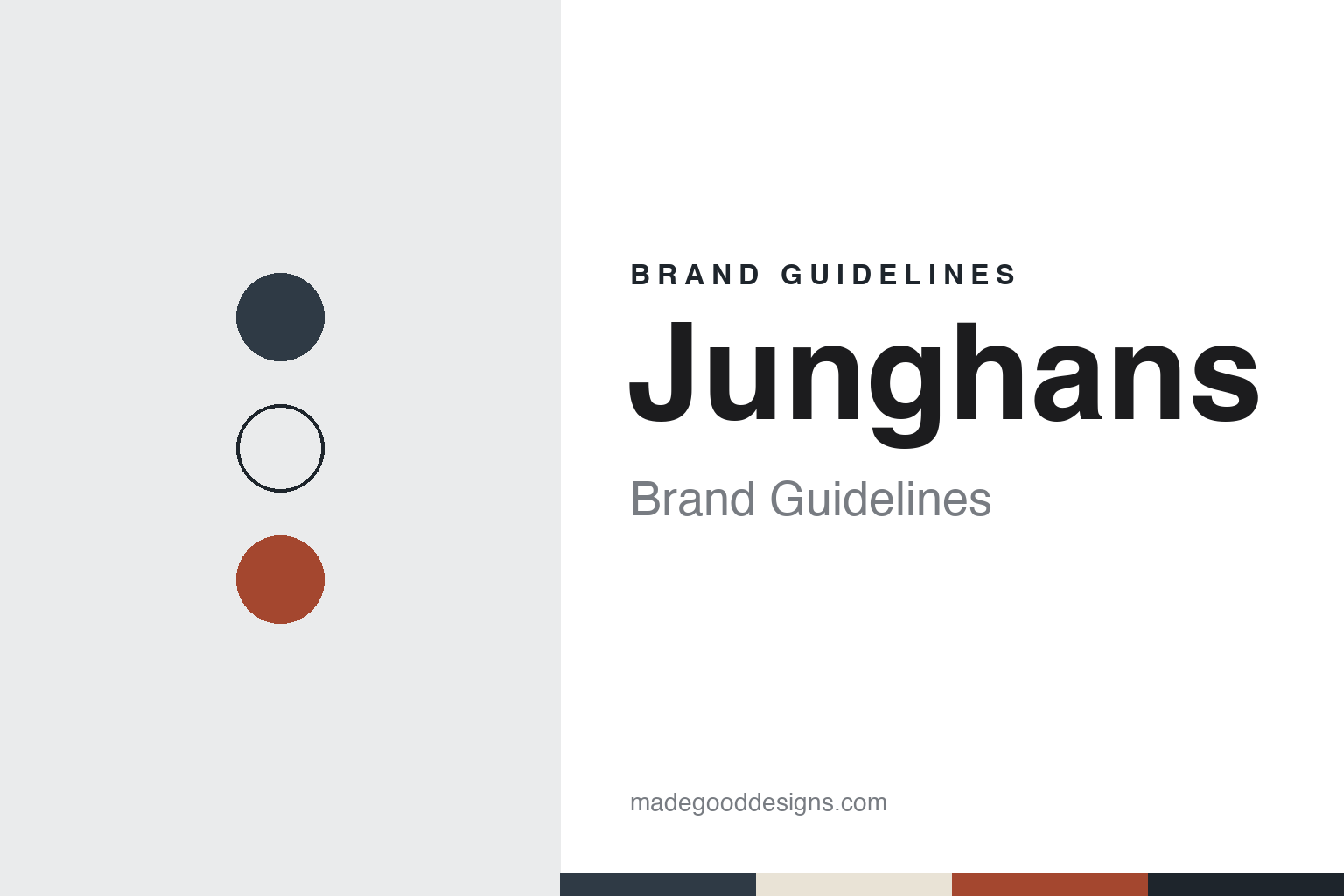
Junghans Brand Guidelines
The Black Forest maker of the eight-pointed star.
Aa
Two constants: a slate, cream and rust palette and a geometric sans register. Abstract homage — not a Junghans product or mark; no watch, logo or star is reproduced.
Zeller & Junghans
An oil mill, a brother-in-law and American machines.
Junghans began in the Black Forest town of Schramberg in 1861, as a maker of clock parts rather than clocks. Erhard Junghans, a businessman who had run a straw-hat factory there, set up an oil mill with his brother-in-law Jakob Zeller-Tobler; German Wikipedia dates the mill to 1860 and the Neue Deutsche Biographie, in 1974, to 1859. It failed, and in 1861 the pair turned to the firm of Zeller & Junghans, which first supplied case parts to other Black Forest clockmakers. The biography adds that Erhard’s brother Xaver, who had emigrated to America, was asked to find suitable machinery and came back to Schramberg as a partner.
That American link shaped the business. According to the biography, parts were stamped by machine rather than cast, which cut costs and improved precision. German Wikipedia says the first movements followed in 1866/67, and that by 1870 about 72 workers were making around 360 clocks a week. Luise Junghans took over the management in 1870 and in 1875 sold the firm to her sons Erhard and Arthur. Arthur had spent a year in American clock factories, and he introduced a series of technical changes; alarm clocks on the American pattern followed in the late 1870s.
The trademark dates from this period. German Wikipedia says the company presented a five-pointed star with a “J” at its centre in 1888, and that the star gained eight points in 1890. It remains the company’s mark. English Wikipedia calls the American star the inspiration and says the eight points were meant to suggest a gear wheel.
By 1903, German Wikipedia and Europa Star agree, Junghans employed more than 3,000 people, made about three million clocks a year and was the largest clock manufacturer in the world. Fuzes joined the range in 1906, German Wikipedia says, and were made in great numbers at Schramberg during the First World War. Hannes Steim, today’s chief executive, told Europa Star in 2024 that this work expanded the firm’s industrial scale. It is also the period of the Terrassenbau, the stepped factory by the industrial architect Philipp Jakob Manz, opened in 1918 and set into the hillside so that workstations received as much daylight as possible.
Colour
Armaments, Max Bill and radio time.
Wristwatches came next: 1926 according to Europa Star, 1927 according to German Wikipedia, which adds that the first movements were bought in and that Junghans made its own from 1930. Europa Star dates the Meister line to 1936.
The Nazi period is part of the company’s record. German Wikipedia, citing a company history published in 2011, says the firm’s directors Erwin and Helmut Junghans turned it towards armaments after 1933, with contracts for aircraft and ship clocks and for fuzes of all kinds. During the Second World War, it says, more than 9,000 people at Schramberg worked mainly on fuzes and other armaments. It also records forced labour: in 1942, 440 “Ostarbeiter” from the occupied East, 332 prisoners of war and forced labourers from France, and 90 forced labourers from Poland were housed by Junghans in the town, with the Soviet and Polish workers living in barracks.
The record extends beyond Schramberg. The Hamburger Morgenpost reported in 2020 that Deutsche Messapparate, known as Messap, was a Junghans subsidiary operating in Hamburg-Langenhorn under a cover name and making time fuzes. The Neuengamme concentration camp memorial records that the women’s satellite camp at Langenhorn held 750 prisoners between September 1944 and April 1945, among them around 500 Jewish women brought from Stutthof, and that they were put to work for the Hanseatische Kettenwerke and a Messap branch, as well as for Hamburg’s city council.
After the war, German Wikipedia says, the French military administration removed key machinery, and civilian production resumed in 1946. Europa Star says Junghans was Germany’s biggest chronometer maker by 1951 and third in the world by 1956. That year the family lost control: German Wikipedia calls Diehl’s move a hostile takeover, completed on 15 November 1956, while Europa Star says Diehl took a majority stake.
The design reputation comes largely from Max Bill, the Swiss artist and architect who studied at the Bauhaus. A Junghans catalogue of 2005 dates his wall clock to 1956/57, says it is shown at the Museum of Modern Art in New York, and dates his mechanical wristwatches to 1962; Europa Star gives 1961 for the wristwatch, and calls it still a best-seller.
Technology followed. German Wikipedia says the Astro-Quarz of 1971 was the first German quartz wristwatch, and both it and Europa Star record Junghans timing the 1972 Munich Olympics. Mechanical production stopped for a time from 1976. Europa Star credits the company with the first radio-controlled table clock in 1985 and the first radio-controlled wristwatch, the Mega 1, in 1990; Wikipedia credits that watch’s design to Hartmut Esslinger and Frog Design.
Typography
Design and documentation.
Watch makers sell objects small enough to hide in a closed hand, so their pictures work at a different scale from the product. The usual image is a macro shot: a dial filling the frame, with the printing, the applied markers and the texture of the surface all larger than life. Brushed and polished steel is lit so that the two finishes separate, and a crystal is angled so that the eye sees through it rather than a reflection on it.
A second set of pictures moves to the bench. A watchmaker’s loupe, a pair of tweezers and an open movement on a work mat are the trade’s shorthand for skill, and they appear in catalogues whether a brand makes many of its own parts or few. Those images show a craft; they do not by themselves show where a particular watch was made, which is why this guide keeps what a company says apart from what independent sources record.
Close-ups do the rest of the work. A chronograph’s pushers suggest timing and motorsport, a screw-down crown suggests water, and enamel and sapphire suggest depth and permanence.
The public stage has long been the fair. Geneva hosts the trade’s big gatherings, where stands are built like small buildings and new models sit behind glass under careful light. Around that stage sit the other habits of the category: archive reissues, anniversary editions, and timekeeping partnerships in sport. Each one gives a brand a story to tell about time, and each one depends on a record that can be checked.
Aa
A plain geometric sans, chosen for this guide. (Specimen set in Jost, a sans STAND-IN; NOT the Junghans logo or any Junghans dial numeral.)
Junghans
Insolvency, a local owner and a factory turned museum.
Ownership changed again in 2000, when Diehl sold the watch business to the holding company Egana Goldpfeil and, German Wikipedia says, kept the defence business and the Schramberg buildings. The fuze maker Junghans Microtec is therefore a separate company from the watch brand. On 29 August 2008, after its parent ran into financial trouble, Junghans filed for insolvency.
The rescue was local. The Schramberg entrepreneur Hans-Jochem Steim and his son Hannes Steim took over on 1 February 2009, German Wikipedia says, and the business has since traded as Uhrenfabrik Junghans GmbH & Co. KG. Europa Star describes the family as owners of Kern-Liebers, a former supplier to the watch industry. Hannes Steim became chief executive in June 2022, and the Stuttgarter Zeitung reported in August 2023 that he would run the company alone as managing shareholder. The family bought the Terrassenbau in 2012, and it opened as the Junghans Terrassenbau Museum in 2018, the building’s centenary.
On production, the company’s position is specific. Steim told Europa Star in 2024 that the radio-controlled movements are all made by Junghans, that mechanical movements come from Switzerland, that quartz calibres are Japanese or Swiss, and that every Junghans timepiece should continue to be made in Schramberg. The news agency dpa reported in 2023 that the watches are assembled at the Black Forest site, that many movements are bought from Switzerland, and that the company employed 110 people, against around 6,000 in the 1960s. Steim told dpa that nearly two-thirds of the watches made in 2022 were mechanical. He names four main lines: Meister, Form, Sports and Max Bill.
For a design guide, Junghans shows how a single mark can outlast repeated changes of owner,. Compare NOMOS Glashütte, another German maker known for plain dials, and Stowa. For this guide we use a slate, a warm cream and a rust accent with a sans, an unofficial interpretation; no product or logo is reproduced.
Explore & save
Keep Junghans’s identity on hand — save it to a board in the Made Good inspiration library.
Junghans identity set
Pin the Junghans slate, cream and rust palette and the geometric sans register to your own board.