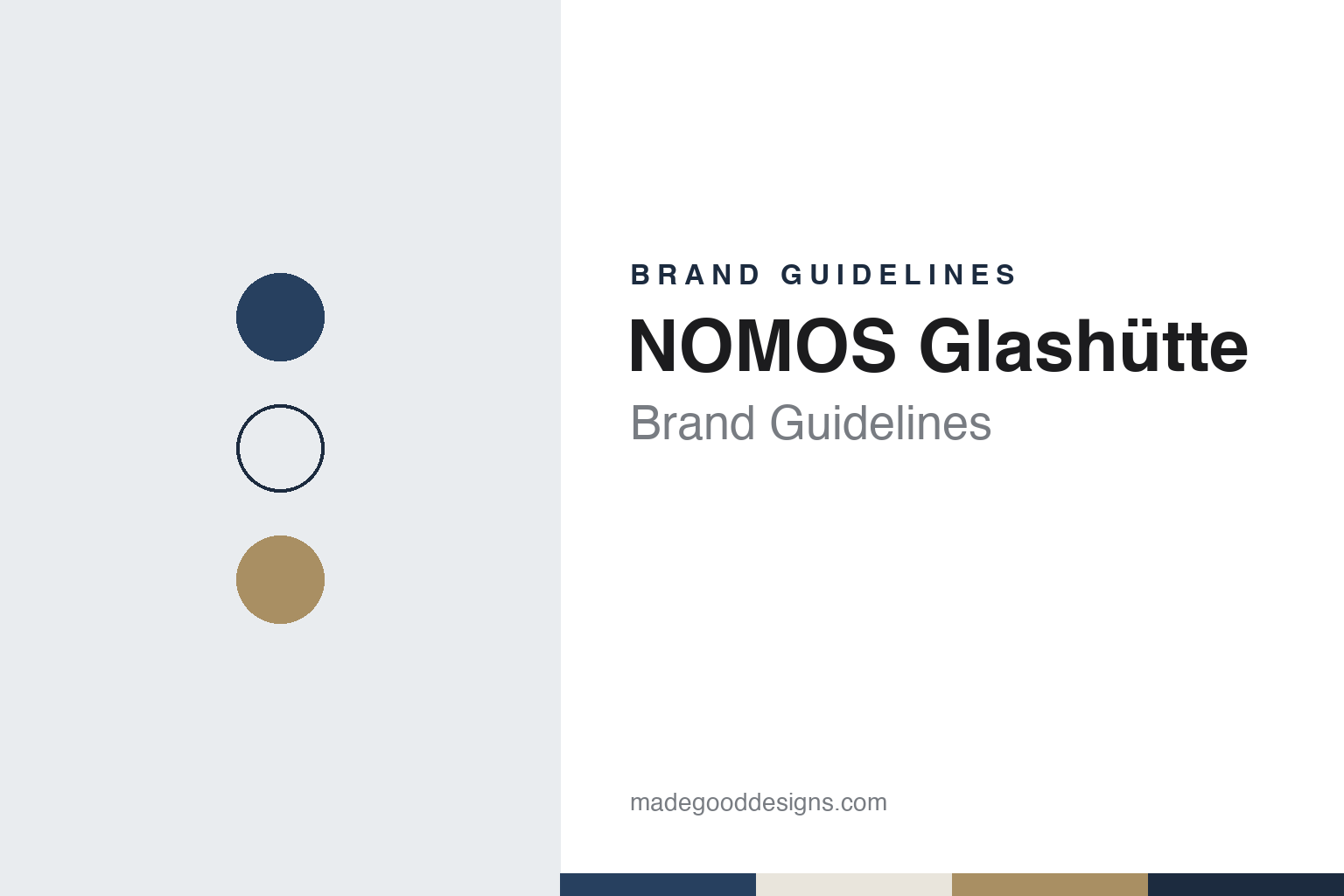
NOMOS Glashütte Brand Guidelines
A Saxon watchmaker founded in 1990, under a name borrowed from 1906.
Aa
Two constants: a NOMOS Glashütte blue, silvered white and champagne palette and a Geometric sans register. Abstract homage — not a NOMOS Glashütte product or mark; no watch, logo or nameplate is reproduced.
Two Companies, One Name
A firm closed in 1910 and a start in 1990.
NOMOS Glashütte has two dates attached to its name, and only one of them is its founding. The first belongs to the Nomos-Uhr-Gesellschaft, Guido Müller & Co., which from 1906 imported Swiss watches and sold them with the added words “Glashütte/Sachsen.” A. Lange & Söhne, the town’s established maker, went to court to stop the practice, and that firm ceased trading in 1910, German Wikipedia says. It and today’s company have nothing in common beyond the word Nomos, which is Greek for law or rule.
The second date is the real one. Roland Schwertner, a Düsseldorf photographer who had also worked in IT, founded the present company in January 1990, two months after the Berlin Wall fell. Swisswatches gave the date as 1 January in November 2024, and called it the first company newly founded in Glashütte after the Wall came down, while East Germany still existed. In a 2022 interview with Escapement, co-owner Judith Borowski said Schwertner had worked as a consultant for a Düsseldorf watch brand, had relatives in the Ore Mountains and knew what the name Glashütte meant to watchmakers in the West.
The first watches followed in 1992: Tangente, Orion, Ludwig and Tetra. English Wikipedia credits the designs to the graphic designer Susanne Günther. Borowski describes a group effort involving Günther, Schwertner, a watchmaker named Christoph and the artist and graphic designer Michael Margos, and she dates his Tetra work to 1993. The early watches ran on a Swiss base movement, the ETA/Peseux 7001, English Wikipedia says.
Colour
From a bought-in base to its own escapement.
Since April 2005 NOMOS has used only its own movements, according to English Wikipedia, starting with the hand-wound Alpha; the first automatic NOMOS, the Tangomat, came that summer. Borowski told Escapement the company moved into Glashütte’s former railway station building in 2005 because it needed space for production and the growing business.
The larger step came at Baselworld in 2014, with the swing system, NOMOS’s own escapement and regulating assembly. Swisswatches reported in 2024 that it took seven years and involved TU Dresden and the Fraunhofer Institute. WatchTime reported in 2016 that managing director Uwe Ahrendt said the work began before anyone could foresee that the Swatch Group would cut hairspring supplies to outside firms. Calibres fitted with the system take the prefix DUW, for Deutsche Uhrenwerke. One of them, the DUW 3001 of 2015, belongs to the neomatik line of thin automatics and stands 3.2 mm high, Swisswatches says.
A German regulation of 2022 requires at least 50 percent of the value of a calibre to be created in and around Glashütte for a watch to be called a Glashütte watch, and German Wikipedia puts NOMOS’s figure at up to 95 percent. The company is not self-contained, though. Swisswatches reported that everything outside the calibre, meaning case, hands, dial, strap and clasp, is bought from outside partners to NOMOS’s designs.
Production sits on three sites: the station building, which houses administration; the Chronometrie on the Erbenhang, occupied since 2000; and a parts plant at Schlottwitz, opened in September 2017, German Wikipedia says.
Typography
Design and documentation.
Watch makers sell objects small enough to hide in a closed hand, so their pictures work at a different scale from the product. The usual image is a macro shot: a dial filling the frame, with the printing, the applied markers and the texture of the surface all larger than life. Brushed and polished steel is lit so that the two finishes separate, and a crystal is angled so that the eye sees through it rather than a reflection on it.
A second set of pictures moves to the bench. A watchmaker’s loupe, a pair of tweezers and an open movement on a work mat are the trade’s shorthand for skill, and they appear in catalogues whether a brand makes many of its own parts or few. Those images show a craft; they do not by themselves show where a particular watch was made, which is why this guide keeps what a company says apart from what independent sources record.
Close-ups do the rest of the work. A chronograph’s pushers suggest timing and motorsport, a screw-down crown suggests water, and enamel and sapphire suggest depth and permanence.
The public stage has long been the fair. Geneva hosts the trade’s big gatherings, where stands are built like small buildings and new models sit behind glass under careful light. Around that stage sit the other habits of the category: archive reissues, anniversary editions, and timekeeping partnerships in sport. Each one gives a brand a story to tell about time, and each one depends on a record that can be checked.
Aa
A geometric sans — after a dial typeface built on 1920s faces. (Specimen set in Jost, a geometric sans STAND-IN; NOT the NOMOS Glashütte logo or the protected Tangente typeface.)
NOMOS Glashütte
A dial typeface, and an agency in Kreuzberg.
The design record is unusually explicit, because Borowski has described it herself. The numerals on the Tangente, she told Escapement, are based on typefaces of the 1920s and are Bauhaus-inspired, but Günther and Margos reworked the old design completely. They drew the 2, 4, 8, 1 and 0 individually, so there was at first no complete set; the 3, the 5 and the other numbers came later, and date numerals were a separate task. The Tangente typeface is protected, she said, and the typography of Tetra and Ahoi is based on it, while each model has its own typography. “NOMOS is Tangente,” she said, likening the watch to a logo. On colour, she said the standard collection prefers tones derived from the material, with brighter dials kept to special models.
The brand’s voice comes from Berlin. Berlinerblau, an agency in Kreuzberg, grew out of Borowski’s own work: a former journalist, she took NOMOS as her first regular client, and the agency was set up as a wholly owned subsidiary. WatchTime wrote in 2016 that weekly advertisements in Der Spiegel got the trade talking in the early years, and that specialist journalists joked about an advertising agency with a watch factory attached. Swisswatches counted about 20 staff there in 2024, around a dozen of them designers, in a former button factory. Outsiders are used too: the Autobahn of 2018 came from more than four years’ work by Werner Aisslinger, Tina Bunyaprasit and the in-house department, Europa Star reported.
The company has stayed in private hands. WatchTime reported in 2016 that Ahrendt and Borowski took over the stake held by the retailer Manufactum in 2003, joining Schwertner as owners, with Schwertner holding the majority; Borowski told Escapement she has been a partner since 2004. All three received the Order of Merit of the Federal Republic of Germany on 1 October 2024, German Wikipedia says. In 2018 the Tangente neomatik 41 Update won the Challenge Watch Prize at the Grand Prix d’Horlogerie de Genève, Boat International reported, and German Wikipedia counts more than 160 design awards and notes membership of the Deutscher Werkbund.
For a design guide, NOMOS Glashütte shows how one drawn set of numerals can carry a whole brand. Compare Stowa, another German maker with a Bauhaus-style dial, and Junghans. For this guide we use a tempered blue, a silvered white and a pale champagne with a sans, an unofficial interpretation; no product or logo is reproduced.
Explore & save
Keep NOMOS Glashütte’s identity on hand — save it to a board in the Made Good inspiration library.
NOMOS Glashütte identity set
Pin the NOMOS Glashütte blue, silvered white and champagne palette and the Geometric sans register to your own board.