De Beers Brand Guidelines
The company that told the world a diamond is forever, and the history behind the line.
Aa
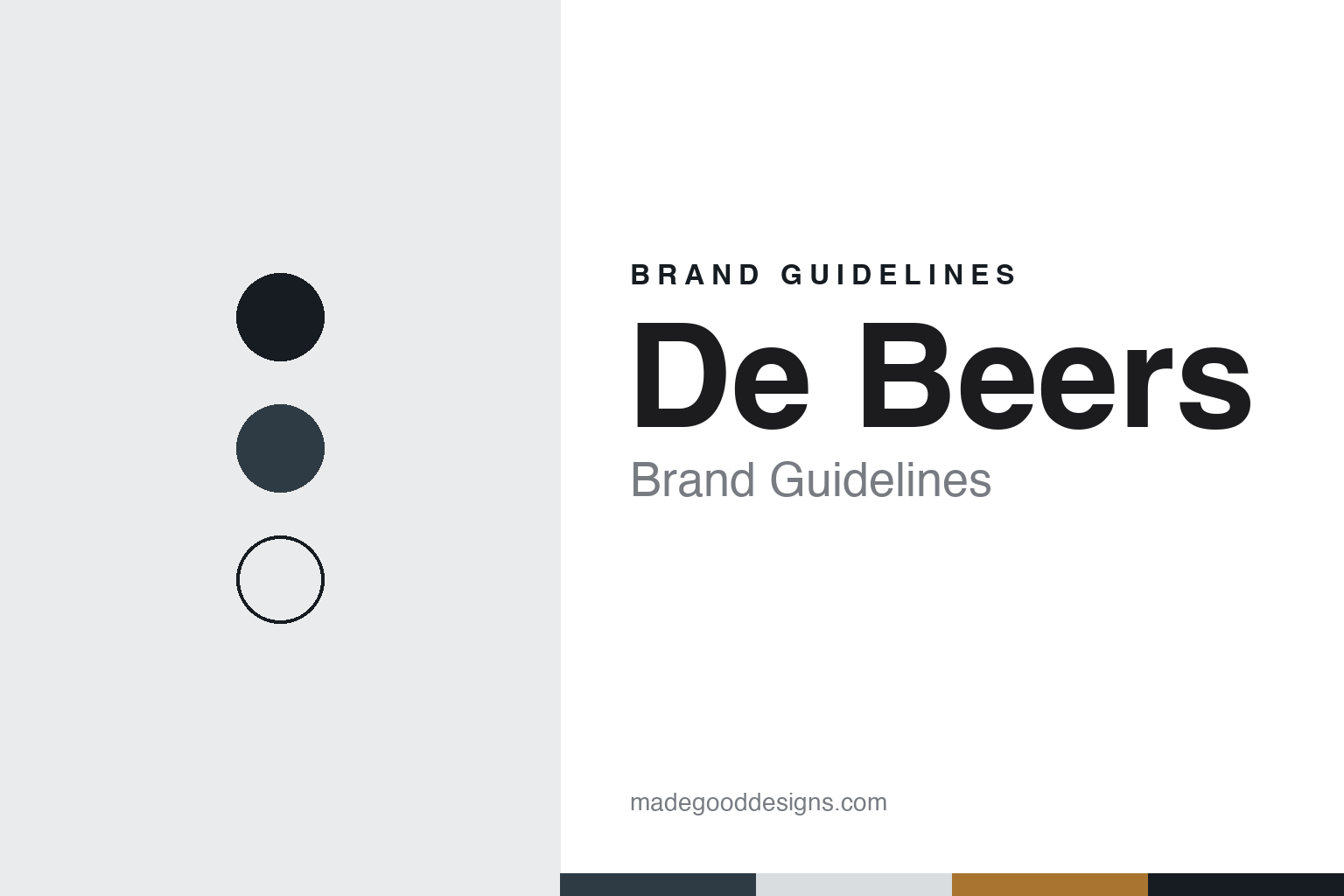
Two constants: a De Beers slate, grey and ochre palette and an Engraved serif register. Abstract homage — not a De Beers product or mark; no diamond, logo or campaign is reproduced.
Vooruitzicht
A farm’s name, a merger and a closed compound.
The name came from a farm, not a founder. Brothers Diederik and Johannes de Beer sold their land, Vooruitzicht, on 31 July 1871, English Wikipedia says, after diamonds were found there; the De Beers mine took their name, and the company took it from the mine.
The company itself dates from 12 March 1888, when, its own history says, Cecil Rhodes and Barney Barnato, who had run competing operations, joined forces as De Beers Consolidated Mines. Rhodes chaired it until 1902. Finance came from Alfred Beit and the London bank N M Rothschild & Sons, English Wikipedia says, and in 1889 Rhodes struck an agreement with the London Diamond Syndicate, which bought a fixed quantity at an agreed price. In the slump of 1891–1892 supply was curtailed to hold the price, English Wikipedia says.
The labour system was built at the same time. Liz Stanley, writing in 2020 for the University of Edinburgh’s Whites Writing Whiteness project, describes the closed compound opened in 1886 by the De Beers Mining Company, the predecessor firm, at Kimberley: housing for around 3,000 African men on some 25 acres behind a 12-foot wall, with access to the mine by a covered route. She records that workers were searched and confined for five days when their contracts ended, and that all of them struck on the day it opened. She calls compounds one of the essences of segregation in South Africa.
Ernest Oppenheimer, who had founded Anglo American, joined the De Beers board in 1926 and took the chair in 1929. His son Harry Oppenheimer took over the running of both groups in 1957 and stepped down in 1982.
Colour
War, apartheid, cartel cases and conflict stones.
De Beers’ own timeline says all its mines closed in 1932, as demand stalled in the Depression, and again in 1940, during the Second World War. The war also brought a dispute with Washington. English Wikipedia says Oppenheimer proposed a US arrangement to supply industrial diamonds in return for protection from prosecution, and that the Justice Department rejected it; a 1945 antitrust case was dismissed because the company had no presence on US soil. Stansfield Turner, a former CIA director, later claimed De Beers had restricted US access to industrial diamonds in the war.
On apartheid, English Wikipedia says Harry Oppenheimer opposed apartheid, arguing that it hindered economic growth, and that De Beers has been criticised for profiting from the system. South Africa’s Truth and Reconciliation Commission said in its 1998 report that the mining industry bore “a great deal of moral responsibility” for the migrant labour system, and described a “shameful history of subhuman compound conditions, brutal suppression of striking workers, racist practices and meagre wages.” Those passages address the industry and Anglo American, a major De Beers shareholder that shared a headquarters with it from 1955. The report says Anglo accepted it could have been a better corporate citizen, and faults its submission for sidestepping African wages.
Competition law followed the company for decades. In July 2004 De Beers Centenary AG pleaded guilty to a 1994 US indictment for conspiring to fix industrial diamond prices and paid a criminal fine, the US Department of Justice announced; its alleged co-conspirator, General Electric, had been tried and acquitted. NBC News reported that the plea cleared the way for De Beers to sell directly in the United States again. In 2006 De Beers made binding commitments to the European Commission to stop buying rough diamonds from Alrosa of Russia, and it later paid a US class-action settlement over price fixing, English Wikipedia says.
The conflict diamond campaign began with Global Witness in 1999, as UN scrutiny turned to diamonds bartered for weapons in Angola. De Beers stopped outside buying, and the Kimberley Process took effect in 2003. De Beers says the diamonds it sells are conflict-free. Global Witness left the scheme in December 2011, saying it had failed in its purpose. English Wikipedia also records a long dispute involving De Beers and the San people of Botswana, who have faced threats of forcible relocation since the 1980s, and a campaign by Survival International; De Beers sold one Botswana mine to Gem Diamonds in 2007.
Typography
Design and documentation.
Fine jewellery is sold on small things seen closely, so its houses present themselves through a settled set of images. Loose stones appear on grey velvet, a surface that gives the eye nothing to compete with. Pearl strands are laid out and sorted by tone, a way of showing that matching is itself the work.
Drawing comes next. Many houses show gouache design sketches, painted on paper so that a jewel can be judged at full size before any metal is cut. These sheets often go into archives and exhibitions alongside the finished pieces, because they show the design as a decision rather than an object. Chaumet’s nickel-silver mock-ups and Gianmaria Buccellati’s remark that he made a design so that a craftsperson could make it belong to the same habit.
Then the bench. Workshop photographs of hands, burins, wooden workbenches and half-set stones have become part of the category’s standard vocabulary. They show that a person made the piece, and they suit a trade in which skills are passed down at the bench.
Finally, there is the box and the street. Red and navy boxes make a purchase recognisable before the jewel is seen. On Place Vendôme in Paris, small windows and restrained frontages do the same job at the scale of a square: a handful of pieces, carefully lit, under a name in plain lettering. The guides in this set look at how each house uses those habits, and at who has owned each name along the way.
Aa
An engraved serif — the register of a certificate. (Specimen set in Libre Caslon Text, a serif STAND-IN; NOT the De Beers logo.)
De Beers
Four words from 1947.
De Beers’ first advertising campaign ran in the United States in 1939, its own history says. In 1947 the copywriter Frances Gerety, at the agency N. W. Ayer, wrote “A Diamond Is Forever,” which Advertising Age named the best slogan of the 20th century in 2000, English Wikipedia says. De Beers marketed diamonds as a symbol of love and commitment, the same source says, and later promoted eternity and trilogy rings. Its “Shadows” television films, silhouettes set to Karl Jenkins’s Palladio, are dated to 1993 by English Wikipedia and to 1995 in the United States by De Beers.
De Beers Diamond Jewellers began in 2001 as a joint venture with LVMH, and the first boutique opened on London’s Old Bond Street in 2002. De Beers bought out LVMH in 2017 and took the name De Beers Jewellers; in 2025 it became De Beers London, which JCK reported alongside plans for a Paris flagship. Forevermark, launched in 2008, gave selected diamonds a microscopic inscription. Lightbox, a laboratory-grown line, launched in 2018 with stones produced in Oregon, and De Beers announced its end in May 2025.
Mining runs through partnerships. English Wikipedia describes Debswana in Botswana and Namdeb in Namibia as 50–50 joint ventures with those governments; De Beers also mines in South Africa and Canada. Its sales arm moved from London to Botswana in 2013, the company says. Its share of rough diamonds fell from as high as 90% in the 1980s to 29.5% in 2019, English Wikipedia says.
Ownership is changing. Anglo American raised its stake to 85% by buying the Oppenheimers’ 40%, in a deal announced in November 2011, leaving the Government of Botswana with 15%. In May 2024 Anglo said it would spin off or sell De Beers. In July 2026 a Botswana minister told lawmakers that Anglo had chosen the Global Diamond Consortium, chaired by the former De Beers chief executive Gareth Penny, as preferred bidder, National Jeweler reported, with completion expected by the final quarter of 2026 and subject to conditions; Miningmx reported later that month that talks were not final.
For a design guide, De Beers shows how a slogan can outlast the market power behind it, and how a brand’s history stays attached to its name. Compare Graff, another diamond name, and Tiffany, an American jeweller. For this guide we use slate, grey and an ochre with a serif, an unofficial interpretation; no product or logo is reproduced.
Explore & save
Keep De Beers’s identity on hand — save it to a board in the Made Good inspiration library.
De Beers identity set
Pin the De Beers slate, grey and ochre palette and the Engraved serif register to your own board.