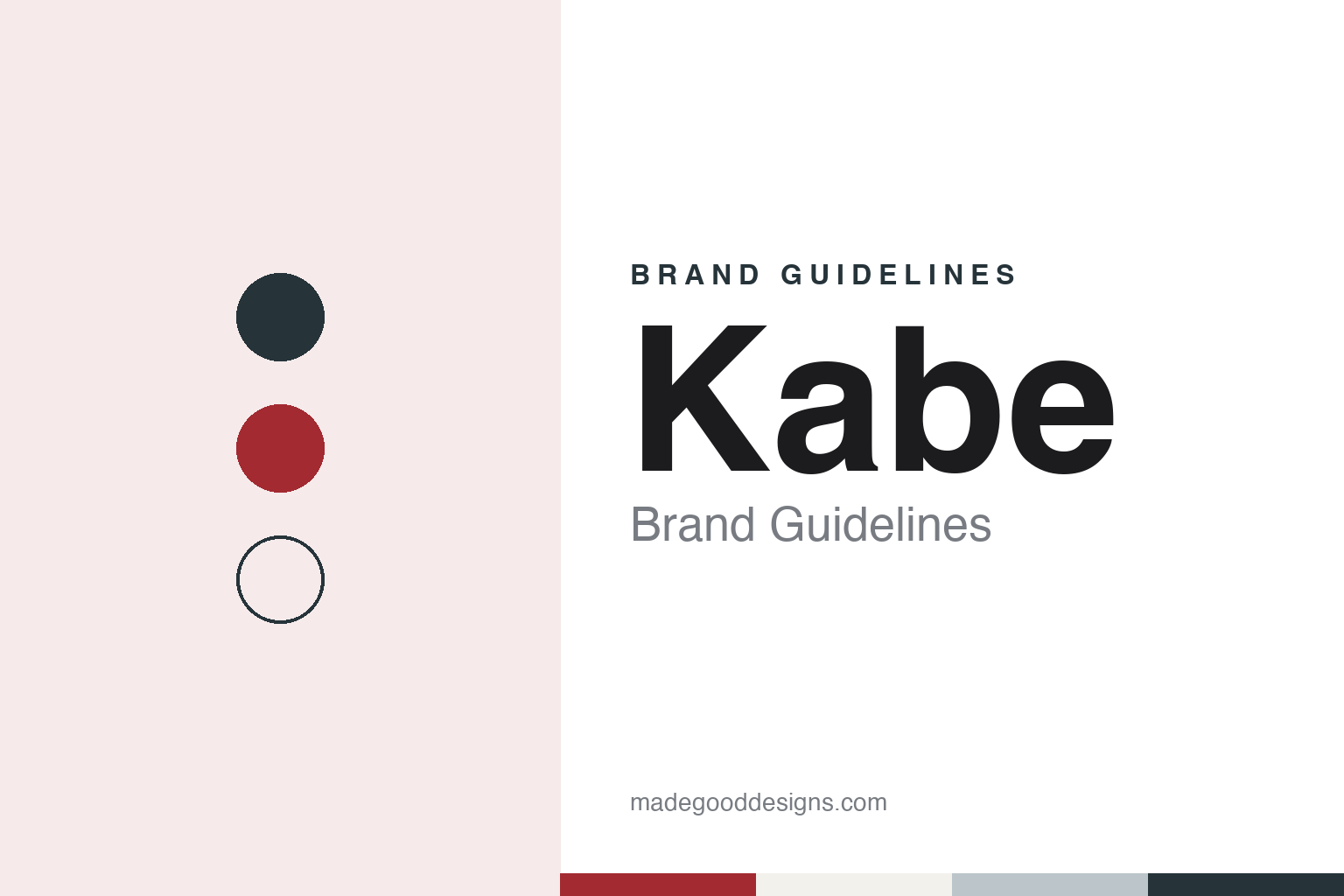
Kabe Brand Guidelines
The Swedish caravan maker that grew from a family holiday project in a garage.
Aa
Two constants: a Kabe red, white and winter slate palette and a Plain Nordic sans register. Abstract homage — not a Kabe product or mark; no vehicle, logo or nameplate is reproduced.
Karosseri AB Elit
A holiday project and a name made to fit.
Kabe dates itself to 1957, and what it records for that year is a sales business, not a factory. KABE Group’s 2025 annual report says Kurt Blomqvist began selling English caravans in 1957, built his first caravan in 1958 and made the first eight Komet 250 models in 1959. Swedish Wikipedia gives 1957 as the founding year and Blomqvist as the founder.
The company’s history page tells a story about a family holiday. Kabe says that in 1958 Blomqvist, then in charge of the Swedish air administration’s inspection work at Saab in Jönköping, was building a caravan in his garage so that the family could give up the tent. Three weeks before they were due to leave it was finished, and he sold it. The disappointed family sent him back to the garage. He kept working while they enjoyed the holiday, Kabe says, came home with a finished caravan and sold that too. Building went on through the autumn, and by the next summer eight vans were ready. The Komet 250 was 2.4 metres long and 1.8 metres wide.
The name took some engineering of its own. Kabe says it comes from the founder’s initials, KB, spelled out as KÅBE. That was taken, and dropping the ring from the Å left a name too close to another company, KABI. Blomqvist’s answer was Karosseri AB Elit, which shortens to KABE. Swedish Wikipedia also gives Karosseri AB Elit as the original name. The company is now KABE AB and writes its name in capitals in its marketing.
Four years on, Kabe says, Blomqvist had tired of doing two jobs and turned to the caravans. The annual report says the company moved to a 300-square-metre factory in Tenhult, in Småland, in 1962.
Colour
Modules, sandwich panels and floor heating.
Kabe’s model names arrived early and have lasted. The annual report says its Gemstone series, sold in Swedish as Ädelsten, has existed since 1963, and that the Briljant, introduced in 1966, still exists today. Promobil named Smaragd and Ametist as the bestsellers of that family in a 2016 test.
The company’s visual signature dates from 1970. The annual report says that was the year Kabe developed its modular system and that “the classic KABE livery in red and white” first appeared. Promobil’s 2016 test of the Briljant 470 XL still described a broad red decorative stripe along the side.
The technical story runs through the following decades. The annual report says Kabe began building 2.50-metre-wide caravans in 1981, introduced its first own motorhomes, produced with Volvo, in 1983, and adopted the “sandwich panel principle” in 1985. Kabe credits Blomqvist with the features introduced in the 1980s and 1990s: Ecoprim insulation in 1987, the waterborne AGS floor heating system, for which it applied for a patent in 1988, plastic wall studs in 1989 and ventilated walls in 1992. AGS became standard in 1990, the annual report says.
The modular work became Flexline in 1992. Kabe says the system uses the same modules across caravan and motorhome models, and gives more than 100,000 possible product variants. Blomqvist explained the logic on the company’s history page: caravans could be built to about 60 percent and finished for the customer once sales picked up, which kept production steady through the year.
Promobil has paid most attention to the insulation. It reported in January 2026 that Kabe’s sandwich panels measure 50 millimetres in the floor, 45 in the roof and 41 in the walls, and credited those panels as a key reason for the brand’s winter use. The same article quoted a Caravaning test of the Estate 660 DGDL, which found the living space and floor evenly heated and free of draughts. Its 2016 Briljant test described Alde hot-water heating with four floor loops, an oak-style furniture decor, and light beige and brown fabrics.
The current range is laddered. The annual report lists five caravan series, from the entry-level Estate to the Imperial, which the company calls Europe’s most exclusive caravan model. It says its Hacienda series consists of Europe’s largest caravans; Promobil gave a maximum length of 11.57 metres in 2016. Its motorhomes include the semi-integrated Novum and Royal and the fully integrated Crown and Imperial, built on Mercedes chassis, and the company says they are developed for year-round use in the Nordic climate. Kabe also uses the name Travel Master for its motorhomes; a new version was shown at the Elmia fair in 1997.
Typography
Design and documentation.
Motorhome makers tend to sell a picture before they sell a vehicle: a white van on a pitch by the sea, doors open, with the road implied behind it. The colour itself has a history in the category. Chausson says it was the first maker to “dare” white bodywork, on its 1984 overcabs.
The second image is more technical. Layout is what buyers compare, so makers lean on plans, cut-away views and model numbers that stand for a floor plan. Chausson’s 2027 catalogue, for instance, explains a lounge feature by listing the numbered models that have it, and Rapido’s vans run from V55 to V68. Rapido’s website offers a comparison tool and 360-degree views of its models, and Chausson’s invites buyers to compare its ranges by the way they want to travel.
The third setting is the dealer forecourt. Chausson says it reaches more than 15 European countries through specialist distributors, and Trigano, its parent, created the Libertium dealership network in 2023 and says it has 70 sales outlets. Rapido’s history shows how early this mattered: Le Journal des Entreprises counts ten dealers in the brand’s first years of rigid caravans.
The category’s annual stage is the Caravan Salon in Düsseldorf. The fair calls itself the world’s leading trade fair for mobile travel, and reports 259,000 visitors in 2026, with 834 exhibitors from 41 countries in 15 halls and on the outdoor grounds. It says those visitors covered more than 250,000 square metres of motorhomes, caravans, roof-top tents and equipment, which puts whole vehicles, not just pictures of them, in front of the public. The next edition runs from 27 August to 5 September 2027.
Aa
A plain Nordic sans, for a name built from initials. (Specimen set in Archivo, a sans STAND-IN; NOT the Kabe logo.)
Kabe
Still family controlled, still in Tenhult.
Kabe remains controlled by its founding family. The annual report says the investment company EKEN bought 25 percent in 1976, with the rest staying with the Blomqvists, and that Kabe floated on the stock exchange’s new OTC list in 1983. KABE Group AB says it has been listed in Stockholm since then. The family held 51 percent of the capital and 67 percent of the votes at the end of 2025, according to the shareholder table on the group’s website. In 1995 Blomqvist became chair and Alf Ekström took over as chief executive; Ekström signed the 2025 report as chief executive.
Around the main business the group has grown in several directions. Accessories moved into a separate company, KAMA Fritid, in 1987. That year Kabe also bought all the shares of the English company Fleetwood Caravan, sold half to Slovenia’s Adria in 2000, and saw Adria Mobil take over the rest in 2004. In 2001 Kabe set up the business that imports Adria caravans and motorhomes, and the company says that agreement was extended in 2023 until 2034. In England, Promobil reported that Kabe had held 21.5 percent of Coachman of Hull since July 2018 and completed its takeover on 19 February 2021. From 1984 to 1995 there was even a Kabe Sommarland, a summer leisure park in Jönköping, Swedish Wikipedia says.
On where things are made, Kabe is direct. Its website says its head office, development department and production are in Tenhult, where it builds every caravan and motorhome model along with its walls, roofs and floors and has its own joinery factory, and that all of its caravans and motorhomes are Swedish made. The wider group also reports production in the UK, for Coachman, and in Poland, for Affinity Camper Vans, while Adria’s products come from Novo Mesto in Slovenia.
The website uses the line “Alltid steget före,” or “always one step ahead.” The company calls itself the largest and leading Nordic maker of caravans and motorhomes, and says it became market leader in Sweden in 1994.
For a design guide, Kabe shows how a brand can stay tied to one town and one climate for more than half a century. Compare Adria, whose Nordic imports sit inside the same group, and Hobby, another caravan maker that began in a garage. For this guide we use a red, a snow white and a winter slate with a sans, an unofficial interpretation; no product or logo is reproduced.
Explore & save
Keep Kabe’s identity on hand — save it to a board in the Made Good inspiration library.
Kabe identity set
Pin the Kabe red, white and winter slate palette and the Plain Nordic sans register to your own board.


