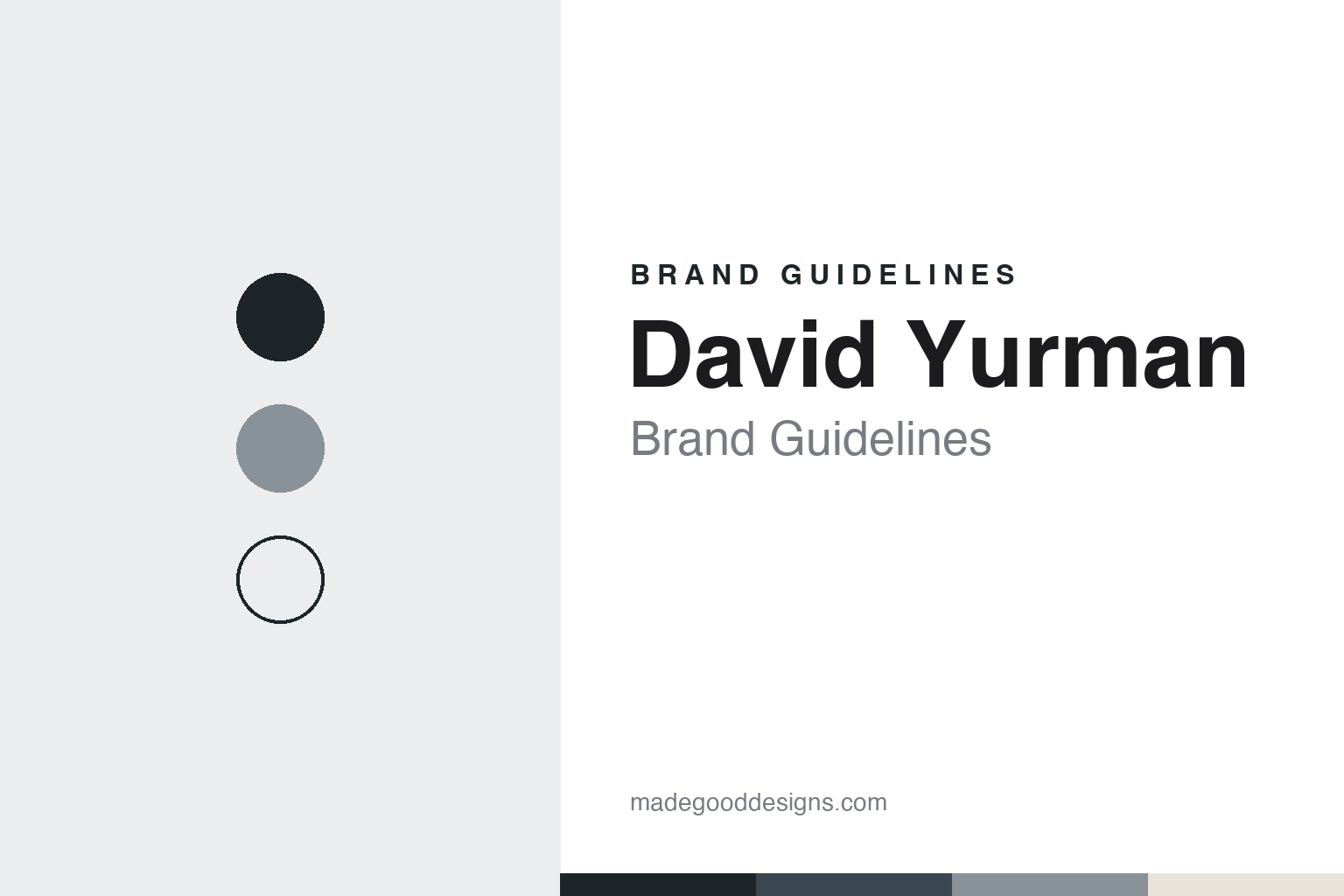
David Yurman Brand Guidelines
The sculptors who twisted Cable into a New York jewelry house.
Aa
Two constants: a David Yurman slate, wire grey and warm stone palette and a Sculptural serif register. Abstract homage — not a David Yurman product or mark; no jewel, logo or nameplate is reproduced.
Sculpture to wear
A sculptor, a painter and a studio upstate.
David Yurman was founded in 1980 by the sculptor David Yurman and his wife Sybil Yurman, a painter. The company gives New York City as its birthplace, and its statement under California’s supply-chain law describes a privately held, family-owned business headquartered in New York: David Yurman Enterprises LLC, organized in Delaware. JCK gave the same founding year in 2024, reporting on a talk the couple gave at New York’s 92nd Street Y. Sybil Yurman told the audience that she suggested naming the company after David alone, partly because she was selling paintings through a big gallery and thought a split commitment between art and jewelry could hurt those sales.
The training came first. English Wikipedia and the company both say Yurman learned welding from the sculptor Ernesto Gonzalez as a teenager, and both say he apprenticed with the modernist sculptor Jacques Lipchitz in the 1960s; the company dates that apprenticeship from 1964 and adds a period with Theodore Roszak in 1970. Wikipedia says that he helped make the railings of the promenade in what is now the David H. Koch Theater at Lincoln Center.
In 1969, the company says, he was working as a foreman for the sculptor Hans Van de Bovenkamp when Sybil Kleinrock applied to be studio manager. She had taught ceramics at Berkeley and, by the company’s account, studied with the Japanese potter Shoji Hamada.
The two left the city in the early 1970s. English Wikipedia places them in Carmel, in upstate New York; the company says Putnam Valley, and dates their first design studio, Putnam Art Works, to 1973. Yurman called that early work “sculpture to wear,” the company says, and the two showed at more than 150 craft fairs a year. In 1977 he was one of 12 jewelers chosen for the first New Designer Gallery at the Retail Jewelers of America show in New York, a date both sources give. On its timeline the company quotes Victoria Gomelsky, as editor-in-chief of JCK: “David Yurman was the first designer whose ‘face’ was associated with his jewelry.”
Colour
“The river that runs through all of our designs.”
The company’s first collections, it says, were beaded jewelry in pearls, lapis, garnets and jade. Recognition came in 1981, when the Cultured Pearl Associations of America and Japan named Yurman Designer of the Year. The company ties that award to mabé pearls: it says the couple found a bag of imperfect blister pearls at the pearl dealer Assael, learned they were due to become ashtrays and bolo ties, and bought the lot.
The signature followed in 1982. The bronze rods of Yurman’s welded sculpture led to Starlight, the company says, bundled strands of gold dotted with diamonds. A twist of those parallel wires became the Cable bracelet, shaped by hand from 50 feet of gold wire, with end caps of pink tourmaline and emerald. JCK also dates it to 1982 and reports that the couple divide their work into “B.C.” and “A.C.,” before and after Cable; Yurman told the 2024 audience it began with him twisting wires into “a simple helix.” The company points to ancient torques in the Metropolitan Museum of Art as an inspiration, and says Yurman calls Cable “the river that runs through all of our designs.”
Later launches widened the range. In 1997 came Silver Ice, which the company says made Yurman the first major designer to set diamonds in sterling silver. A first Wedding Collection followed in 2006 and a High Jewelry Collection in 2010, and in 2017 the company took out a design trademark for its DY Signature Cut diamond.
Its own stores came later. The first boutique opened on Madison Avenue in New York in 1999, about two decades after the company began. Advertising changed around the same time, through black and white campaigns by the photographer Peter Lindbergh. English Wikipedia dates the first to 2000, shot in St. Barts with Amber Valletta; the company says 2001, and calls those pictures a departure from the still-life jewelry advertising of the period. Kate Moss then fronted the campaigns for about a decade from 2004, the company says.
Stores became part of the design language. A Rodeo Drive flagship opened in 2006, and in 2010 a five-story converted townhouse on Madison Avenue, a collaboration with the architect Michael Gabellini, with what the company calls a Cable-inspired staircase and door handles sculpted by Yurman. A New York flagship on East 57th Street followed in 2019. Rizzoli published David Yurman Cable, the brand’s first book, in 2017, and Phaidon published Sybil and David Yurman: Artists and Jewelers in 2024. The Museum of Arts and Design gave Yurman its Visionaries! award in 2013, English Wikipedia says.
Typography
Fine jewellery and pearls.
Fine jewellery is sold on small things seen closely, so its houses present themselves through a settled set of images. Loose stones appear on grey velvet, a surface that gives the eye nothing to compete with. Pearl strands are laid out and sorted by tone, a way of showing that matching is itself the work.
Drawing comes next. Many houses show gouache design sketches, painted on paper so that a jewel can be judged at full size before any metal is cut. These sheets often go into archives and exhibitions alongside the finished pieces, because they show the design as a decision rather than an object. Chaumet’s nickel-silver mock-ups and Gianmaria Buccellati’s remark that he made a design so that a craftsperson could make it belong to the same habit.
Then the bench. Workshop photographs of hands, burins, wooden workbenches and half-set stones have become part of the category’s standard vocabulary. They show that a person made the piece, and they suit a trade in which skills are passed down at the bench.
Finally, there is the box and the street. Red and navy boxes make a purchase recognisable before the jewel is seen. On Place Vendôme in Paris, small windows and restrained frontages do the same job at the scale of a square: a handful of pieces, carefully lit, under a name in plain lettering. The guides in this set look at how each house uses those habits, and at who has owned each name along the way.
Aa
A sculptural serif — for a house that began in welded bronze. (Specimen set in Cormorant Garamond, a serif STAND-IN; NOT the David Yurman logo.)
David Yurman
A twist that went to court.
Cable has also been tested in law. In August 2001 the US Court of Appeals for the Second Circuit upheld the company’s copyright claims against Prime Art & Jewel of Dallas, JCK reported, but overturned the trade dress protection it had won in the lower court, citing its “inability to articulate” the features of that trade dress. Trade dress is the distinguishing look of a product. The company has kept registering and asserting those rights. In 2016, it says, it registered a design trademark for its 10mm Renaissance bracelet; in March 2019, English Wikipedia says, a New York federal court entered a default judgment and permanent injunction in its favor against 31 defendants accused of selling counterfeits through websites; and in September 2023 The Fashion Law reported a new complaint in which the company claimed rights in a Cable Classic trade dress, sold, it said, since at least 1993. Those were the company’s allegations in a filing.
The company is also open about where its jewelry is made. Its supply-chain statement for the financial year ended January 3, 2026 says the jewelry is designed in the United States and crafted by suppliers across North America, Europe and Asia, and that in 2025, 79% of finished goods were made in the United States, Italy, Thailand and India. The same statement counts retail stores in the US, Canada, Hong Kong and France and more than 300 locations worldwide. The company says its diamonds comply with the Kimberley Process, and that it joined the Responsible Jewellery Council in 2016 and became a certified member in 2018. Abroad, Unity Marketing reported in June 2022 that it had opened its first Paris flagship, on the rue Saint-Honoré.
Ownership has stayed in the family. Evan Yurman, the founders’ son, joined in 2003, according to the company and Wikipedia; National Jeweler says 2002. He led design for men’s jewelry, and in November 2021 he became president, replacing Carol Pennelli, with his father remaining lead designer and his mother chief brand officer, National Jeweler reported; Unity Marketing described the parents as co-CEOs. “We’ve said no to a lot of people who wanted to buy the company,” David Yurman told Worth in October 2025. The name itself may yet move: at the 2024 talk he said the family was “seriously considering” shortening it to Yurman, JCK reported. The website still carries the full name.
For a design guide, David Yurman shows how one twisted form, repeated for more than forty years, can carry a whole house, from a bracelet to a staircase. Compare Tiffany & Co, another American jeweler, and Harry Winston, another New York name. For this guide we use a slate, a wire grey and a warm stone with a serif, an unofficial interpretation; no product or logo is reproduced.
Explore & save
Keep David Yurman’s identity on hand — save it to a board in the Made Good inspiration library.
David Yurman identity set
Pin the David Yurman slate, wire grey and warm stone palette and the Sculptural serif register to your own board.