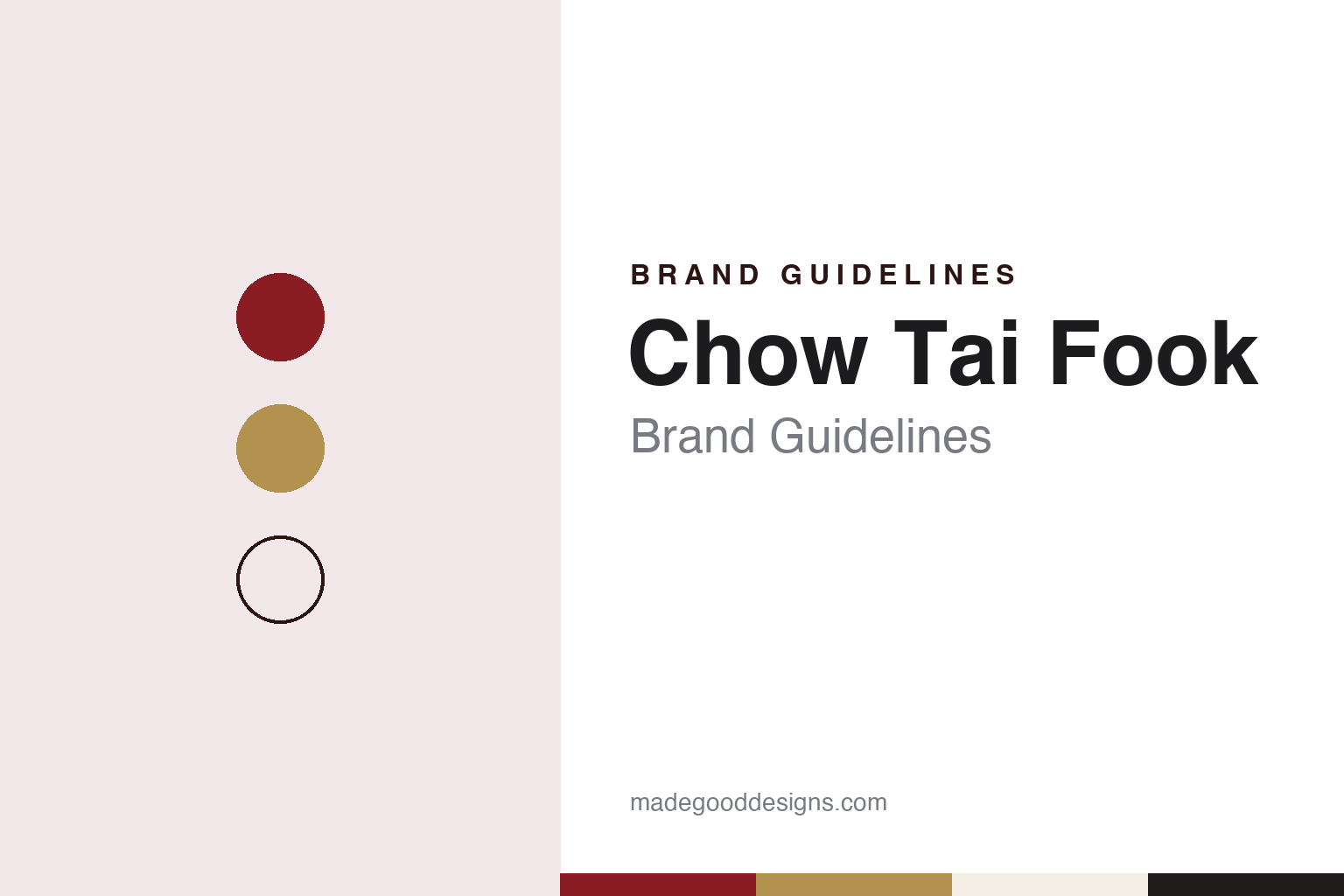
Chow Tai Fook Brand Guidelines
A 1929 Guangzhou gold shop that became a listed Hong Kong jewellery chain.
Aa
Two constants: a Chow Tai Fook red and gold palette and a Heritage serif register. Abstract homage — not a Chow Tai Fook product or mark; no jewellery, logo or monogram is reproduced.
The gold shop
From Guangzhou to Hong Kong.
Chow Tai Fook began as a gold shop in Guangzhou in 1929. Its founder, Chow Chi-yuen, was born in Shunde in Guangdong and sold traditional gold accessories, English Wikipedia says. The group’s 2026 annual report still dates the brand from that year, and the stock code it took in Hong Kong, 1929, repeats the date.
War moved the business, and the sources disagree on the dates. English Wikipedia’s group article puts the shift to Portuguese Macau in 1940, adding that some say 1931; Chinese Wikipedia has it trading in Macau from 1938 and in Hong Kong from 1939. Bloomberg News, in a profile carried by The Globe and Mail in October 2016, says Cheng Yu-tung fled to Macau in 1940 to escape China’s war with Japan and, at 15, became an apprentice at Chow’s gold shop, then moved to Hong Kong in 1946 to open a store. English Wikipedia also places a first branch on Queen’s Road Central in 1946.
Cheng, who became Chow’s son-in-law, took over the business in 1956, according to English Wikipedia; Chinese Wikipedia says 1947. The chain was incorporated in Hong Kong as Chow Tai Fook Jewellery Company in 1961. English Wikipedia credits Cheng with introducing gold of 99.99% purity as a product, which it says became a standard among Hong Kong peers, and says the company acquired a licence to buy diamonds from De Beers in 1964.
Bloomberg says Cheng put profits from selling gold into Hong Kong property. New World Development, founded in 1970 and listed in 1972, is an associate of the private Chow Tai Fook group, whose unlisted holdings include Rosewood hotels, English Wikipedia says. The jewellery chain is one part of that group.
On 15 December 2011 a new holding company, Chow Tai Fook Jewellery Group, listed on the Hong Kong Stock Exchange. It is still controlled by the family holding structure: the 2026 annual report shows Chow Tai Fook Capital with 73.39% at 31 March 2026, an interest also recorded against Cheng Yu Tung Family (Holdings). Henry Cheng is chairman, Kent Wong is managing director, and Conroy Cheng and Sonia Cheng are vice-chairmen.
Colour
Stones, workshops and counters.
The group has long presented itself as a maker as well as a seller. Its 2014 annual report describes a vertically integrated model running from raw materials through design and production to sales, with four production sites, in Shunde, Shenzhen, Wuhan and Hong Kong, making almost half of the products it sold, and diamond cutting and polishing sites in Shunde, South Africa and Botswana. It named De Beers, Rio Tinto and ALROSA as suppliers. That picture has since changed in part: The Standard reported on 6 June 2024 that production at the Shenzhen factory had been suspended from 1 June, with some departments moving to Shunde. The 2026 annual report speaks of “in-house ateliers” and “highly automated production hubs,” and describes the core business as manufacturing and selling jewellery.
Large stones gave the name international attention. English Wikipedia records that Chow Tai Fook Jewellery bought the 507-carat rough Cullinan Heritage diamond in 2010, at a then-record price for a rough stone, and that the Pink Star went to Chow Tai Fook at a Sotheby’s auction in Hong Kong in April 2017; it notes that Sotheby’s named the jeweller while the Financial Times reported the buyer as Chow Tai Fook Enterprises.
The retail network is the larger story. Bloomberg called the company “the world’s largest jewellery retailer” in 2016. Lippincott’s account of the 2024 refresh refers to 8,000 stores, and the annual report’s table peaks at 7,549 points of sale before falling to 5,689 at 31 March 2026, of which 5,540 were in the Chinese mainland. Hong Kong had 72 and Macao 24. The same table shows small but growing footholds abroad, including Thailand and Japan, and a first store in Australia.
The portfolio has widened beyond the flagship name. On 31 August 2014 the group completed its purchase of Hearts On Fire, the American diamond brand, according to its interim report, and it bought the coloured-gem specialist ENZO in January 2020, Wikipedia says. The 2026 report lists those two alongside MONOLOGUE. It also notes that the group designed and produced the official medals for the 15th National Games of China, as the exclusive jewellery sponsor.
Typography
How jewellers present themselves.
A jewellery retailer sells something most customers cannot judge by eye. Much of its visual identity works on that gap, using bright counters, close-up photography and printed assurances to make purity, weight and origin feel visible. The store counter is the oldest of these devices: pieces sit under strong light, on neutral trays, with a member of staff between the customer and the case.
Festive selling changes the display. Gold sets shown for weddings and holidays tend to be arranged as full ensembles, with necklace, earrings and bangles together, and campaigns are often planned around the calendar. The store itself can carry the message. JCK reported in 2023 that Tanishq’s New Jersey store used Dhokra metal-casting in its signage, and Khaleej Times reported in 2013 that Kalyan Jewellers’ UAE showrooms each had a dedicated diamond floor.
Online sellers have had to replace the counter with a screen. Their pages lean on magnified diamond viewers, grading details and rotating product images, so the shopper can inspect a stone without holding it. The certificate, the cut chart and the zoomed photograph do the work a salesperson once did, and they tend to be set in plain, spec-sheet type.
Younger demi-fine brands use a looser language. Their pictures favour stacked rings and layered chains shown on hands and necks rather than on trays, and the gift box often becomes part of the identity, since many pieces are sold as presents. Charm bars, where a customer builds a piece in the shop, turn the counter into something closer to a workshop. Each of these settings asks something different of a logo, a typeface and a palette, which is why this guide looks at what can be documented about each brand.
Aa
A heritage serif — “The Chinese House of Timeless Craft and Beauty.” (Specimen set in Cormorant Garamond, a serif STAND-IN; NOT the Chow Tai Fook logo.)
Chow Tai Fook
A red kept, a logotype added.
The identity was reworked for the 95th anniversary. In April 2024 the group announced a new logo, new websites and a plan to refurbish every store over five years, ending at its centenary in 2029, Marketing-Interactive reported. Its stated vision became “To be the leading global jewellery brand that is a trusted lifetime partner for every generation.” Jing Daily described the change as the first time the business had moved away from its red theme.
The consultancy Lippincott has published its part of the work, built around the concept “The Chinese House of Timeless Craft and Beauty.” It describes a Heritage logo in two versions, one keeping the original red badge and one placed directly on full red backgrounds, which retains the divider line and proportions of its predecessor and gives prominence to the founding year. The visual system is led by a new English logotype, with the Heritage logo used as a sign-off on selected items. A new monogram sets the initials C, t and f inside an outline that Lippincott says draws on the detailing of ancient Chinese jewellery boxes.
Colour is unusually well documented for this category. Lippincott says it helped define “Chow Tai Fook Timeless Red,” introduced in collaboration with Pantone, and added three companions it names Legacy Gold, Jade Black and Porcelain White. It also says it worked with ten partner agencies on the launch and continues as a “brand guardian.”
The stores and collections followed the same line. The first global flagship, on Canton Road in Tsim Sha Tsui, Hong Kong, opened on 11 February 2026, Marketech APAC reported. At about 10,000 square feet it is the group’s largest store in Hong Kong and Macao, with a heritage gallery at the entrance and the debut of Chow Tai Fook Home, a lifestyle line. Abroad, the 2026 report lists new stores at Jewel Changi Airport in Singapore, Siam Paragon in Bangkok and Westfield Sydney. Its signature collections include Rouge, Joie and the Palace Museum Collection. In June 2025 it showed Timeless Harmony, its first high jewellery collection, designed by Nicholas Lieou, and in March 2026 it appointed David Tse as global creative director.
For a design guide, Chow Tai Fook shows how an old retail name can add a modern logotype while keeping its colour and its founding date. Compare Tanishq, another Asian jewellery chain, and Graff, a name built on great diamonds. For this guide we use a lacquer red, a burnished gold and a soft black with a serif, an unofficial interpretation; no product or logo is reproduced.
Explore & save
Keep Chow Tai Fook’s identity on hand — save it to a board in the Made Good inspiration library.
Chow Tai Fook identity set
Pin the Chow Tai Fook red and gold palette and the Heritage serif register to your own board.