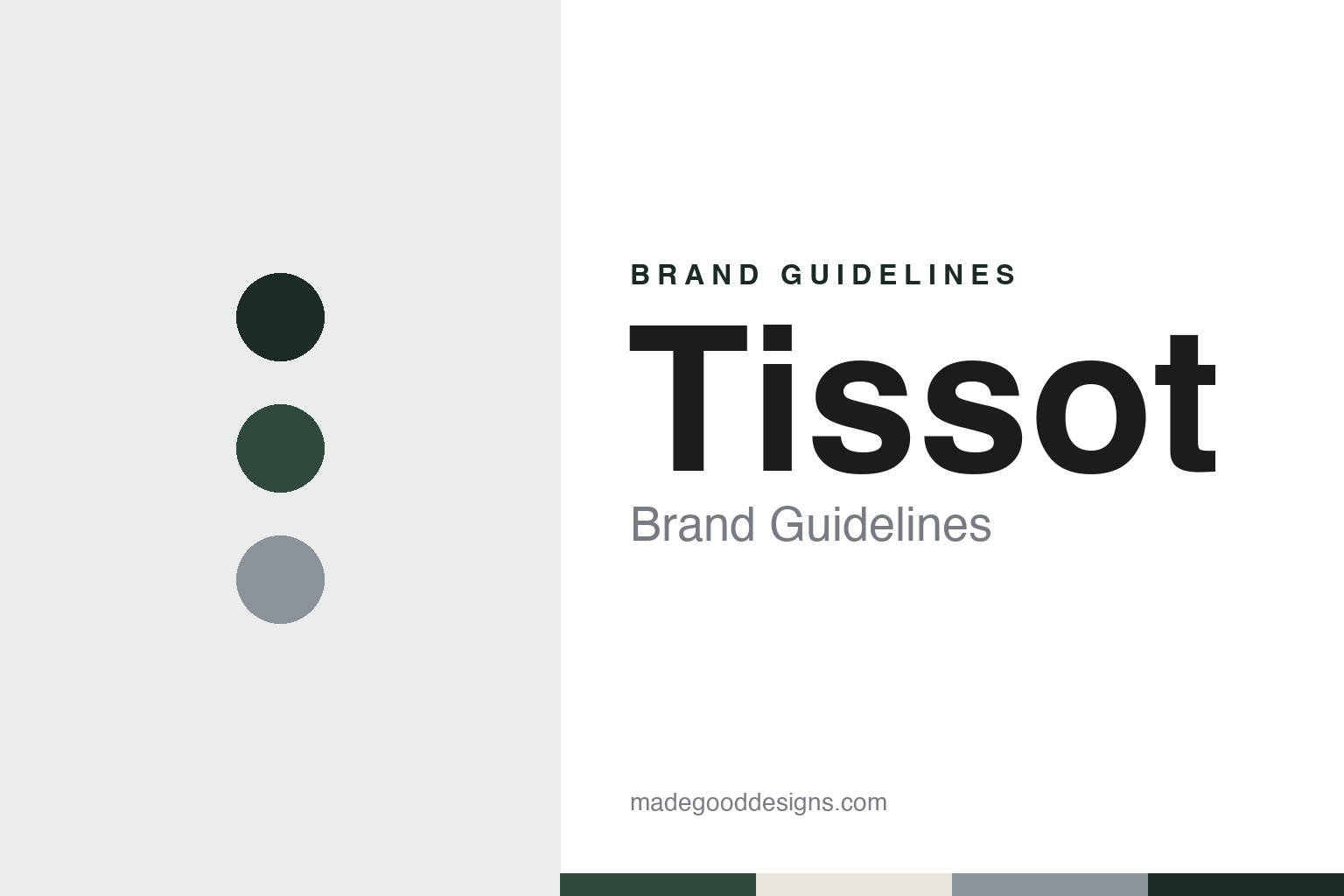
Tissot Brand Guidelines
The Le Locle watch house, from Russian pocket watches to the PRX.
Aa
Two constants: a Tissot Jura green and brushed steel palette and a Quiet serif register. Abstract homage — not a Tissot product or mark; no watch, logo or dial is reproduced.
A Comptoir in Le Locle
A father, a son and a Jura watch town.
Tissot began in Le Locle, in the Swiss canton of Neuchâtel, in 1853. The Historical Dictionary of Switzerland records that Charles-Félicien and Charles-Émile Tissot-Daguette, father and son, opened a watch trading house, a comptoir, in the town that year. French Wikipedia describes the father as a fitter of gold cases and the son as a watchmaker, and gives the firm’s name as Ch. F. Tissot & Fils. It worked by the old Swiss system of établissage: outworkers made parts at home and brought them to the comptoir for assembly and sale. The company’s own account places the start on the lower floors of a family house.
Its first big market lay far from the Jura. English Wikipedia says Charles-Émile left for Russia in 1858 and sold hunter-case pocket watches across the empire, and that his son Charles moved to Moscow in 1885 to run the branch there. French Wikipedia says the First World War and the 1917 revolution then shut down the Russian trade and pushed the firm toward wristwatches for a broader public.
The workshop changed at the same time. French Wikipedia says Charles-Émile took over the house in 1901 and began to mechanise production, and that a modern factory went up in 1907. The Historical Dictionary of Switzerland dates the move from comptoir to full manufacture to 1917. It also names the fourth generation: Paul Tissot, in commercial affairs from 1911, and his sister Marie, in accounts from 1916, who ran the company together from 1939. The firm stayed in the family until 1971.
In 1930 Tissot allied with Omega inside a new holding company, SSIH, the Société suisse pour l’industrie horlogère. Swatch Group’s history calls that union the cornerstone of SSIH. French Wikipedia adds that the two houses had been commercial partners since 1925, and that the holding let them share supply and distribution.
Colour
From the Tissot plan to the touch screen.
One of Tissot’s early branding decisions is well documented. In 1930, the Historical Dictionary of Switzerland says, the company adopted a commercial plan built on a restricted choice of watches and an advertising presence in retailers’ windows. The dictionary calls it the “plan Tissot,” and credits it, with an antimagnetic watch, for rising sales in 1933. French Wikipedia dates that watch to 1930 and calls it the world’s first antimagnetic wristwatch.
Materials became the next signature. The dictionary records a plastic watch, the Astrolon, developed in the early 1970s, and cases of granite or mother-of-pearl launched in 1985. English Wikipedia dates the plastic Idea 2001 to 1971, the granite RockWatch to 1985, the Pearl to 1987 and the Wood to 1988. It credits Tissot with being the first to make watches from each of those materials. The company’s motto is “Innovators by Tradition.”
The T-Touch, a watch controlled through its touch-sensitive sapphire crystal, followed. The dictionary dates its commercial launch to 2000, as does French Wikipedia; English Wikipedia says 1999. The company still lists tactile watches as a category of its own.
The brand’s most visible recent product came from its archive. Watchonista reported that in 1978 Tissot answered the quartz era with a series of slim watches with integrated bracelets and quartz movements. Hypebeast reported in March 2021 that the design was returning as the PRX 40 205, with “P” and “R” for “Precise and Robust” and “X” for ten atmospheres of water resistance; Watchonista says the name itself was registered a few years after 1978. Time+Tide, in May 2021, described the vertically brushed case and bracelet and the polished bezel. Hypebeast also reported that an automatic with Swatch Group’s Powermatic 80 movement was on the way, and Tissot’s website now calls the PRX a collection, a re-edition of a design developed in 1978. On 22 October 2026 Swatch Group announced a PRX Skeleton special edition with the basketball player Damian Lillard.
Typography
Design and documentation.
Watch makers sell objects small enough to hide in a closed hand, so their pictures work at a different scale from the product. The usual image is a macro shot: a dial filling the frame, with the printing, the applied markers and the texture of the surface all larger than life. Brushed and polished steel is lit so that the two finishes separate, and a crystal is angled so that the eye sees through it rather than a reflection on it.
A second set of pictures moves to the bench. A watchmaker’s loupe, a pair of tweezers and an open movement on a work mat are the trade’s shorthand for skill, and they appear in catalogues whether a brand makes many of its own parts or few. Those images show a craft; they do not by themselves show where a particular watch was made, which is why this guide keeps what a company says apart from what independent sources record.
Close-ups do the rest of the work. A chronograph’s pushers suggest timing and motorsport, a screw-down crown suggests water, and enamel and sapphire suggest depth and permanence.
The public stage has long been the fair. Geneva hosts the trade’s big gatherings, where stands are built like small buildings and new models sit behind glass under careful light. Around that stage sit the other habits of the category: archive reissues, anniversary editions, and timekeeping partnerships in sport. Each one gives a brand a story to tell about time, and each one depends on a record that can be checked.
Aa
A quiet serif for a nineteenth-century house. (Specimen set in Source Serif 4, a serif STAND-IN; NOT the Tissot logo.)
Tissot
Group company, Le Locle address.
Tissot’s ownership follows the wider story of the Swiss industry. In 1983 SSIH merged with Asuag to form SMH, the Historical Dictionary of Switzerland says, and SMH took the name Swatch Group in 1998. Asuag’s brands, Swatch Group’s history says, included Longines, Rado, Certina and Mido, and the group’s website lists Tissot among its watch brands today.
Tissot Ltd remains at Le Locle, and Swatch Group says Tissot crafts its watches in the town. The dictionary’s dated figures are more specific: in 2010 the company employed 1,000 people, 300 of them in Le Locle, and made about three million watches a year. French Wikipedia reports an estimate of 3.1 million watches for 2023, from a Morgan Stanley and LuxeConsult study. French Wikipedia also says Tissot stopped making ébauches, the raw movements, between 1975 and 1980. Time+Tide identified the 2021 PRX quartz movement as an ETA calibre. The group describes Tissot’s prices as accessible, and English Wikipedia says the group classes the brand as mid-range.
The town itself has become part of the identity. Tissot says its Le Locle collection, unveiled for the brand’s 150th anniversary in 2003, took its Roman numerals and Clous de Paris dial from the clock of the town’s church, and that the name on the dial is written in italic cursive. Another current range, Chemin des Tourelles, appears among the collections Swatch Group names.
Sport is the public face of the brand. Swatch Group names Tissot as Official Timekeeper of the NBA, MotoGP and the Tour de France. English Wikipedia dates the first of its timekeeping work to ski races at Villars-sur-Ollon in 1938, and the NBA partnership to the 2015–16 season; French Wikipedia says Tissot timed the Tour de France from 1988 to 1992 and returned in 2016. Its ambassadors, Swatch Group says, include Lillard, the rider Enea Bastianini, the cyclist Primož Roglič and the actor Simon Gong.
The name needs one caution: English Wikipedia notes that Tissot is not associated with Mathey-Tissot, a separate Swiss watch firm.
For a design guide, Tissot shows how a house can make its address, its archive and its timekeeping work carry the brand. Compare Omega, its partner in SSIH, and Swatch, another brand of the same group. For this guide we use a Jura green and a brushed steel with a serif, an unofficial interpretation; no product or logo is reproduced.
Explore & save
Keep Tissot’s identity on hand — save it to a board in the Made Good inspiration library.
Tissot identity set
Pin the Tissot Jura green and brushed steel palette and the Quiet serif register to your own board.