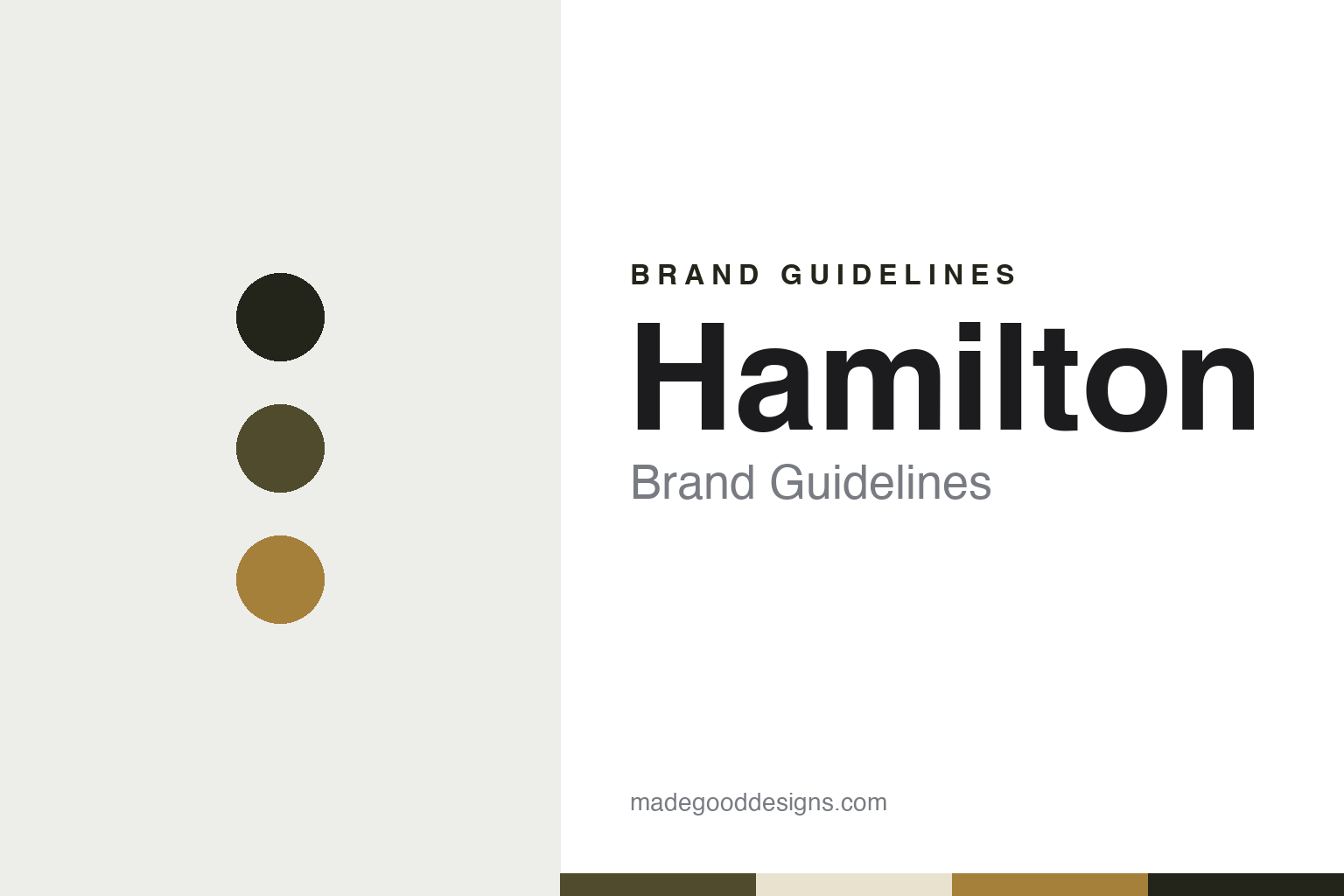
Hamilton Brand Guidelines
The Lancaster railroad watch maker that became a Swiss brand.
Aa
Two constants: a Hamilton field khaki and old brass palette and a Field sans register. Abstract homage — not a Hamilton product or mark; no watch, logo or dial is reproduced.
The Watch of Railroad Accuracy
A bankrupt factory, a new name and the railroads.
Hamilton grew out of a run of failed watch companies in Lancaster, Pennsylvania. English Wikipedia’s history of the site says the Adams & Perry Watch Manufacturing Company started the first building in 1874 and went bankrupt in 1876, and that the Keystone Standard Watch Company, begun there in 1886, went the same way. A group of Lancaster investors bought its assets at auction in 1892, along with those of a bankrupt watch company in Aurora, Illinois, and founded the Hamilton Watch Company on 14 December 1892.
No single founder carries the story. English Wikipedia says the name was first meant to be “Columbian,” until stockholders learned that the Waterbury Watch Company held that trademark, and that “Hamilton” honours Andrew Hamilton, the colonial lawyer who was the original owner of the factory site.
The first watch under the name, English Wikipedia says, was an 18-size, 17-jewel pocket watch of 1893. The railroads made the company’s reputation. Hamilton says its pocket watches earned the title “The Watch of Railroad Accuracy,” and that by 1920 its 992 model was the timekeeper chosen by the US government for American-built railroads in France. German Wikipedia says 55 percent of American railroad staff used Hamilton watches by 1900.
The factory grew with the trade. The site’s twin clock towers date from 1874 and 1916, and the complex kept expanding until 1963. Wrist-worn models followed: English Wikipedia and the company both date the turn to wristwatches to the First World War, and Hamilton bought its Illinois rival, the Illinois Watch Company, in 1927 according to German Wikipedia or 1928 according to English Wikipedia.
Colour
Chronometers, the Electric and the Pulsar.
The Second World War reshaped production. Hamilton says it stopped making consumer watches in 1942 to supply the US armed forces, and produced more than one million timepieces between 1942 and 1945, earning Army-Navy “E” awards. English Wikipedia says the US Naval Observatory had asked American makers in 1939 to mass-produce marine chronometers, that Hamilton was given two Ulysse Nardin chronometers to study, and that the Navy accepted its product in 1942. The resulting Model 21 was made in thousands. Hamilton also says it supplied almost 40,000 wristwatches to the British military between 1965 and 1976.
In 1951, English Wikipedia says, Hamilton fought off a takeover bid by the watch company Benrus, and the resulting federal case became a landmark in American antitrust law.
The 1950s brought the design the company is known for. Wired recorded in 2008 that the Hamilton Electric 500 was announced at a press conference in January 1957, as the first battery-operated electric wristwatch, after development that began in 1946. Wired also said the watch was rushed out to beat competitors and proved less reliable than a wound watch. Its cases included the asymmetrical Ventura, by the American industrial designer Richard Arbib. Hamilton says he was told to design whatever he wanted without regard for practicality, and that it was his first sketch. Elvis Presley wore one in Blue Hawaii in 1961. German Wikipedia links the movement’s development to work with Helmut Epperlein’s Ersingen company, and says the Electric was built until 1965; Wired gives 1969.
Then came the digital watch. Hamilton announced the Pulsar in 1970, according to English Wikipedia, which credits both a team led by John Bergey and the engineer Peter Petroff, and says it was developed with Electro/Data. Guinness World Records names the Pulsar P-1 as the first electronic digital watch and dates its release to 4 April 1972; German Wikipedia puts first deliveries in February 1971. Its red display lit only when a button was pressed, and it appeared in the 1973 James Bond film Live and Let Die. English Wikipedia says Seiko acquired the Pulsar brand in 1978.
Typography
Design and documentation.
Watch makers sell objects small enough to hide in a closed hand, so their pictures work at a different scale from the product. The usual image is a macro shot: a dial filling the frame, with the printing, the applied markers and the texture of the surface all larger than life. Brushed and polished steel is lit so that the two finishes separate, and a crystal is angled so that the eye sees through it rather than a reflection on it.
A second set of pictures moves to the bench. A watchmaker’s loupe, a pair of tweezers and an open movement on a work mat are the trade’s shorthand for skill, and they appear in catalogues whether a brand makes many of its own parts or few. Those images show a craft; they do not by themselves show where a particular watch was made, which is why this guide keeps what a company says apart from what independent sources record.
Close-ups do the rest of the work. A chronograph’s pushers suggest timing and motorsport, a screw-down crown suggests water, and enamel and sapphire suggest depth and permanence.
The public stage has long been the fair. Geneva hosts the trade’s big gatherings, where stands are built like small buildings and new models sit behind glass under careful light. Around that stage sit the other habits of the category: archive reissues, anniversary editions, and timekeeping partnerships in sport. Each one gives a brand a story to tell about time, and each one depends on a record that can be checked.
Aa
A plain sans for a field watch. (Specimen set in Archivo, a sans STAND-IN; NOT the Hamilton logo.)
Hamilton
An American name, made in Switzerland.
Hamilton’s American manufacturing did not outlast the 1960s. In 1966, English Wikipedia says, it bought the Buren Watch Company of Büren an der Aare, and with it the micro-rotor automatic movement. Hamilton says it played a pivotal role in the Caliber 11, an automatic chronograph movement, and German Wikipedia names Breitling, Heuer-Leonidas and Dubois-Depraz as partners in that work. In 1969, it says, the Lancaster factory closed and manufacturing moved to Buren; Buren returned to Swiss ownership in 1971 and the factory was liquidated by 1972.
The brand then passed to a Swiss group. English Wikipedia gives two dates for the purchase by SSIH, the holding company of Omega and Tissot: 1971 and, more specifically, 16 May 1974. It says the American parent took the name HMW when it sold the watch division, and its history of the site says the Lancaster company was renamed Hamilton Technology in 1980 and left the complex. Swatch Group’s own history says Hamilton later joined SSIH, which became part of the group formed by the merger with Asuag.
The buildings remain. The complex was listed on the National Register of Historic Places in 1982 and converted to apartments, English Wikipedia says, and the Japanese web magazine Openers reported in 2015 that the clock tower still stood, with the “H” of Hamilton on the gatepost.
Today the company is Hamilton International Ltd, in Biel/Bienne. Swatch Group describes the brand as “born in Lancaster, Pennsylvania in 1892 and crafted in Switzerland today.” Its website organises the range into lines such as Khaki Field, Khaki Aviation, Ventura and American Classic, and in April 2026 Swatch Group announced a Khaki Field Mechanical 36mm based on a rare vintage military reference.
Film is central to how the brand presents itself. Hamilton calls itself the “Movie Brand” and says its watches have appeared in more than 500 films and television shows since Shanghai Express in 1932. It says the Ventura has featured in every Men in Black film since 1997, and that the “Murph” watch was designed for Christopher Nolan’s Interstellar in 2014 and later sold as the Khaki Field Murph. Its Behind the Camera Awards, begun in 2006, honour film crews.
For a design guide, Hamilton shows how a brand can keep an American story after its manufacturing has moved abroad. Compare Timex, another American watch name, and Tissot, its sister brand. For this guide we use a field khaki and an old brass with a sans, an unofficial interpretation; no product or logo is reproduced.
Explore & save
Keep Hamilton’s identity on hand — save it to a board in the Made Good inspiration library.
Hamilton identity set
Pin the Hamilton field khaki and old brass palette and the Field sans register to your own board.