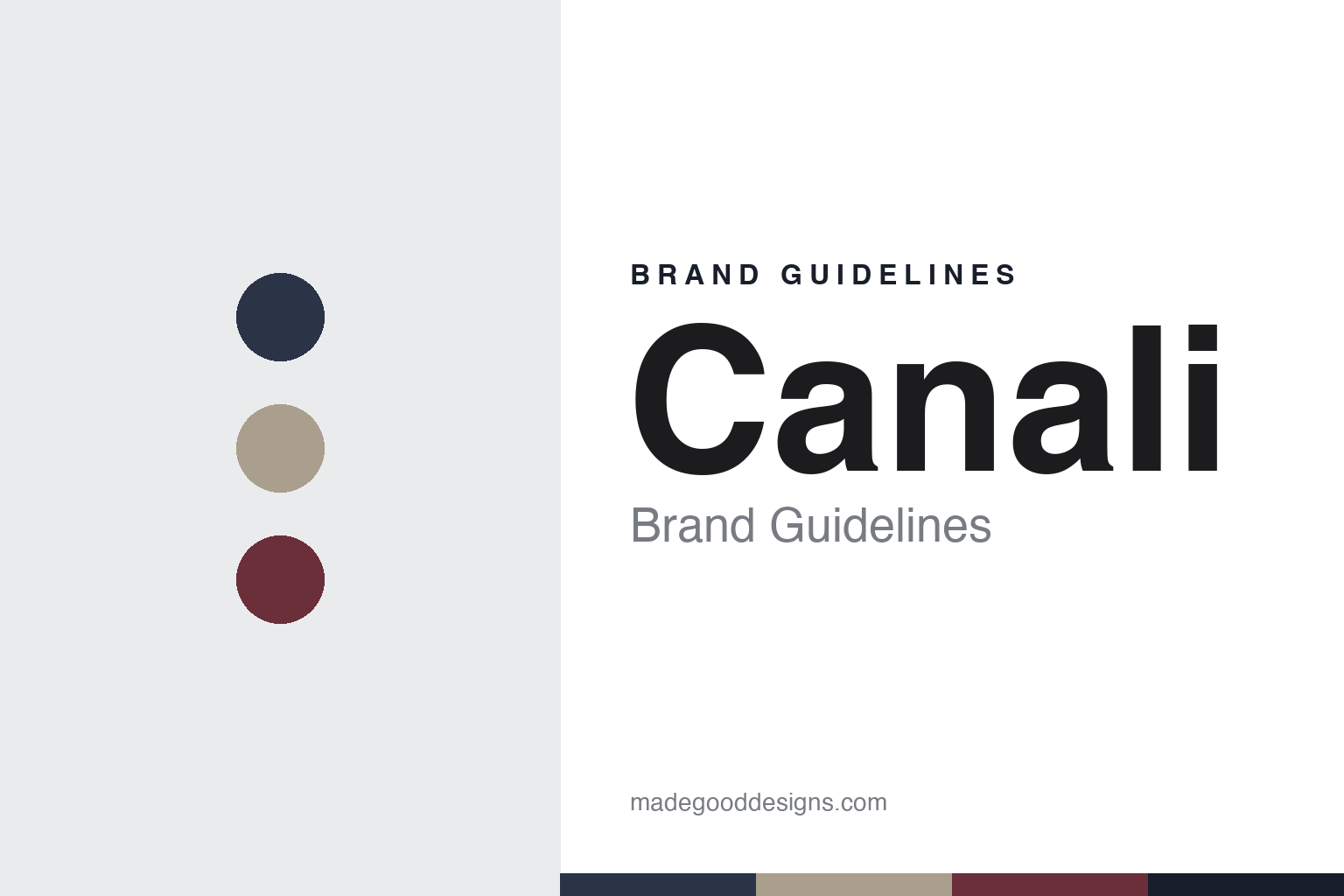
Canali Brand Guidelines
The Brianza family tailor that sold raincoats under a cat before it put its own name on suits.
Aa
Two constants: a Canali navy, stone and bordeaux palette and a Sartorial serif register. Abstract homage — not a Canali product or mark; no garment, logo or label is reproduced.
Cafra
Two brothers in Brianza, then a raincoat and a cat.
Canali dates itself to 1934 and to Triuggio, a town in Brianza, the Lombard district north of Milan. Il Sole 24 Ore reported in June 2025 that the company was founded by Giacomo and Giovanni Canali and is still controlled by the same family, and V Magazine placed its roots in Triuggio in 2020.
The company’s own history starts earlier. Its Canali Anthology site, published around the 85th anniversary, says Giacomo opened a tailor’s shop in Triuggio in 1908, and that the company proper began in 1934 when his brother Giovanni joined, bringing experience from the textile firm Galeazzo Viganò. English Wikipedia describes Giovanni as a fabric magnate and Giacomo as a tailor.
The workshop grew to about 100 employees between 1934 and 1939, the company says. Its history then says the war limited the firm’s activities, and elsewhere describes a production halt at many Italian companies.
The second generation took over the rebuilding. Giuseppe, Genesio and Eugenio, Giovanni’s sons, divided commercial, production and administrative work between them, the company says, and in 1953 they restructured the business as Fratelli Canali S.p.A. and launched a new brand, Cafra, a name made from CAnali and FRAtelli, the Italian for brothers.
Cafra is where the company’s history turns to visual identity. The firm had turned to raincoats, and the Anthology says it began advertising them in specialist magazines, which prompted it to think about the look of its main product. Its first emblem was a swan, chosen as a creature that stays dry even in water. In the mid-1950s the company was given a sketch of a cat in a trench coat and bowler hat, carrying an umbrella. The cat, the company explains, is the one pet nobody sees wet, and the drawing became a decorative element on its raincoats.
Colour
From raincoats to the suit.
The raincoat was the first of what the company calls its three icons. It gives its specialist raincoat years as 1958 to 1968, working in silk, wool and cotton alongside newer materials such as Lilion and Rilsan. Between 1969 and 1971, it says, it made a major strategic change and specialised in men’s clothing, and the suit has been its flagship product since the 1970s.
Canali says that in 1974 it was the first company in Italy to buy and install an automatic cutting system, controlled by an electronic computer, which cut several garments at once; English Wikipedia also records it as the first Italian tailor to introduce mechanised cutting machines in the 1970s. The company presents this as a way of adding precision to traditional tailoring rather than replacing it, and today it says a Canali suit takes about 200 steps to produce.
The Canali name itself came relatively late. In the early 1980s, as the third generation joined, the company began to use the Canali brand and ran its first communication campaign, its history says. That period also brought a collaboration with the Pitti Uomo trade fair and showrooms in Paris, New York and London. The company dates its move into Spain and Mexico to 1987 and into Russia, China, India and Oceania to the early 1990s, with a Toronto showroom opening its way further into North America.
Headquarters moved from Triuggio to Sovico in 1994. Retail came after that: the company says its Via Verri flagship in Milan opened in 1999 and marked the beginning of its retail experience. It lists a Pitti Immagine Uomo prize in 2003.
The third icon is the KEI jacket of 2007. The company says the name comes from the initial of the English word knit, because the aim was a jacket as comfortable as a knit, although KEI remains a full-canvas construction. It has since extended that construction to suits, coats and trousers. Its collections have also been divided into named segments, including Exclusive, from the late 1990s, and Black Edition, added in 2019.
Canali has used film and the web to tell this story. 200 Steps was a video series of interviews with people from other crafts, inspired by the number of stages in a suit, and its subjects included the calligrapher Job Wouters and the industrial designers Barber & Osgerby. Canali Anthology, a digital archive of interviews and archive material, was previewed during Milan Fashion Week in 2020, V Magazine reported. In 2010, English Wikipedia says, the New York Yankees pitcher Mariano Rivera fronted an advertising campaign, the first time the brand used an athlete.
Typography
Design and documentation.
Tailoring houses have an unusual advantage in presenting themselves: the work itself is graphic. A bespoke order follows a set sequence. The customer and tailor choose fabrics, linings and details, the tailor takes measurements and drafts a pattern from scratch, and the cloth is chalked out and cut with shears before being basted for a fitting. Chalk marks on cloth, paper patterns on hooks and a cutter working at the board are the working tools of that sequence, and they also make natural pictures for a house’s windows, pages and packaging.
The street matters too. Savile Row in Mayfair, London, is known principally for bespoke men’s tailoring, and tailors have traded there since at least 1803. Its windows can be a statement in themselves: when Nutters of Savile Row opened in 1969, it used bold displays created by the then unknown Simon Doonan. In Italy the home town often takes the street’s place, and a house can put a place name at the front of its story, as Zegna does with its mill in the Biellese Alps.
Cloth carries the identity as well. Fabrics and linings are chosen at the start of an order, which puts the fabric book in the customer’s hands early. Mills keep their own record of that work: the Zegna archive at Trivero holds sample books alongside technical drawings.
The words matter as much as the images. A bespoke garment starts from a new pattern, made to measure adjusts an existing one, and ready-to-wear comes in standard sizes. In June 2008 Britain’s Advertising Standards Authority ruled that an advertisement calling a suit cut and sewn by machine “bespoke” did not breach its code, and the term has stayed contested since.
Aa
A sartorial serif — a family name on a label. (Specimen set in Cormorant Garamond, a serif STAND-IN; NOT the Canali logo.)
Canali
Still a family company, still in Brianza.
Canali remains in family hands. Its website describes a family-run company now in its third generation, with Stefano Canali as president and chief executive, and Il Sole 24 Ore said the same family was still in control in 2025. Its legal notice names Canali S.p.A. of Sovico, under the direction and coordination of Canali Holding S.p.A. The company moved to offices in Milan’s Porta Nuova in 2014, its timeline says, and opened an automated logistics centre in Sovico in 2016.
On production, the company says it has five production centres in Italy and more than 1,400 employees worldwide; English Wikipedia still gives seven factories. In December 2025 Stefano Canali told Capital that the company had never moved production abroad and that keeping it in Italy was costly but consistent with its idea of excellence. Not every Italian plant has lasted. In October 2017 Canali announced the closure of its factory at Carate Brianza, with the loss of 134 jobs, according to the European Restructuring Monitor, which reports that the company cited a persistent fall in sales, that workers went on strike and that unions disputed the decision.
Its reach today is wide. The website lists more than 190 boutiques and more than 1,000 retail stores in over 100 countries; its London flagship is on New Bond Street, TheIndustry.fashion reported. Stefano Canali told Il Sole 24 Ore in 2025 of a restyled Beverly Hills flagship and a new Hong Kong shop with the first Locanda Canali next door, following a Canali Café in China.
The creative side changed in 2026. In May the company named Alessio Lillocci as creative director, TheIndustry.fashion and FashionUnited reported, after almost 21 years at Brunello Cucinelli and almost a year at Prada. His job is to oversee the brand’s identity and to reinterpret its aesthetic codes, and English Wikipedia says his first collection will be for spring 2027. The Fall Winter 2026 campaign features the actor Ethan Hawke, and the company groups its sustainability work under a project called CAre.
For a design guide, Canali shows how a family company can change its product and its name while the family and the district stay the same. Compare Brioni and Brunello Cucinelli, where Lillocci spent most of his career. For this guide we use a navy, a stone and a bordeaux with a serif, an unofficial interpretation; no product or logo is reproduced.
Explore & save
Keep Canali’s identity on hand — save it to a board in the Made Good inspiration library.
Canali identity set
Pin the Canali navy, stone and bordeaux palette and the Sartorial serif register to your own board.