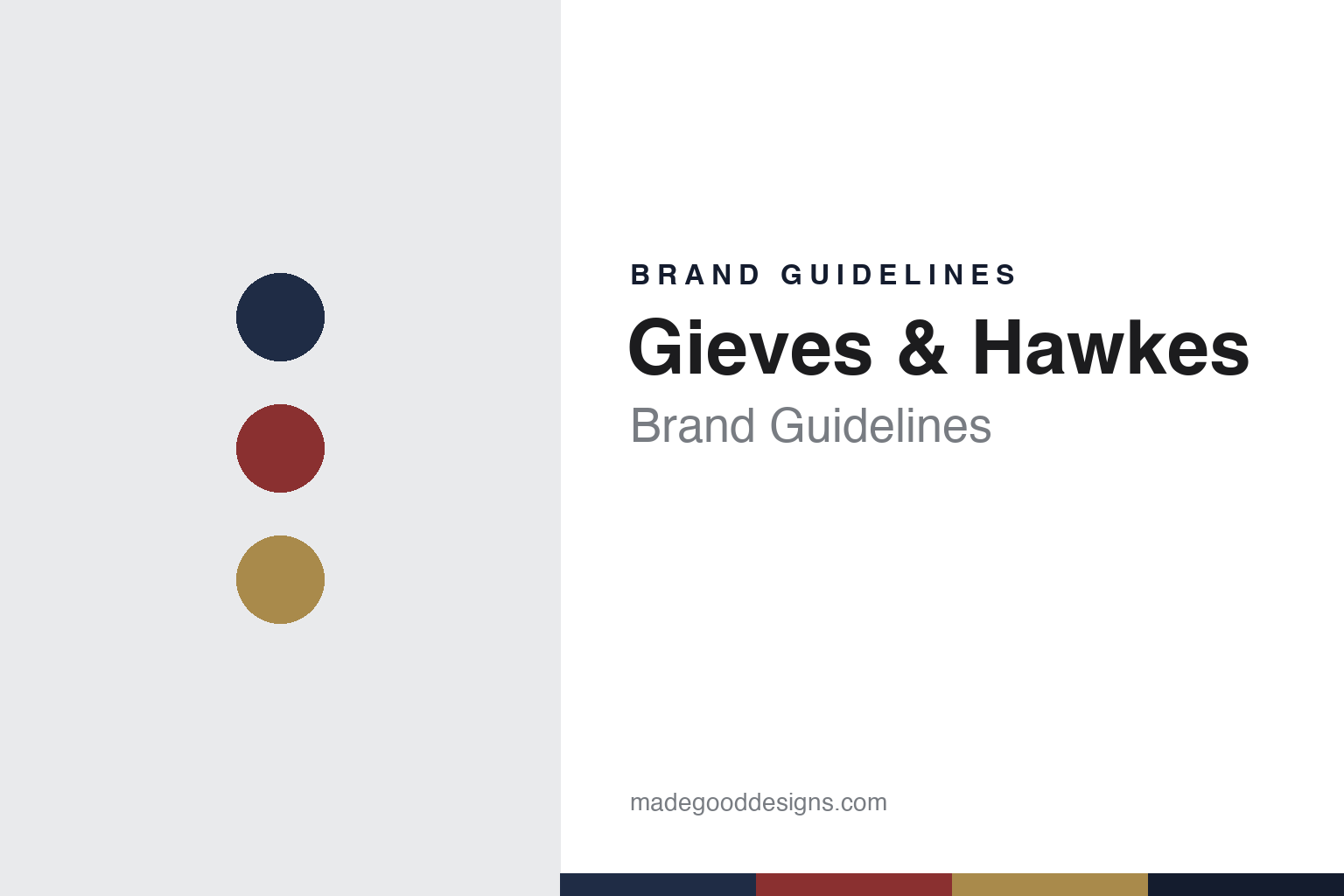
Gieves & Hawkes Brand Guidelines
Two military tailors, one naval and one army, joined at No. 1 Savile Row.
Aa
Two constants: a Gieves & Hawkes navy, scarlet and braid palette and a Georgian serif register. Abstract homage — not a Gieves & Hawkes product or mark; no garment, crest, logo or warrant is reproduced.
Two Dates
An army hatter in London and a naval tailor in Portsmouth.
Gieves & Hawkes is two old firms under one name, and the join shows. In December 2014 the art historian Charles Saumarez Smith noted on his website that the building displayed two dates on its façade, 1771 and 1785. The first belongs to Hawkes and the second to Gieves, and the company still gives both: it says it was formed from two military tailors, Gieves, founded in 1785, and Hawkes, founded in 1771, the first known for supplying the Royal Navy and the second the British Army.
The Hawkes side began with hats. Thomas Hawkes came to London in 1760, English Wikipedia says, and worked for Mr Moy, a velvet cap-maker. In 1771 he set up in Brewer Street, selling to the military, and by 1793 he was at 17 Piccadilly and was being described as “Helmet, Hat and Capmaker to the King,” Saumarez Smith writes. English Wikipedia records that the firm later developed a form of pith helmet known as the Wolseley pattern, and Saumarez Smith credits it with the shako and the solar topee.
The Gieves side began in Portsmouth, and it did not begin with anyone called Gieve. Melchisedek Meredith set up as a naval tailor in 1785 at 73 High Street, according to a history published by the antiques dealer Christopher Clarke, which says Rodney, Howe, Collingwood and Nelson were among his clients. Saumarez Smith argued in 2014 that the correct date is 1784.
James Watson Gieve joined the business in 1835, working under Augustus Meredith, Melchisedek’s son. English Wikipedia says he became a partner of Joseph Galt in 1852, in a firm that had taken in Meredith’s, and that in 1887 he bought the remaining shares and formed Gieves & Co.
Both firms grew with the services they dressed. The company says that by the late 19th century Gieves was outfitting some 98% of naval cadets at Dartmouth, and that its work for the Royal Navy extended to a telegraph system, a dress indicator and a waistcoat with an inflatable belt. It says the outbreak of war in 1914, and again in 1939, greatly increased demand for uniforms at both houses, and that several Gieves branches were damaged in the Blitz and reopened soon afterwards.
Colour
A town house, a map room and a warrant.
The address came from Hawkes. English Wikipedia says the firm bought No. 1 Savile Row from the Royal Geographical Society on 23 December 1912; the company gives the year as 1913. English Wikipedia dates the house to 1732; the company says it was designed by William Kent as a town house and passed to the Dukes of Devonshire in 1756. The Society arrived in 1870, by the company’s date, or 1871 in Wikipedia’s timeline, and the company says its Map Room survives inside. TheIndustry.fashion describes the building as Grade II-listed.
Tailoring changed there too. The company says Hawkes & Co were the first tailors on Savile Row to introduce ready-to-wear, in the 1920s, and that by 1939 this was being advertised as “Immediate Wear,” after a comprehensive mail-order catalogue produced by Gieves in 1910. English Wikipedia adds that Hawkes was appointed to dress the Honourable Corps of Gentlemen at Arms, the monarch’s bodyguard.
The houses came together in 1974, when Gieves Ltd acquired Hawkes & Co, with the freehold of No. 1 Savile Row, English Wikipedia says, and took the name Gieves & Hawkes. The company dates the move into the building to 1975, and says the combined firm kept up bespoke tailoring there alongside its made-to-measure, ready-to-wear and military work. In the 1980s, English Wikipedia says, it licensed the Rochester, New York, manufacturer Hickey Freeman to make a licensed version of its clothes for North America.
Royal service is the house’s main credential, and the sources give different dates for how it began. The company says it has held warrants since George III in 1789; English Wikipedia says Thomas Hawkes received his first warrant in 1809. TheIndustry.fashion reported in 2022 that it holds a Royal Warrant for The King. The company says it made Queen Elizabeth II’s boat cloak in 1953, photographed by Cecil Beaton, and lists tailoring for royal houses from Denmark to Tonga.
The house has also marked a change on the cutting-room floor. In 2009, English Wikipedia says, Kathryn Sargent of Gieves & Hawkes became the first woman to be a head cutter on Savile Row. And it has dressed teams as well as officers: the same source records official attire for the Formula One team Brawn GP in 2009 and a capsule collection with Mercedes GP in 2010. The firm marked its 250th anniversary in 2021.
Typography
Design and documentation.
Tailoring houses have an unusual advantage in presenting themselves: the work itself is graphic. A bespoke order follows a set sequence. The customer and tailor choose fabrics, linings and details, the tailor takes measurements and drafts a pattern from scratch, and the cloth is chalked out and cut with shears before being basted for a fitting. Chalk marks on cloth, paper patterns on hooks and a cutter working at the board are the working tools of that sequence, and they also make natural pictures for a house’s windows, pages and packaging.
The street matters too. Savile Row in Mayfair, London, is known principally for bespoke men’s tailoring, and tailors have traded there since at least 1803. Its windows can be a statement in themselves: when Nutters of Savile Row opened in 1969, it used bold displays created by the then unknown Simon Doonan. In Italy the home town often takes the street’s place, and a house can put a place name at the front of its story, as Zegna does with its mill in the Biellese Alps.
Cloth carries the identity as well. Fabrics and linings are chosen at the start of an order, which puts the fabric book in the customer’s hands early. Mills keep their own record of that work: the Zegna archive at Trivero holds sample books alongside technical drawings.
The words matter as much as the images. A bespoke garment starts from a new pattern, made to measure adjusts an existing one, and ready-to-wear comes in standard sizes. In June 2008 Britain’s Advertising Standards Authority ruled that an advertisement calling a suit cut and sewn by machine “bespoke” did not breach its code, and the term has stayed contested since.
Aa
A Georgian serif — the voice of a town house. (Specimen set in Libre Caslon Text, a serif STAND-IN; NOT the Gieves & Hawkes logo.)
Gieves & Hawkes
From Hong Kong to Frasers Group.
Ownership moved to Hong Kong in 2002. English Wikipedia says the company, by then a plc, accepted an offer from Hong Kong’s USI Holdings that year; TheIndustry.fashion describes the pre-2012 owner as a subsidiary of Hong Kong-based Wing Tai Properties. In May 2012 it was acquired by the Hong Kong group Trinity, owner of Kent & Curwen and Cerruti, and in 2017 Trinity was bought by China’s Shandong Ruyi, TheIndustry.fashion reported.
Trouble followed at the parent. In October 2021 Retail Gazette reported that Gieves & Hawkes was at risk of closing because of the debt crisis at Trinity and Shandong Ruyi, and that Trinity faced being wound up. In January 2022 FashionUnited, citing The Times, reported that Trinity had been placed into liquidation after failing to find a buyer, with FTI Consulting and R&H Services as joint liquidators. TheIndustry.fashion gives the same outcome.
The buyer was Frasers Group, the owner of Sports Direct, House of Fraser and Flannels, which confirmed the purchase in November 2022. The deal covered the brand and five UK stores including the Savile Row flagship, TheIndustry.fashion reported, and chief executive Michael Murray said it secured a long-term future for the brand. The company’s website now says it is “back in British hands.”
That website lists No. 1 Savile Row, Bath, Birmingham, Chester and Winchester, along with a listing at Flannels in Leeds. The flagship reopened in September 2026 after what the company called an extensive refurbishment, TheIndustry.fashion reported. The 7,000 sq ft store covers bespoke, made-to-measure, ready-to-wear and military, and its joinery, furniture and display pieces use rope motifs that recall naval uniforms. Managing director Jason Gerrard said the Robert Gieves Room on the first floor now holds a display of imagery and ephemera developed with Adam Ellis Studio, tracing the business from 1771 to the present.
The website keeps the service language too: its pages sit under the headings “Outfitters to the Services” and “By Appointment,” and its military department lists lacing and medals.
For a design guide, Gieves & Hawkes shows how a merged house can keep both of its founding stories in public view. Compare Henry Poole & Co and Huntsman, two other Savile Row houses. For this guide we use a navy, a scarlet and a braid gold with a serif, an unofficial interpretation; no product or logo is reproduced.
Explore & save
Keep Gieves & Hawkes’s identity on hand — save it to a board in the Made Good inspiration library.
Gieves & Hawkes identity set
Pin the Gieves & Hawkes navy, scarlet and braid palette and the Georgian serif register to your own board.