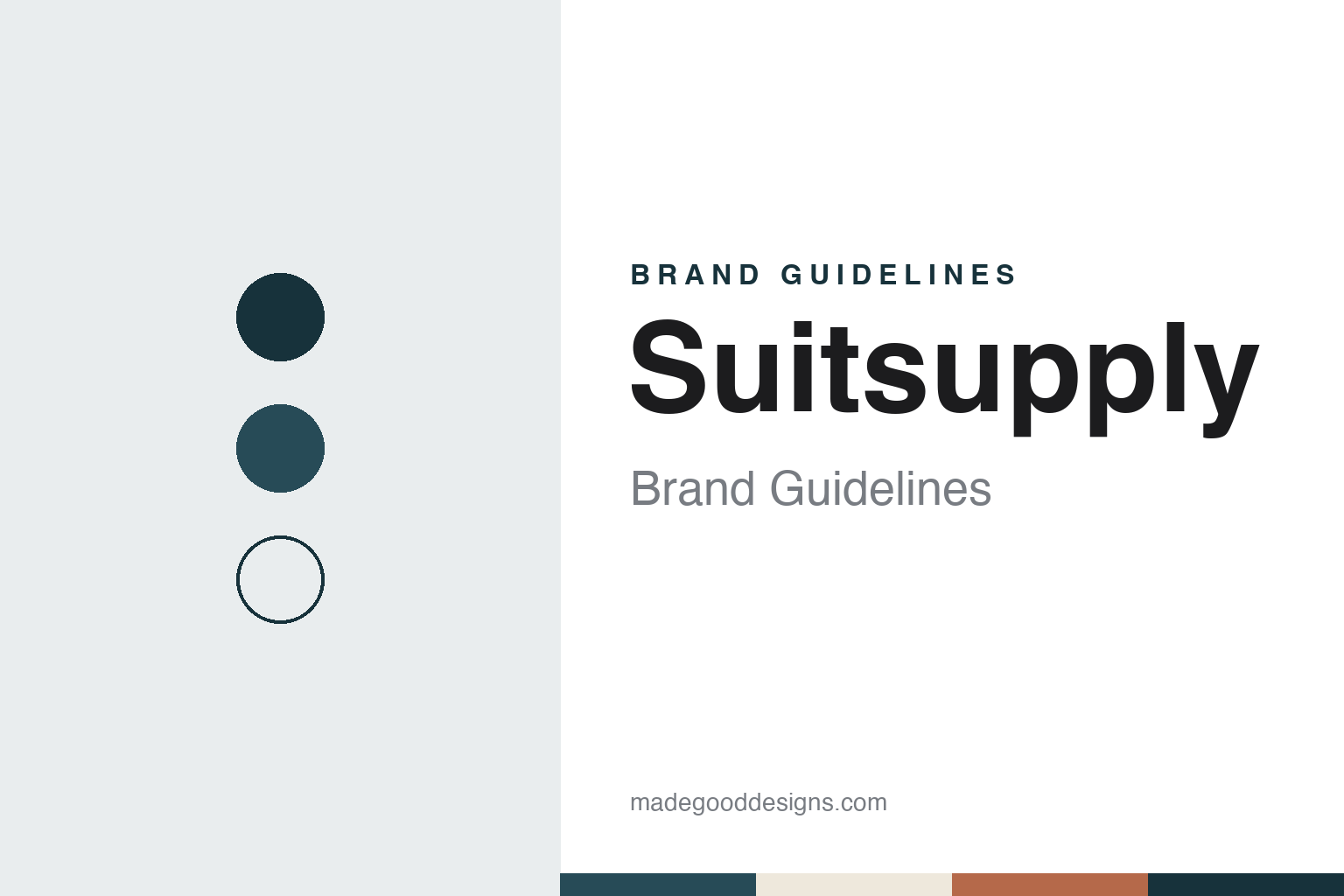
Suitsupply Brand Guidelines
The Dutch suit company that cut out the middleman and put tailors in its stores.
Aa
Two constants: a Suitsupply teal and linen palette and a Geometric sans register. Abstract homage — not a Suitsupply product or mark; no garment, logo or label is reproduced.
The Student Trade
Trunk shows, then a business without a middleman.
Suitsupply began as a student’s side trade. A profile by Judith Beermann in The Georgetown Dish, a Washington news site, said in August 2012 that the company started in Amsterdam about a decade earlier, when the law student Fokke de Jong needed extra money and sold suits at trunk shows to fellow students and nearby office workers. Gentleman’s Gazette, reviewing the brand in December 2020, gives the year as 2000 and says he started it as a college student.
The idea behind it, by the 2012 account, came from seeing how many steps high-end suits passed through before reaching a customer. De Jong set out to remove them. Nish de Gruiter, quoted in the same piece, called Suitsupply “a vertically integrated company” that handled its own design and buying and ran its own operations.
Shops followed later. Gentleman’s Gazette dates the first brick-and-mortar store to 2007. By the time it reached the United States, with a store in New York’s SoHo in 2011, the company had opened 35 stores in Europe, The Georgetown Dish reported, and a Washington store followed in August 2012. FashionUnited counted nearly 100 stores in 22 countries in 2018. The company’s website now invites customers to “one of our 150 stores worldwide.” De Jong was still chief executive in 2020, Gentleman’s Gazette said, and it described the company as privately held; the name that appears in Fair Wear’s 2026 report is Suit Supply B.V.
In 2017 FashionUnited reported a separate women’s label, Suistudio, with stores in Shanghai, New York and Amsterdam and its own web store. De Jong said the project took two years and described it as an independent company with its own designers.
Colour
Italian cloth, tailors on the shop floor.
On its website the company describes itself as “straight to the point and still personal,” and it sells the visit as a service: fittings, pinning and style advice, with coffee and beer on offer, and in some shops lounge, terrace or rooftop areas. Alterations are the headline. In-store tailors work to a promised 30 minutes to three days, and the company calls them the “fastest tailors in the world.”
The range beyond the ready-made rack is Custom Made, which the company says offers over 1,000 fabrics, delivered in three to four weeks, in store or online. A stored set of measurements, the Size Passport, lets a customer reorder with a click.
The company’s page promises “Italy’s finest fabrics.” Gentleman’s Gazette saw showroom fabrics in 2020 from names including VBC, E. Thomas, Ceruti and Colombo, without identifying which mills supplied which garments. The 2012 account said raw materials were sourced in Europe and manufacturing was mainly in the Far East.
Fair Wear Foundation’s published report is the fullest record of where the clothes are made. Suit Supply has been a member since January 2007. The report published in May 2026, covering 2025, lists 18 production locations in China with 71 percent of volume, 12 in Italy with 11 percent, and smaller shares in Portugal, Mauritius and Indonesia at 4 percent each, followed by Myanmar, India, Cambodia, Morocco and North Macedonia. Gentleman’s Gazette saw “Made in China” and “Made in Myanmar” labels in 2020.
The same report places the company in Fair Wear’s top Leader category, a rating the company cites on its website. It also records problems. Fair Wear says the company explored disengaging from Myanmar after the military coup, then stayed against Fair Wear’s strong recommendation to leave, citing a long relationship with the factory, its workers’ skill and its investments there; it reports quarterly to Fair Wear. It says the wage target it requires for members staying in Myanmar was not reached, and that no progress was made on living wages in 2025, and it recommends a long-term plan for financing wage increases.
Typography
Cloth, chalk and the shop window.
Tailoring houses have an unusual advantage in presenting themselves: the work itself is graphic. A bespoke order follows a set sequence. The customer and tailor choose fabrics, linings and details, the tailor takes measurements and drafts a pattern from scratch, and the cloth is chalked out and cut with shears before being basted for a fitting. Chalk marks on cloth, paper patterns on hooks and a cutter working at the board are the working tools of that sequence, and they also make natural pictures for a house’s windows, pages and packaging.
The street matters too. Savile Row in Mayfair, London, is known principally for bespoke men’s tailoring, and tailors have traded there since at least 1803. Its windows can be a statement in themselves: when Nutters of Savile Row opened in 1969, it used bold displays created by the then unknown Simon Doonan. In Italy the home town often takes the street’s place, and a house can put a place name at the front of its story, as Zegna does with its mill in the Biellese Alps.
Cloth carries the identity as well. Fabrics and linings are chosen at the start of an order, which puts the fabric book in the customer’s hands early. Mills keep their own record of that work: the Zegna archive at Trivero holds sample books alongside technical drawings.
The words matter as much as the images. A bespoke garment starts from a new pattern, made to measure adjusts an existing one, and ready-to-wear comes in standard sizes. In June 2008 Britain’s Advertising Standards Authority ruled that an advertisement calling a suit cut and sewn by machine “bespoke” did not breach its code, and the term has stayed contested since.
Aa
A geometric sans — straight to the point. (Specimen set in Jost, a sans STAND-IN; NOT the Suitsupply logo.)
Suitsupply
Advertising that divides opinion.
The brand is much discussed for its advertising; B&T wrote in 2021 of a long record of racy, hypersexualised imagery. Earlier posters showing half-naked women drew objections from the Dutch advertising standards body, DutchNews reported in February 2018. That month’s campaign took a different line, showing two men kissing. It ran in stores in 22 countries, excluding Russia and the United Arab Emirates, DutchNews said, and FashionUnited added billboards, bus stops and tram stops.
The reaction was immediate. DutchNews reported that the company lost more than 14,000 Instagram followers within a few hours, while FashionUnited put the loss at close to 15,000 and said it then gained more than 30,000 in the first days after launch. The company said that pride and love, though celebrated in many parts of the world, were generally left out of mainstream advertising. De Jong said fashion ads rarely showed attraction between men, so the company wanted to do so “for once,” and that he expected no short-term sales gain. Gay rights groups praised the work, DutchNews said.
In March 2021 the company returned with a campaign built on the line “the new normal is coming,” showing straight and queer people in intimate poses, trade title B&T reported. Esquire called it “gross,” B&T said, and Cindy Gallop wrote on Twitter that the brand “has a point.” De Jong framed it as optimism, saying that post-pandemic life was on the horizon. A 2018 FashionUnited headline had already called Suitsupply the most “controversial” suit brand.
For a design guide, Suitsupply shows how a young company can build recognition through service and provocation instead of heritage. Compare Hugo Boss and Zegna, two much older suit brands. For this guide we use a deep teal, a linen and a brick tone with a sans, an unofficial interpretation; no product or logo is reproduced.
Explore & save
Keep Suitsupply’s identity on hand — save it to a board in the Made Good inspiration library.
Suitsupply identity set
Pin the Suitsupply teal and linen palette and the Geometric sans register to your own board.