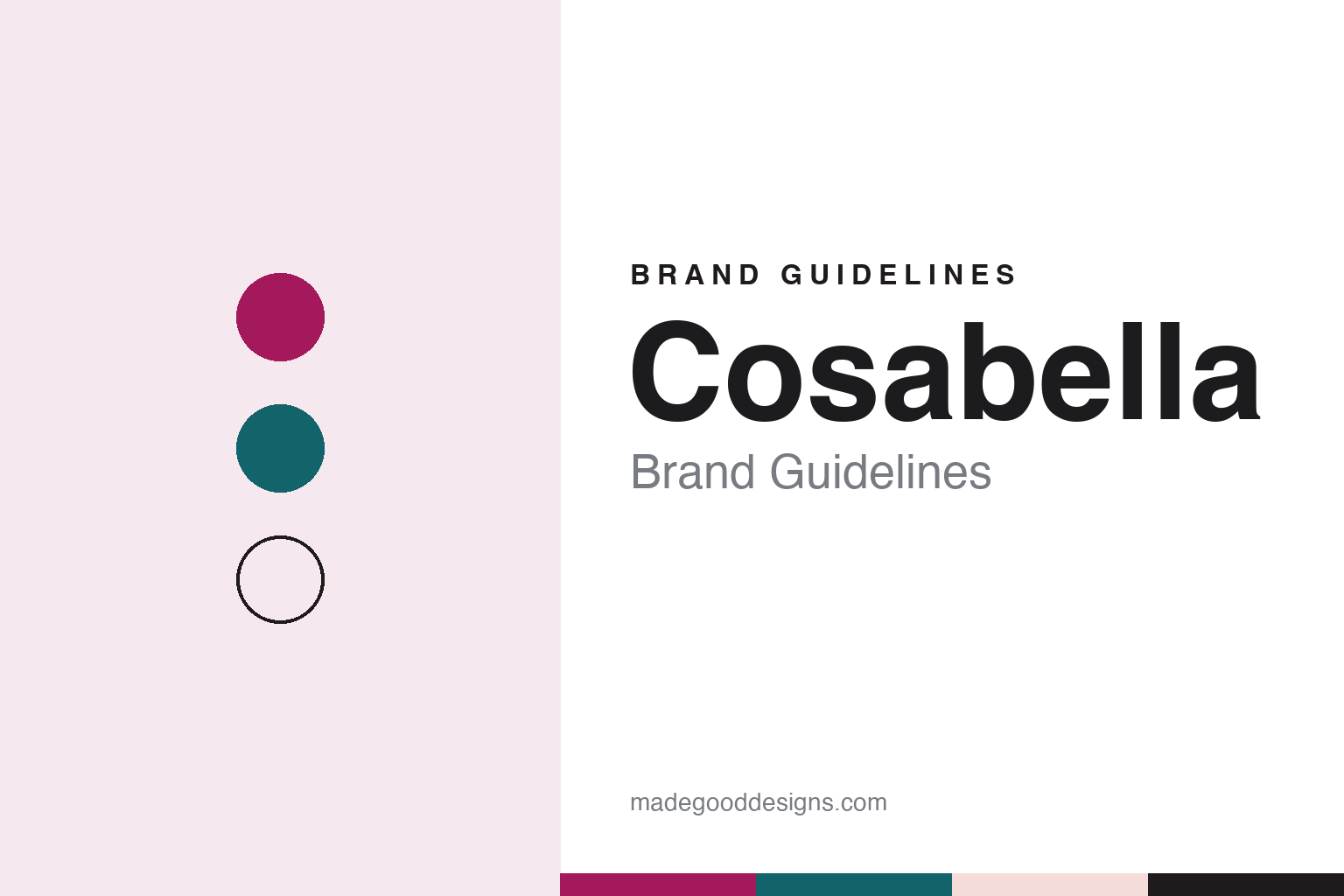
Cosabella Brand Guidelines
A beautiful thing from Carpi, sold from Miami.
Aa
Two constants: a bright rose, teal and blush palette and a high-contrast serif register. Abstract homage — not a Cosabella product or mark; no garment, logo or label is reproduced.
A beautiful thing
A short stay in Miami and a call home to Carpi.
Cosabella began with a temporary work posting. Entrepreneur reported in May 2013 that Ugo Campello, an engineer, and his wife, Valeria, who had trained as a lawyer in Italy, came to Miami in the early 1980s, intending to stay for eight months. Valeria, wanting something of her own to do, called contacts in her home town of Carpi, in northern Italy, which has a tradition of textile manufacturing. She ordered goods to sell in Miami, first to friends and then to local stores.
An October 2011 profile from Italian South Florida, reprinted on the company’s blog, says her first stock included embroidered tops, linen sets and Egyptian cotton T-shirts. She hired a salesman, Sergio Oxman, who became a partner; Entrepreneur says he left amicably in 2005, when the family bought his stake. That profile says an Italian friend’s lingerie company supplied samples, and that New York buyers responded. The bodysuit was among the first successes.
The company was formally founded in 1983. The name is Italian for “beautiful thing.” Ugo left engineering in 1985 to work on it full time.
Then the business model broke. Entrepreneur says a stronger lira doubled the cost of goods within 18 months, while cheap products were arriving from China. Cosabella’s answer was to stop importing other makers’ goods and start its own line of lingerie, made in Italy. Ugo designed it, beginning with simple cotton pieces and moving into lace, hosiery and other fabrics. Positioned as a luxury brand with Italian origins, it no longer had to compete on price, and it found a place in boutiques and high-end department stores. Entrepreneur dates the start of the brand’s identity to about three years after the founding.
It stayed a family business for decades. Their children grew up in it: Guido Campello took over sales and Silvia Campello ran operations by 2013, Entrepreneur reported, and the magazine put the range at more than 1,620 styles, sold in more than 90 countries.
Colour
Lace, mesh and nearly 200 hues.
Colour is the brand’s clearest design signature. The company’s blog said in 2016 that it had made lace garments in nearly 200 hues and called its dyeing ability one of its trademark features. In the 2011 profile, Guido Campello linked that to the Italian tradition of dyeing around Fabriano and the Marche, and contrasted it with the blacks and greys he associated with New York, Paris and London.
The early hits used fabrics and cuts borrowed from elsewhere. The blog says that in the mid-1980s Cosabella used the sheer mesh of hosiery for bodysuits, and that mesh thongs in bright colours, known in Italian as “perizoma,” built its following. The Soire mesh collection, it says, was designed in the early 1990s.
The product most linked with the name is the Never Say Never stretch lace and its Sweetie bralette, and its dates vary by source. The company’s blog said in 2019 that the Sweetie was introduced in 2008, while a 2021 post traces the style to a wire-free bralette designed in the late 1980s. Lingerie Briefs said in November 2020 that it began in 2005, and the Lingerie Museum dates the Never Say Never collection to 2002. The company calls the Sweetie “the Original Bralette,” which is its own claim. A Curvy Collection in larger cup sizes followed, about four years before that 2021 post, the company says.
Later ideas ranged further. Entrepreneur described lace with fibres developed by Ugo Campello that glowed under black light, a cashmere tube for fall 2012 that could be worn 14 ways, and Amore, a lower-priced label for JCPenney.
Where the garments are made is worded differently over time. In 2011 the profile described distribution offices in Carpi, a production site in Fabriano and more than thirteen “laboratori,” specialist workshops that are generally family-owned. In 2019 the company’s blog said its pieces were produced in Italy “from first thread to final inspection.” In June 2023 it said it manufactured in Europe. Its heritage page now reads “Italian-inspired lingerie since 1983” and speaks of sourcing Italian laces. Those are the company’s own statements.
Typography
Design and documentation.
Hosiery and high-street lingerie are sold at close quarters. A pair of tights is usually bought in a flat packet or from a hanger, a bra from a rail and a vest from a folded stack, so much of the design work falls on the things around the garment: the pack, the hook, the shelf and the shop front. Type on a legwear packet has a practical job to do, since it has to carry a name, a style and a size in a small space.
Retail shapes the look as much as print does. Some names in this field are found mainly in their own shops, often in shopping malls and on high streets, where the shop front is the largest sign the brand has. Oniverse, the Italian group behind Calzedonia and Intimissimi, says it sells its collections exclusively through single-brand stores. Others reach customers through department stores, or as a concession inside another retailer: in 2005 the trade paper TextilWirtschaft reported Intimissimi shop-in-shops opening inside Victoria’s Secret in the United States.
Colour is often seasonal. A wall of tights or swimwear arranged by shade can work as display and stock at once, and a change of season can change the look of a shop without touching its fittings. Plain folded basics pull the other way, relying on cut, material and label rather than pattern, so that the same shop can hold both a bright display and a quiet one.
This guide sets out what can be checked about each brand: who founded it, who owns it and what it says about where its products are made, with the company’s own claims marked as such. The palettes and specimens here are our own.
Aa
A high-contrast serif for a brand that sells Italian lace. (Specimen set in Bodoni Moda, a serif STAND-IN; NOT the Cosabella logo.)
Two sales
From a Miami family to a Swiss group to a New York brand firm.
The family era ended in May 2022, when the Swiss underwear group Calida, owner of the Calida and Aubade brands, bought Cosabella, FashionUnited reported. Guido Campello, then managing director, welcomed the deal, and the company was described as family-owned with second-generation management. Calida said Cosabella would be its US hub, giving Calida and Aubade a way into the American market.
That lasted four years. On 23 July 2026 Calida agreed to sell the brand to Crown Brands Group of New York through an asset purchase, following a strategic review, FashionUnited reported; the price was not disclosed. Calida said the sale would let it concentrate on its two core brands. Inside Retail reported the deal on 27 July and FashionUnited said on 28 July that it had been completed. What changed hands was the trademark, the intellectual property and commercial inventory.
The new structure divides the brand among specialists. FashionUnited says Crown, a brand-management firm, directs global brand strategy, marketing and licensing. Rafar Group, a US manufacturer and the parent of Gelmart International, is the exclusive intimate apparel licensee, overseeing product design, development, e-commerce and distribution, as it does for Hanky Panky, which Crown bought in December 2025. Dreamwear, another US apparel maker, holds the sleepwear and loungewear licence. Raymond Dayan, Crown’s chief executive, cited “true Italian craftsmanship” as part of the appeal.
Descriptions of its nationality vary: FashionUnited called it a US brand when Calida announced the sale and an Italian label when Crown completed it. In November 2026 the brand’s website still sold the Never Say Never line and dated itself to 1983.
For a design guide, Cosabella shows a brand carried by a name, a lace and a colour range through three owners. Compare Natori, a New York house still described as family-owned, and Intimissimi, an Italian lingerie brand. For this guide we use a bright rose, teal and blush with a serif, an unofficial interpretation; no product or logo is reproduced.
Explore & save
Keep Cosabella’s identity on hand — save it to a board in the Made Good inspiration library.
Cosabella identity set
Pin the Cosabella bright rose, teal and blush palette and the high-contrast serif register to your own board.