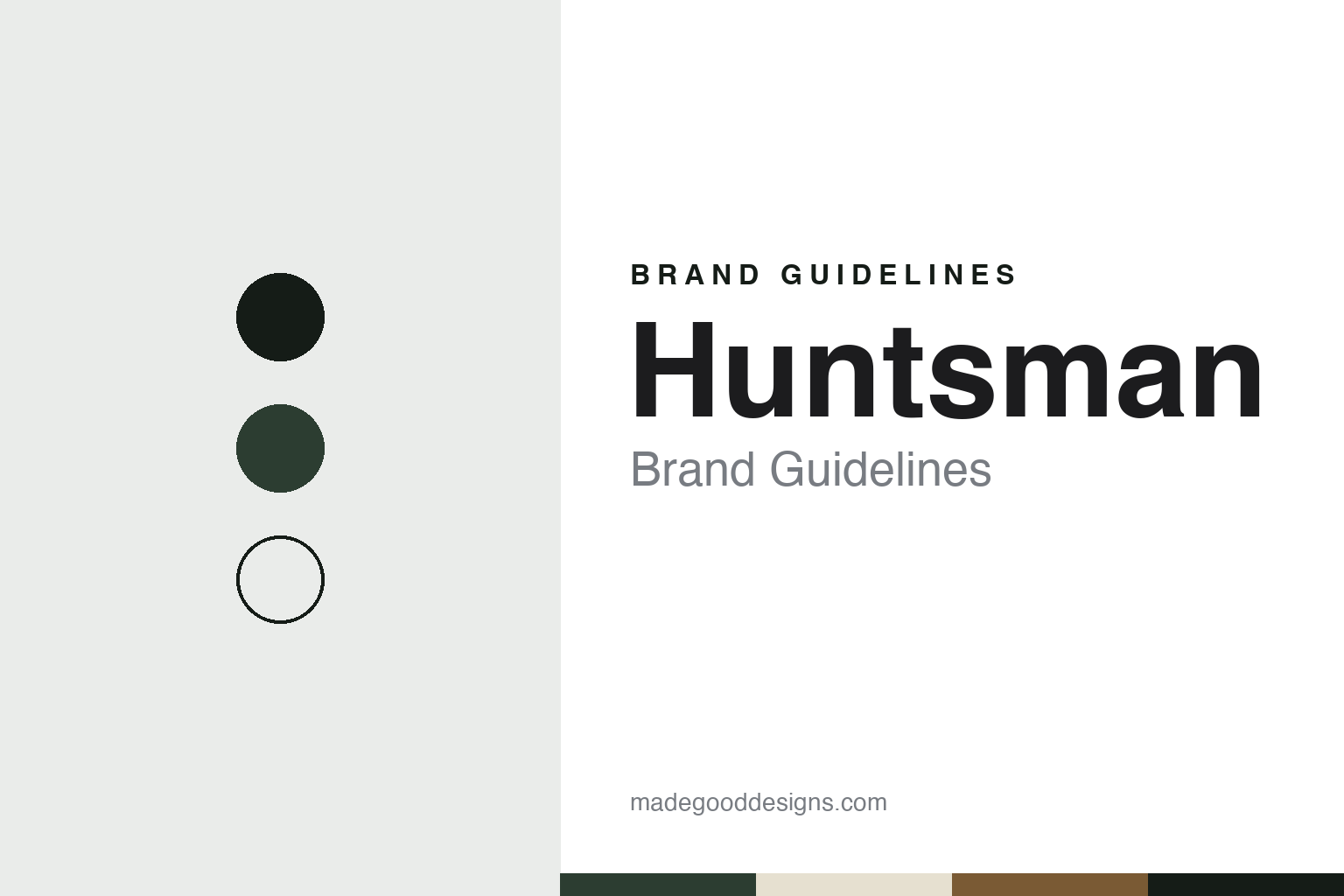
Huntsman Brand Guidelines
The breeches maker behind the one-button cut at 11 Savile Row.
Aa
Two constants: a Huntsman fitting-room green, tweed and saddle tan palette and a Sharp serif register. Abstract homage — not a Huntsman product or mark; no garment, logo or crest is reproduced.
Breeches Maker
A sporting trade, and two dates for one house.
Huntsman has two dates. The company says the business was founded in 1809 as a specialist breeches maker, and that Henry Huntsman acquired it in 1849, when it became H. Huntsman & Sons. The later date is the one the brand leads with: its website still reads “Est. 1849,” it marked 175 years in 2024, and a 2013 company statement and Square Mile in 2016 both gave 1849 as the founding year.
The trade was riding, and the company says its early identity was rooted in the demands of equestrian life. Royal custom followed. Savile Row Style magazine dated the first Royal Warrant to 1866, and the company shows a plaque naming it Leather Breeches Maker by Appointment to the Prince of Wales.
The move that fixed its address came in 1919, when the company says it relocated to 11 Savile Row. It marked a century there in 2019. In the 1930s, it says, the business passed out of the Huntsman family to Robert Packer, who took it from breeches into suits and evening wear. During the 1940s, the company says, it made military garments for the war.
Colour
Colin Hammick and the one-button line.
The house style is tied to one cutter. Colin Hammick joined as an apprentice in 1942, the company says, and became head cutter in the 1950s. Savile Row Style wrote that from the 1950s through the 1970s, under Hammick, Huntsman was the star of the street, and that The Tailor & Cutter once named him the World’s Best Dressed Man. Its head cutter in 2013, Patrick Murphy, recalled watching the cars draw up from Davies & Son across the road as a trainee. The company’s pages place Hammick’s refinement of the cut in the 1950s on one page and the 1960s on another. His name stays on the premises: Huntsman has called fitting room one after him.
The cut is the house’s signature. The company calls it the One Button Cut: a single button at the waist, a strong, structured shoulder, high armholes, a suppressed waist and a longer, slightly flared skirt. It derives this from the hacking jacket, the three-button riding coat, so the sporting past is built into the shape. The company repeats an old line that one Huntsman customer could recognise another in the street by the cut of their suit.
By the 1950s, the company says, the cut was drawing clients from Hollywood. Square Mile reported in 2016 that Gregory Peck commissioned a total of 160 suits, and listed Laurence Olivier, Elizabeth Taylor and David Bowie among the clients, with Bowie’s patterns hanging on a wall at No. 11. The company adds Clark Gable. It says it has made women’s clothing for more than 175 years, and today it names a head ladieswear cutter, Magdalena Handwerker.
The offer widened over time. The company says ready-to-wear and made-to-measure arrived in the 1960s, and Square Mile reported that a ready-to-wear collection was reintroduced after Campbell Carey became creative director in 2015, alongside online sales and the first trunk shows in Asia.
Typography
Chalk, cloth and the cutting board.
Tailoring houses have an unusual advantage in presenting themselves: the work itself is graphic. A bespoke order follows a set sequence. The customer and tailor choose fabrics, linings and details, the tailor takes measurements and drafts a pattern from scratch, and the cloth is chalked out and cut with shears before being basted for a fitting. Chalk marks on cloth, paper patterns on hooks and a cutter working at the board are the working tools of that sequence, and they also make natural pictures for a house’s windows, pages and packaging.
The street matters too. Savile Row in Mayfair, London, is known principally for bespoke men’s tailoring, and tailors have traded there since at least 1803. Its windows can be a statement in themselves: when Nutters of Savile Row opened in 1969, it used bold displays created by the then unknown Simon Doonan. In Italy the home town often takes the street’s place, and a house can put a place name at the front of its story, as Zegna does with its mill in the Biellese Alps.
Cloth carries the identity as well. Fabrics and linings are chosen at the start of an order, which puts the fabric book in the customer’s hands early. Mills keep their own record of that work: the Zegna archive at Trivero holds sample books alongside technical drawings.
The words matter as much as the images. A bespoke garment starts from a new pattern, made to measure adjusts an existing one, and ready-to-wear comes in standard sizes. In June 2008 Britain’s Advertising Standards Authority ruled that an advertisement calling a suit cut and sewn by machine “bespoke” did not breach its code, and the term has stayed contested since.
Aa
A sharp serif — a long line and one fastening. (Specimen set in Cormorant Garamond, a serif STAND-IN; NOT the Huntsman logo.)
Huntsman
A financier, a film and a handloom.
The name is old, but the company behind it is not. Companies House shows H. Huntsman & Sons Limited was incorporated in December 2004 under another name and took the Huntsman name in February 2005; FashionUnited reported in 2013 that private investors had owned the house since 2005. On 8 January 2013, a Huntsman statement said, it came under the co-ownership of the Bond Street designer Roubi L’Roubi, as creative director, and his business partner Pierre Lagrange, the Belgian-born co-founder of the hedge fund GLG. Square Mile reported in 2016 that the general manager and head cutter had left soon after, and that L’Roubi had since left too.
Lagrange stayed. Companies House lists him as a director since January 2013 and as the person with significant control, and the head cutter and creative director Campbell Carey called him “our chairman and owner” in a Gentleman’s Gazette interview.
The film came next. The Savile Row Bespoke Association, of which Huntsman was a founding member, said in February 2015 that Huntsman inspired the tailor’s shop in Matthew Vaughn’s Kingsman: The Secret Service, and that its interiors at 11 Savile Row appear in the film. Huntsman says Vaughn, a customer since he was 18, had the idea during a fitting, and that Lagrange was an executive producer of the films. It redecorated a fitting room to match the set and sells an Inspired By Kingsman range.
Abroad, it has premises on West 57th Street in New York, which Square Mile said opened in March 2016 and the company dates to 2017. Its then chief executive told the magazine it was the first Savile Row tailor to open a shop there.
The company says bespoke begins with up to 28 measurements and a paper pattern, takes up to 80 hours of handwork and at least three fittings, and is made by its own cutters and tailors. It says three suits for Alexander McQueen’s collection at London Fashion Week in 2026 were made at 11 Savile Row, renewing a link FashionUnited described in 2013 as a joint venture. Made-to-measure starts from a house block pattern. It also says it is the only tailor on Savile Row with its own handloom, for clients’ private tweeds.
For a design guide, Huntsman shows how a single cut can identify a house. Compare Henry Poole & Co, the family house along the same street, and Alexander McQueen, the fashion house it tailored for in 2026. For this guide we use a fitting-room green, a tweed oatmeal and a saddle tan with a serif, an unofficial interpretation; no product or logo is reproduced.
Explore & save
Keep Huntsman’s identity on hand — save it to a board in the Made Good inspiration library.
Huntsman identity set
Pin the Huntsman fitting-room green, tweed and saddle tan palette and the Sharp serif register to your own board.