David’s Bridal Brand Guidelines
The Florida salon that became a national bridal chain.
Aa
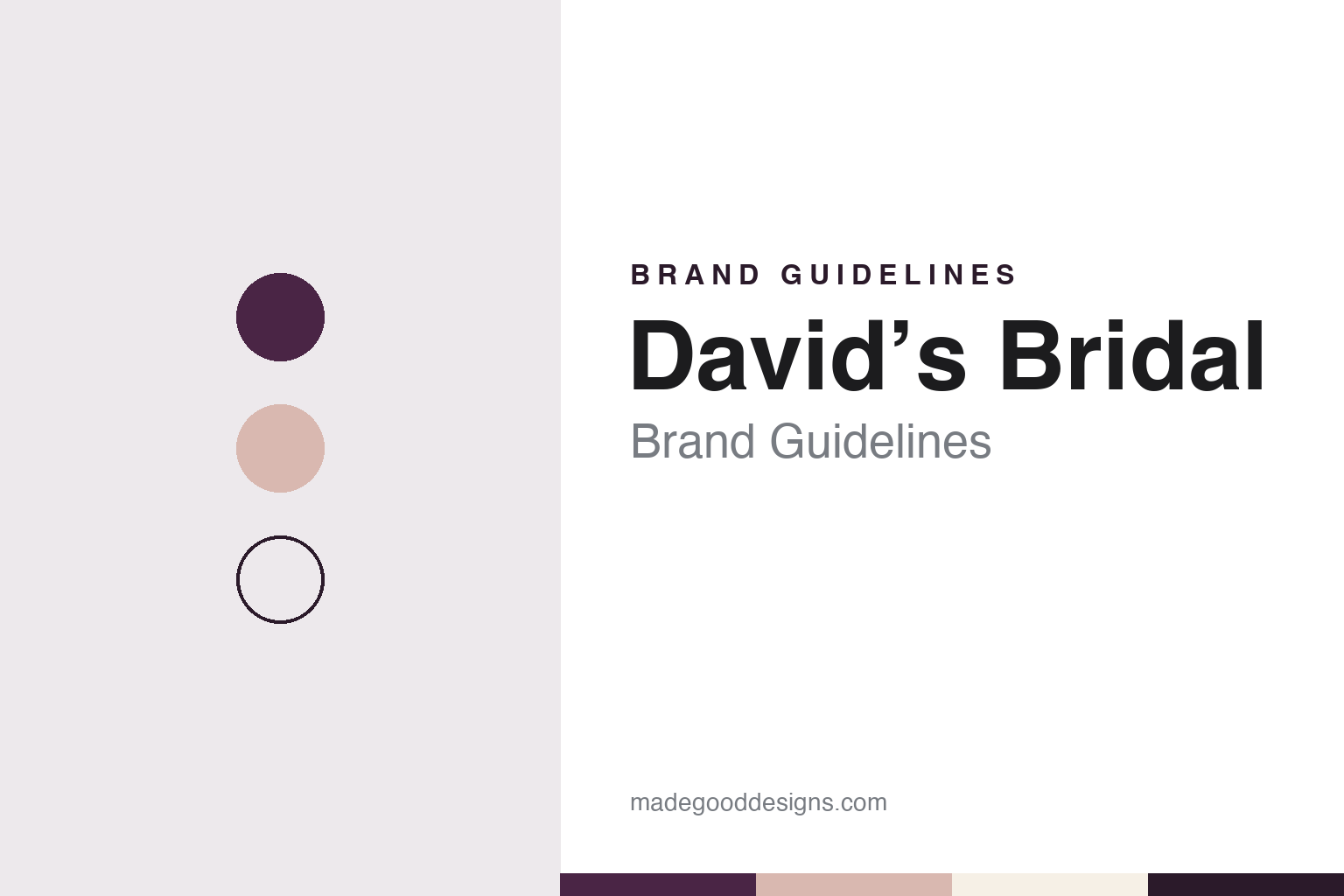
Two constants: a David’s Bridal aubergine, blush and ivory palette and a Friendly retail sans register. Abstract homage — not a David’s Bridal product or mark; no gown, logo or label is reproduced.
From Salon to Superstore
A Florida shop, then a warehouse idea.
David’s Bridal started in 1950 as a small bridal salon in Fort Lauderdale, Florida, according to the International Directory of Company Histories, published in 2000. The South Florida entrepreneur Phil Youtie bought the salon in 1972. From 1973 to 1988 he owned 18 salons, which he ran mainly as leased bridal boutiques inside department stores, under the David’s banner.
The idea that made the name national was a change of format. In 1990, the directory says, Youtie teamed up with his childhood friend Steven Erlbaum, founder of the Philadelphia-based Mr. Good Buy chain. The two incorporated the company and opened the first David’s Bridal Wearhouse in Hallandale, Florida; English Wikipedia places the shift to a warehouse model in the late 1980s. The directory calls the store the first of its kind. It measured about 12,000 square feet, against about 2,500 for an average bridal salon, and customers searched racks of gowns with little help from staff. Signs warned that sales were final and that there were no alterations on site.
The trade was divided. Traditional salons argued that bridal was a service business, and David’s Bridal became known as the “Wal-Mart” of the wedding industry, a title the company rejected, the directory says. Erlbaum answered that the chain covered all price points and every segment of the market.
Between 1994 and 1995 the company grew from 14 stores to 36 and began turning its warehouses into bridal superstores, with better lighting, more comfortable dressing rooms, personal consultants and alterations on site. “Wearhouse” was dropped from the name. The format differed from a salon in one central way: a salon ordered a gown after a fitting on a sample, while David’s Bridal stocked thousands of gowns in sizes two through 26, so a bride could often take hers home the same day.
The company went public in 1999, on Nasdaq under the symbol DABR, and launched an e-commerce site the same year. At that point it sold under private labels such as Michelangelo and Lady Eleanor, and held exclusive licenses for wedding gowns from Gloria Vanderbilt, Jessica McClintock and Oleg Cassini. The directory also recorded that nearly all of its gowns were made abroad.
Colour
A run of owners and two Chapter 11 filings.
The founders’ era ended quickly. May Department Stores bought the company in 2000, English Wikipedia says, and Federated Department Stores bought May in 2005. On November 17, 2006, David’s Bridal passed to the private-equity firm Leonard Green & Partners. Clayton, Dubilier & Rice, another private-equity firm, completed its acquisition on October 11, 2012.
By 2015 the chain was working on its image. Bustle, citing Racked, reported that June that chief executive Pamela Wallack wanted to stop the company being known as the “Walmart of Weddings.” Stores once filled with clear plastic garment bags now showed dresses uncovered on the racks, and its social media had moved from photos of online models to images from inside the stores and of customers in their purchases. Bustle also noted collaborations with designers such as Zac Posen and Vera Wang.
Then came the debt. David’s Bridal filed for Chapter 11 on November 19, 2018, English Wikipedia says. Glossy reported that week that the company had promised to fulfil every order already placed, and pointed to later marriages, younger digital-first brands and changing shopping habits as pressures on the business. The company emerged in January 2019, run by a group of lenders that included Oaktree. James Marcum became chief executive that June. English Wikipedia records that in-store prices had not matched online prices at the time, and that returns could not be made in stores.
The second filing followed on April 17, 2023, in New Jersey. The Associated Press reported that the chain then had about 300 stores and more than 11,000 workers, had said days earlier that it could eliminate more than 9,200 jobs, and was looking for a buyer while its stores stayed open and orders were filled. Oaktree announced a sale to CION Investment Corp. on July 14, 2023, and CION became the owner ten days later, English Wikipedia says. The Philadelphia Inquirer reported in February 2026 that the company had since laid off thousands of employees and cut its store count by about a third.
Typography
Gowns, lace and showrooms.
Bridal houses sell a single garment that most customers will wear once, and their images tend to reflect that. The dress usually comes first, shown whole on a stand or a model, with the room, the light and the type kept quiet around it. Pages often stay pale and uncluttered, so that white, ivory and blush can be told apart.
Close-ups do much of the remaining work. Lace, tulle, beading and hand finishing are hard to read at full length, so lookbooks and websites move in on a sleeve, a hem or a bodice seam. These details carry the claims about workmanship, and they give a designer’s pattern or a house’s lace a recognisable surface.
The runway calendar sets the rhythm. New York Bridal Fashion Week and Barcelona Bridal Fashion Week give houses a fixed moment to show a season, and many present a named collection with its own theme, set and printed material. The show then feeds the photography, film and social posts that follow it through the year. Backstage pictures, fittings and the walk down the runway all give a house more ways to show how a gown moves.
The shop is the other stage. Showroom mirrors, fitting platforms, soft seating and rails of samples are all part of how a label appears to a bride, and a garment bag or printed lookbook may be the piece of the brand that she takes home. For a designer, that makes the category a useful study in restraint: a small set of tones, a quiet typeface and careful photography, repeated from the catalogue to the fitting room.
Aa
A friendly retail sans — a name read from the mall and the street. (Specimen set in DM Sans, a sans STAND-IN; NOT the David’s Bridal logo.)
David’s Bridal
A retailer rebuilt around planning.
The company has also moved. It had been based in Conshohocken, Pennsylvania, since January 2000, and in 2024 it sold that building and moved to a smaller leased office in King of Prussia, The Philadelphia Inquirer reported, with about 200 employees expected to work there. The Inquirer named CION as the owner in February 2026.
Kelly Cook joined as chief marketing officer in 2019 and became chief executive in April 2025, the second woman to lead the company, according to the Inquirer. In March 2026 the paper called David’s Bridal the country’s largest bridal retailer and put it at nearly 200 locations. Under Cook the business has been widened beyond the store. Pearl, its wedding-planning platform, builds a personalized task list after a quiz and offers an AI concierge. English Wikipedia dates the first Pearl app to January 2023, while Cook told the Inquirer in 2026 that it had launched “last summer.” The company has added a wholesale division that could place its designer dresses in boutiques and department stores, a luxury boutique concept that English Wikipedia names Diamonds & Pearls, with boutiques in Massachusetts and Florida reported by the Inquirer, and Breaking Bridal, a docuseries following real couples. It also uses AI in some photo shoots, photographing dresses on a green mannequin and adding models digitally.
Its most visible design move came on April 7, 2026, when the company announced its first Vera Wang Bride bridal and bridesmaids collections at New York Bridal Fashion Week. The Fall 2026 collection appeared first on its website, with stores due to follow from June 30.
For a design guide, David’s Bridal shows how a retail format can carry a name through repeated changes of owner: the salon, the warehouse, the superstore and now the planning platform have all traded under the same words. Compare Vera Wang, the designer name now on its collections, and Gloria Vanderbilt, an earlier licensed name on its gowns. For this guide we use an aubergine, a dusty blush and a soft ivory with a sans, an unofficial interpretation; no product or logo is reproduced.
Explore & save
Keep David’s Bridal’s identity on hand — save it to a board in the Made Good inspiration library.
David’s Bridal identity set
Pin the David’s Bridal aubergine, blush and ivory palette and the Friendly retail sans register to your own board.