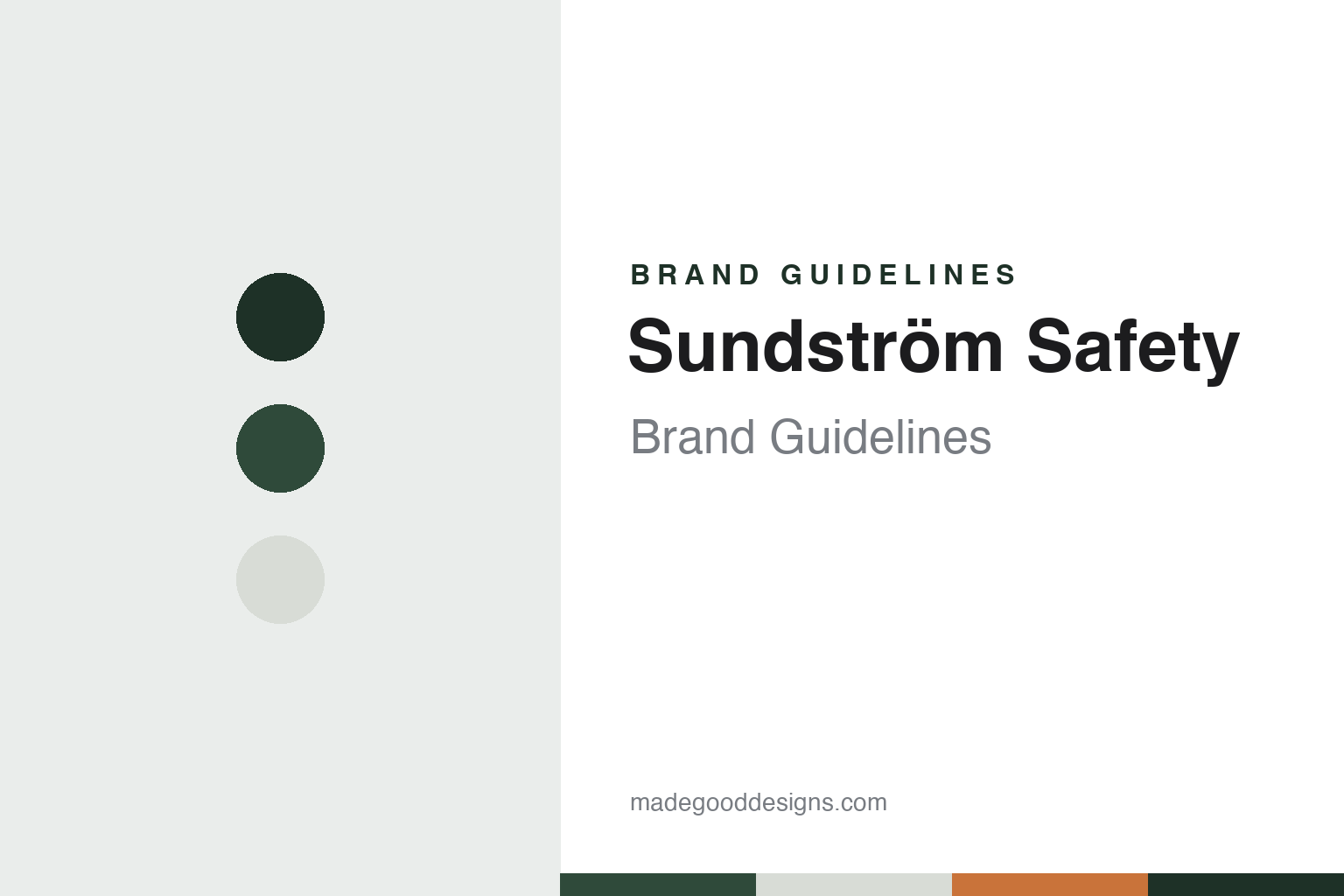
Sundström Safety Brand Guidelines
The Lagan respirator maker founded in 1926.
Aa
Two constants: a pine green, silicone grey and copper palette and a Nordic sans register. Abstract homage — not a Sundström product or mark; no mask, filter, logo or pack is reproduced.
Sundströms Respiratorer
A mining engineer and a family business.
Sundström Safety is a Swedish maker of respirators based in Lagan, a small town in Småland just outside Ljungby. The company says it was founded in 1926 by the mining engineer Ivan Sundström, who saw early on the need for respiratory equipment for miners, whose eyes and lungs were exposed to dust underground. From the start, it says, the aim was equipment that was simple, comfortable and able to fit faces of different shapes.
That last point became a family specialism. The company says Ivan’s son Per Sundström studied at Tekniska skolan in Stockholm, the school now known as Konstfack, Sweden’s university of arts, crafts and design, and that his studies deepened the firm’s understanding of the anatomy of different faces. According to the company’s Swedish timeline, Per became managing director in the 1950s.
For most of its history the business traded as Sundströms Respiratorer. The company says it changed its name to Sundström Safety AB in 1984, by which time production had already left the Stockholm area: in 1976 the factory moved from Lidingö, an island suburb of Stockholm, to Lagan, and in 1986 a new factory opened in the town.
The firm is still family-run. Sundström Safety says the third generation of the Sundström family leads the company today and that the fourth generation is on its way in, and it describes its values as openness, clarity and respect. Swedish Wikipedia’s article on Lagan, describing the town’s economy in 2022, when most local jobs were in manufacturing, lists Sundström Safety AB among its manufacturers as a maker of protective equipment, alongside firms making transmissions, plastic caps and hydraulic cylinders.
Colour
Masks shaped around the face.
Sundström’s product history reads as a sequence of numbered models, each with the SR prefix. The company’s Swedish timeline dates the SR 62 half mask, which it describes as having a unique anatomical shape, to 1972; its English history says Per presented the first anatomical half mask in rubber in the 1960s. The SR 90 half mask, in silicone, followed in 1989, and the company’s English history calls it the first silicone mask, a claim that rests on its own account.
Later models extended the range. The company dates the SR 200 full face mask to 1999, the SR 500 to 2003 and the SR 900 system to 2015. Its catalogue is now arranged by type: half and full face masks, fan-assisted respirators, filters, compressed-air equipment, models for explosive atmospheres marked EX, and escape hoods.
The way the range fits together is central to how the brand presents itself. Sundström says its masks, hoods, visors and helmets work as one system, with filters and accessories that are compatible and can be added to, so that a set-up can be adjusted to the wearer’s comfort and to the needs of a particular workplace.
Quality systems are part of the same story. The company says it became one of the first personal protective equipment makers to be certified to ISO 9001, in 1993. A long-standing supplier offers a glimpse of its working methods: the Swedish coupling maker CEJN, in an article on its own website, says it has supplied quick-release couplings for Sundström’s air-fed equipment for 30 years, and that Sundström carries out its own testing of every product, including pull tests on complete hose kits.
Typography
A category built on fit and routine.
Gas detection and respiratory protection grew up underground. Before electronic sensors, miners carried canaries as an early warning of bad air; in 1937 Dräger’s first detector tube offered a chemical alternative, English Wikipedia notes, and the American company now called MSA Safety began in 1914 with an electric cap lamp for mines. In North America, mine-rescue crews are still known as “Drägermen,” a reminder of how closely the trade and its equipment makers have been tied to mining.
The equipment itself sets the visual tone of the category. A personal gas detector is a small, rugged housing clipped to a jacket, a harness or a helmet, with a display and a sensor opening facing outward. Breathing-apparatus sets combine a backplate, a compressed-air cylinder and a full-face mask, and appear most often in pictures of firefighters at work or in training. Fixed detectors are mounted on walls and pipework in plants, tunnels and refineries, where they are meant to be seen rather than hidden.
Many makers use bright housings in yellow, orange, red or black, colours that stand out against dirt, smoke and grey machinery, and pair them with plain sans-serif type and large figures on the display. Product pages tend to show the device in use in a hazardous setting, or as a clean cut-out against white, rather than as a lifestyle object. Test rooms, calibration stations and training galleries are part of the story too, since equipment of this kind is regularly checked and serviced.
Behind the products sit companies of very different ages and shapes: family-controlled groups, listed corporations and young technology firms, some with long histories that include the war years. For a designer, the category is a study in function first: legibility, contrast and durability, with brand colour used as a signal on the job.
Aa
A Nordic sans — plain, numbered and functional. (Specimen set in Work Sans, a sans STAND-IN; NOT the Sundström Safety logo.)
Made in Lagan
One town, one factory, a family name.
Sundström keeps its operations in one place. The company says its head office, product development and production plant are all in Lagan, and that its products are designed and manufactured there. Its Swedish timeline adds that in 2020 it extended its offices, development department and factory in the town, the latest step after the move from Lidingö in 1976 and the new factory of 1986.
The company’s own description of itself is short. It calls itself a family company, founded in 1926, “in småländska Lagan,” and frames its work around a single subject, respiratory equipment, rather than a broad catalogue of workwear and safety goods. Its slogan, “Keep breathing,” runs across its website, and its products are sold abroad through distributors, with country versions of its site for markets across Europe, North America and Thailand.
The company’s own pages carry the brand through a few recurring elements: the family name, the SR model numbers, the town of Lagan and the thread back to a mining engineer’s interest in fit. In the company’s telling, a design education at Konstfack fed into the shape of a half mask, a story it repeats on its Swedish and English pages, though the two give different decades for the first anatomical mask. The name itself is written with an umlaut, Sundström, and the products carry the short form SR.
For a design guide, Sundström Safety shows how a small family maker can build a brand from one subject, one town and a run of numbered models. Compare Moldex, another maker that keeps a narrow range, and Dräger. For this guide we use a pine green, a silicone grey and a copper with a sans, an unofficial interpretation; no product or logo is reproduced.
Explore & save
Keep Sundström Safety’s identity on hand — save it to a board in the Made Good inspiration library.
Sundström Safety identity set
Pin the Sundström pine green, silicone grey and copper palette and the Nordic sans register to your own board.