Nelson Irrigation Brand Guidelines
The Walla Walla sprinkler maker that grew out of a hose-coupling business.
Aa
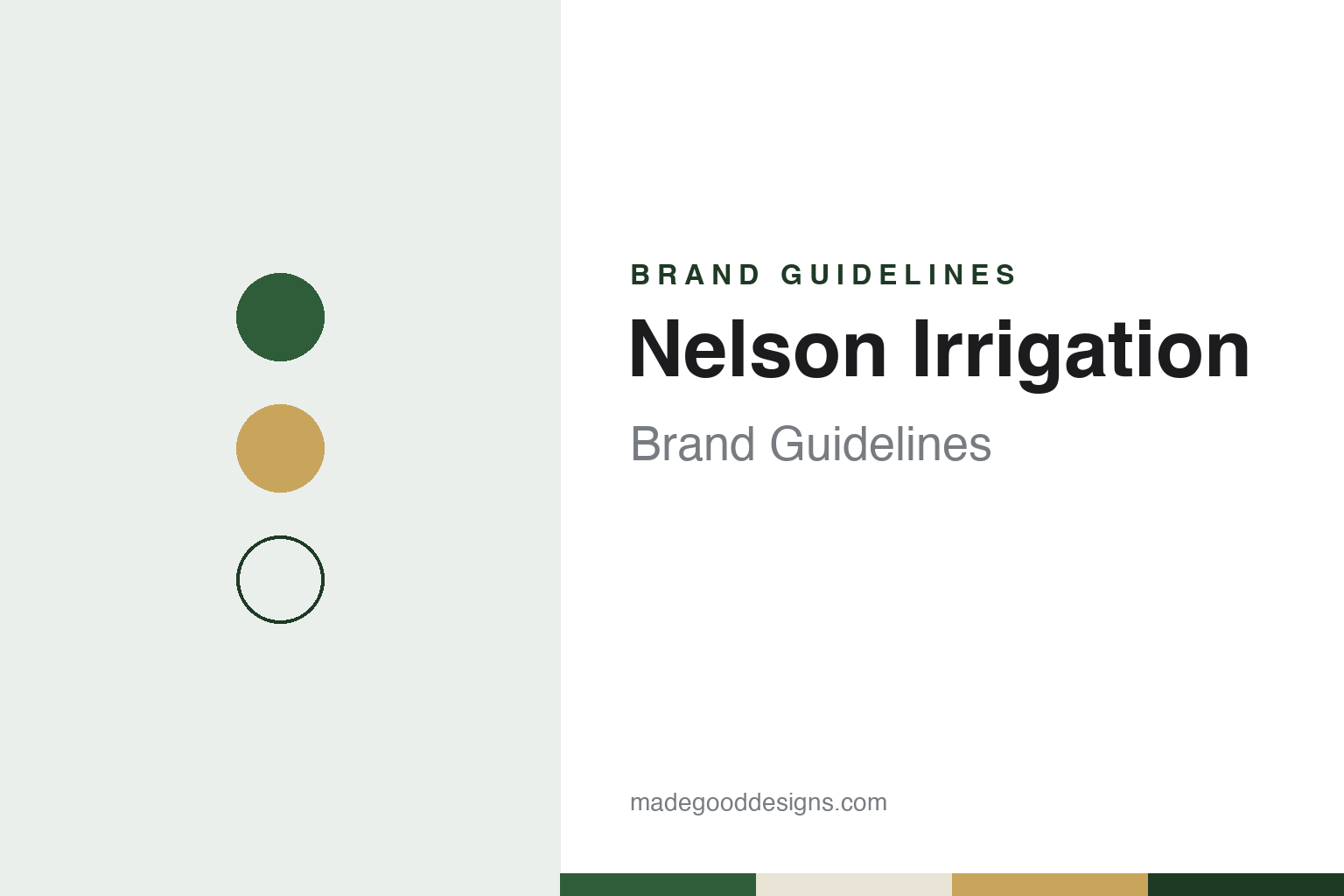
Two constants: a field green and straw palette and a workshop grotesque register. Abstract homage — not a Nelson Irrigation product or mark; no sprinkler, logo or nameplate is reproduced.
From hose couplings to field sprinklers
A family business that moved from garden fittings to farm irrigation.
Nelson Irrigation’s story begins with a garden-hose fitting. In a 2012 history of irrigation manufacturers, the potato-industry magazine Spudman wrote that Lewen Russell Nelson patented a coupling device for garden hoses in 1904 and in 1906 started the Nelson and Morrison Manufacturing Co. in Boulder, Colorado. The business moved to Peoria, Illinois, and then, in 1925, to Pasadena, California, and took the name L.R. Nelson Manufacturing Co. in 1921, the magazine said.
The company tells the early part a little differently. Its own website says Nelson “traces its history of innovation back to 1911,” when Lewen Russell Nelson invented the “Clincher” hose coupler and founded the Central Brass and Stamping Company. The two accounts give different years and company names for the beginning.
The turn towards large-scale farm irrigation came at the start of the 1970s. According to Spudman, L.R. Nelson Manufacturing created a subsidiary, Nelson Irrigation Co., in 1971 to concentrate on large-scale agricultural irrigation. When the parent company was sold and renamed L.R. Nelson Corp., Bart Nelson, the founder’s grandson, bought the subsidiary and moved it to Walla Walla, Washington. The company gives 1972 as the year Nelson Irrigation was founded.
A company newsletter from May 2024 says Nelson Irrigation “set up shop in Walla Walla WA in 1973,” choosing the agricultural Pacific Northwest, where the town is surrounded by vegetable and grain fields, orchards, vineyards, pastures and nurseries. The same newsletter describes working with nearby growers as test partners for research and development, and pictures Bart Nelson in the field with a dealer.
Colour
Big Guns on pivot ends, Rotators under the canopy.
Nelson’s reputation rests on a small number of sprinkler families rather than on whole irrigation machines. The company names its flagship products as Big Gun sprinklers, Rotator sprinklers and 3000 Series pivot products. Alongside them it sells a separate line of end-of-pivot products and a range of pivot sprinklers, which its website groups under mechanized irrigation.
The Rotator name has become the company’s signature word. The trade publication Irrigazette carried news in November 2025 of the R7 Rotator, which it described as the latest addition to the Rotator family: a micro-sprinkler for tree fruit and nut orchards built on Nelson’s 7 Series, with quick-connect and quick-clean fittings, that can be mounted on a trellis wire with a clip instead of on a tube and stake.
One Rotator offshoot now belongs to another company. English Wikipedia, citing the trade magazine Landscape & Irrigation from May 2007, says the MP Rotator — which Wikipedia describes as the first matched-precipitation-rate nozzle, produced by Nelson Irrigation in 2003 — was acquired by Hunter Industries in 2007, through an agreement with Nelson Irrigation that transferred the line from the Walla Walla Sprinkler Company. The MP Rotator name still appears in Nelson’s own product menu.
Beyond sprinklers, the company’s website lists pressure regulators, spinners and sprays, impact sprinklers, control valves, air valves and the Twig wireless automation controls, along with software. Its range is grouped by use: mechanized irrigation, high-volume field crops, tree and vine, nursery, monitoring and control and non-agricultural applications.
The company calls itself “a world leader in manufacturing irrigation equipment for agricultural and industrial applications” and says it holds “dozens of patents” and numerous awards; we give those as its own claims.
Typography
How irrigation makers present themselves.
Irrigation makers sell machines that are easiest to understand from a distance. A centre pivot is a long pipeline of sprinklers carried on wheeled towers that turns slowly around a fixed point, and seen from the air it leaves a field of green circles; the Encyclopedia of the Great Plains, published by the University of Nebraska–Lincoln, describes how that design took the industry from water-driven towers to electric and hydraulic drives, corner arms for square fields and, in the 1990s, computerised controls.
The industry’s pictures tend to follow the product. Pivot and linear makers show long spans crossing fields and sprinkler arcs against a low sun; drip and micro-irrigation makers show thin lines laid along crop rows and emitters at the root zone; sprinkler and controller makers for turf show lawns, sports fields and golf courses. The hardware often shares the page with a phone or a tablet, as remote monitoring and control apps are part of what many of these companies sell.
Many of the names come from small places. The centre pivot grew out of Colorado and Nebraska in the late 1940s and 1950s, according to the Nebraska Hall of Agricultural Achievement, and the Encyclopedia of the Great Plains placed the four major pivot makers it listed in Nebraska towns and cities: Valley, Lindsay, Deshler, Hastings and Omaha. This guide also covers makers of drip and micro-irrigation from Israel, Italy and India, and other irrigation makers from the American West and from France.
The Encyclopedia notes that the big pivot makers sell through networks of exclusive dealers. This guide sets out what can be checked about each brand — who founded it, who owns it, and where it says its products are made — and marks clearly what rests only on the company’s own word.
Aa
A workshop grotesque for a maker of field hardware. (Specimen set in Archivo, a sans STAND-IN; NOT the Nelson Irrigation logo.)
Nelson Irrigation
A one-town manufacturer that names its own values.
Nelson Irrigation presents itself as a manufacturer as much as a brand. The May 2024 newsletter says the company takes pride in being a “MADE IN THE USA” manufacturer and lists its core production skills as plastic injection moulding, precision machining, and the design and building of its own automatic assembly equipment; it pictures assembly machines “designed and built by Nelson Mechanical Engineers.” Those are the company’s own descriptions of its work in Walla Walla.
The company’s voice is plain and practical. Its website groups its values under three words — efficiency, service and invention — with short lines such as “Solve the whole problem,” “Do the right thing” and “Always strive for better.” It describes its engineers testing parts with pressure chambers, 3-D printers and test fields, and calls its staff “water stewards, crop cultivators, field scouts.”
The Walla Walla setting sits at the centre of the story the company tells. The newsletter ties the move of 1973 to the farmland around the town and to the growers who test its products, and the website gives the Walla Walla office as its contact address. Its product pages are organised by crop and by type of system, and its menus point buyers to a dealer finder.
The Nelson name also has a second life outside farming. In Spudman’s account, the sale of the 1970s left two companies carrying the family name: the renamed parent, L.R. Nelson Corp., which grew from the hose-fitting business of Boulder and Pasadena, and Nelson Irrigation in Walla Walla.
For a design guide, Nelson Irrigation shows how a family business can build a brand on a few product names — Big Gun and Rotator — while keeping its identity tied to one farming town. Compare Hunter Industries, which took over the MP Rotator turf line, and Rain Bird, another sprinkler maker with family roots. For this guide we use a deep field green, straw and a pale dust tone with a sans, an unofficial interpretation; no product or logo is reproduced.
Explore & save
Keep Nelson Irrigation’s identity on hand — save it to a board in the Made Good inspiration library.
Nelson Irrigation identity set
Pin the Nelson Irrigation field green and straw palette and the workshop grotesque register to your own board.