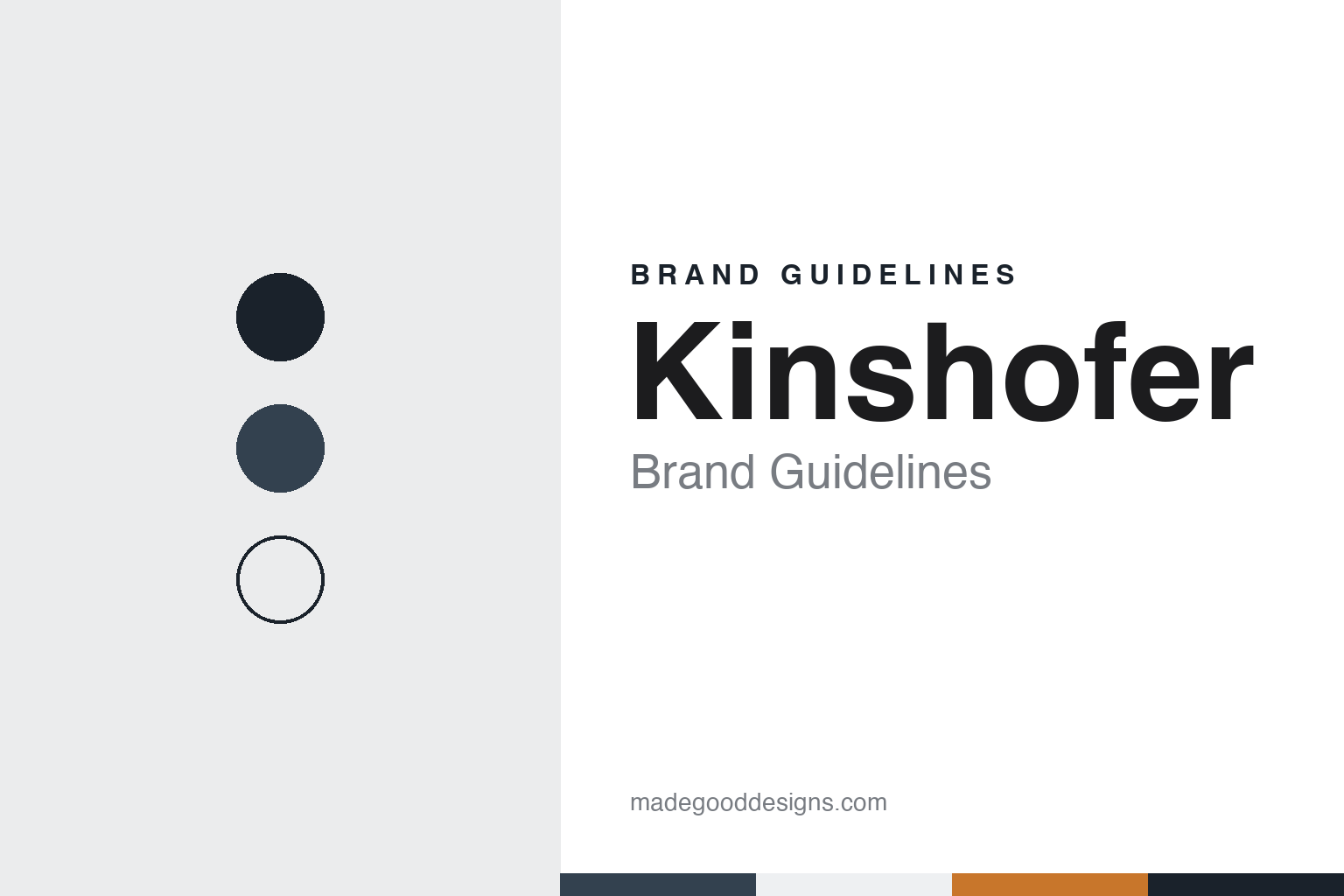
Kinshofer Brand Guidelines
The Bavarian crane and excavator attachment maker founded in Miesbach in 1971.
Aa
Two constants: a slate, amber and fog palette and an engineering grotesque register. Abstract homage — not a Kinshofer product or mark; no attachment, logo or nameplate is reproduced.
Kinshofer Maschinenbau Miesbach
From brickworks fittings to grabs.
Kinshofer is named after its founder. The company says Alfred Kinshofer founded Kinshofer Maschinenbau Miesbach in Miesbach, in Upper Bavaria, on 4 August 1971. At first the small business made bridge bearings, handrails and fittings for brickworks, such as tunnel kiln trucks and lifting and lowering devices for tile presses.
The brickworks connection pointed the way to its later trade. The company says work on its first brick stack grapple began in 1973, followed within a year by a pallet fork and a clamshell bucket. New production halls followed in eastern Miesbach in 1975 and 1977, and in 1979, by the company’s account, it developed its first rotator with 360-degree endless rotation. In 1980 the firm took the name Kinshofer Greiftechnik GmbH, “Greiftechnik” meaning grab technology, and made its first sales in the United States and the United Kingdom.
A British sales company, Kinshofer UK, followed in Stockport in 1984, and a French one in Strasbourg in 1987, the year the company says Alfred Kinshofer sold his shares while staying on as a consultant. In December 1990 the business moved into a new plant at Marienstein, a village that German Wikipedia places in the municipality of Waakirchen, in the same Miesbach district; the company describes it as its German manufacturing site today. It took its present name, Kinshofer GmbH, in 2006.
Colour
Grabs for cranes, tools for excavators.
Kinshofer works on two kinds of carrier. For loader cranes, the hydraulic cranes mounted on trucks, it makes clamshell buckets, brick stack grapples, pallet forks, timber and logging grapples, orange peel grapples for scrap and rotators. For excavators it makes quick couplers, tilt couplers, selector and demolition grabs, shears and pulverisers, augers and, through acquired brands, hydraulic breakers. Its website sorts all of this by trade: construction, demolition, scrap, railway work, forestry, landscaping and snow clearing among them.
Two technologies carry the brand’s own names. The company says it developed the patented HPXdrive in 2003, a cylinderless drive used on its grabs, and that the design won an iF award in silver for product design. The second is the NOX tiltrotator, which the company traces to its 2011 purchase of the Finnish firm Aponox in Hämeenlinna. A tiltrotator sits between an excavator arm and its tool, letting the tool turn through a full circle and tilt from side to side; Kinshofer describes the NOX as offering continuous 360-degree rotation and a tilt of up to 50 degrees each way, and has since added a smaller TR025 model for mini excavators.
The company makes its products in several countries. Besides Marienstein, it says it planned plants at Gmünd in Austria and České Velenice in the Czech Republic in 1997, with production starting the following year, and opened a factory at Sanborn, in New York State, in 2013, mainly for large demolition equipment. A Beijing company, Darda Kinshofer Construction Machinery, was founded in 2008, and the 2015 purchase of Auger Torque, the company says, added earth drills and trenchers for backhoes, skid steers and telehandlers as well as cranes and excavators. In 2023, the company says, it joined the Open-S alliance, a common standard for the hydraulic interface between machine couplers, tiltrotators and tools.
Typography
Attachments and the trade.
Excavator attachments are sold on what they let a machine do. A tiltrotator sits between the arm and the bucket so that the bucket can turn and tilt, and its makers tend to show it at work: a bucket angled along a trench in a city street, a ditch shaped beside a forest road in northern Sweden, a grab sorting stone on a building site. Hydraulic breakers are pictured against rock faces and concrete, demolition shears against steel, and quick couplers in close-up, where the meeting of tool and machine is the point of the picture.
Much of this trade began in the Nordic countries. engcon traces its tiltrotator to the mid-1980s in Jämtland, and Rototilt traces its name to a 1986 launch by Noreco of Umeå; in 2020 Rototilt and Steelwrist launched Open-S, a shared standard for fully automatic quick couplers, KHL reported. Breaker and demolition-tool makers in Italy, Finland, France, Germany and Japan complete the group of makers in these guides.
The makers meet their customers in person. Trade fairs such as bauma in Germany and Intermat in France, Conexpo in Las Vegas and national machinery shows are where new ranges are unveiled; engcon says it first showed its tiltrotator at a Stockholm fair in 1993, and Rototilt presented its Rototilt Control concept at bauma in 2022. Demonstration days, factory open houses and dealer events let operators try the equipment, and much selling goes through local dealers and sales companies.
This guide sets out what can be checked about each maker — who founded it, who owns it, and where it says its products are made — and marks clearly what rests on the company’s own word. The palettes and typefaces shown are our own interpretation, not the brands’ marks.
Aa
An engineering grotesque for a Bavarian attachment maker. (Specimen set in Archivo, a sans STAND-IN; NOT the Kinshofer logo.)
Kinshofer
A Swedish owner and a growing family of brands.
Kinshofer has belonged to a Swedish group since 2007. Vertikal.net reported on 13 August 2007 that the Swedish industrial company Lifco AB had bought Kinshofer GmbH, which it described as a German manufacturer of crane and excavator attachments, and that Lifco planned to run the business with its existing management and staff, with Kinshofer continuing to focus on the design, manufacture and sales of crane and excavator attachments. At the time, the report said, Lifco was made up of two business areas, Sorb Industries and a dental wholesaler, and was owned by Carl Bennet AB.
Under Lifco, Kinshofer has grown by buying other attachment makers. Before the sale it had already bought Liftall of Canada in 2000 and the Dutch demolition and recycling tool maker Demarec in 2006; afterwards came RF-System of Sweden, Auger Torque, Solesbee’s of Georgia and the Doherty group of New Zealand and Australia, the company says. The Construction Index reported on 1 March 2019 that Kinshofer had acquired a majority stake in Hammer, an Italian breaker maker, adding breakers to its range. The company lists further purchases since then, including Cangini Benne and Trevi Benne in Italy, Prolec in England, HGT in Germany, Eurosteel and GMT Equipment in the Netherlands, and, in 2026, Boscaro in Italy and Mozelt in Germany.
In 2019, the company says, it moved its headquarters from Marienstein to Holzkirchen, south of Munich, while production stayed at Marienstein. It now presents itself as the Kinshofer Group, with more than a dozen brands under one umbrella.
For a design guide, Kinshofer shows how a founder’s surname can become the umbrella name for a whole family of acquired brands. Compare engcon, another tiltrotator maker, and Liebherr, a construction machinery group founded in Germany. For this guide we use a slate blue-grey, an amber and a fog white with a sans, an unofficial interpretation; no product or logo is reproduced.
Explore & save
Keep Kinshofer’s identity on hand — save it to a board in the Made Good inspiration library.
Kinshofer identity set
Pin the Kinshofer slate, amber and fog palette and the engineering grotesque register to your own board.