McCloskey International Brand Guidelines
The trommel maker of Ontario and County Tyrone, kept as its own brand inside Metso.
Aa
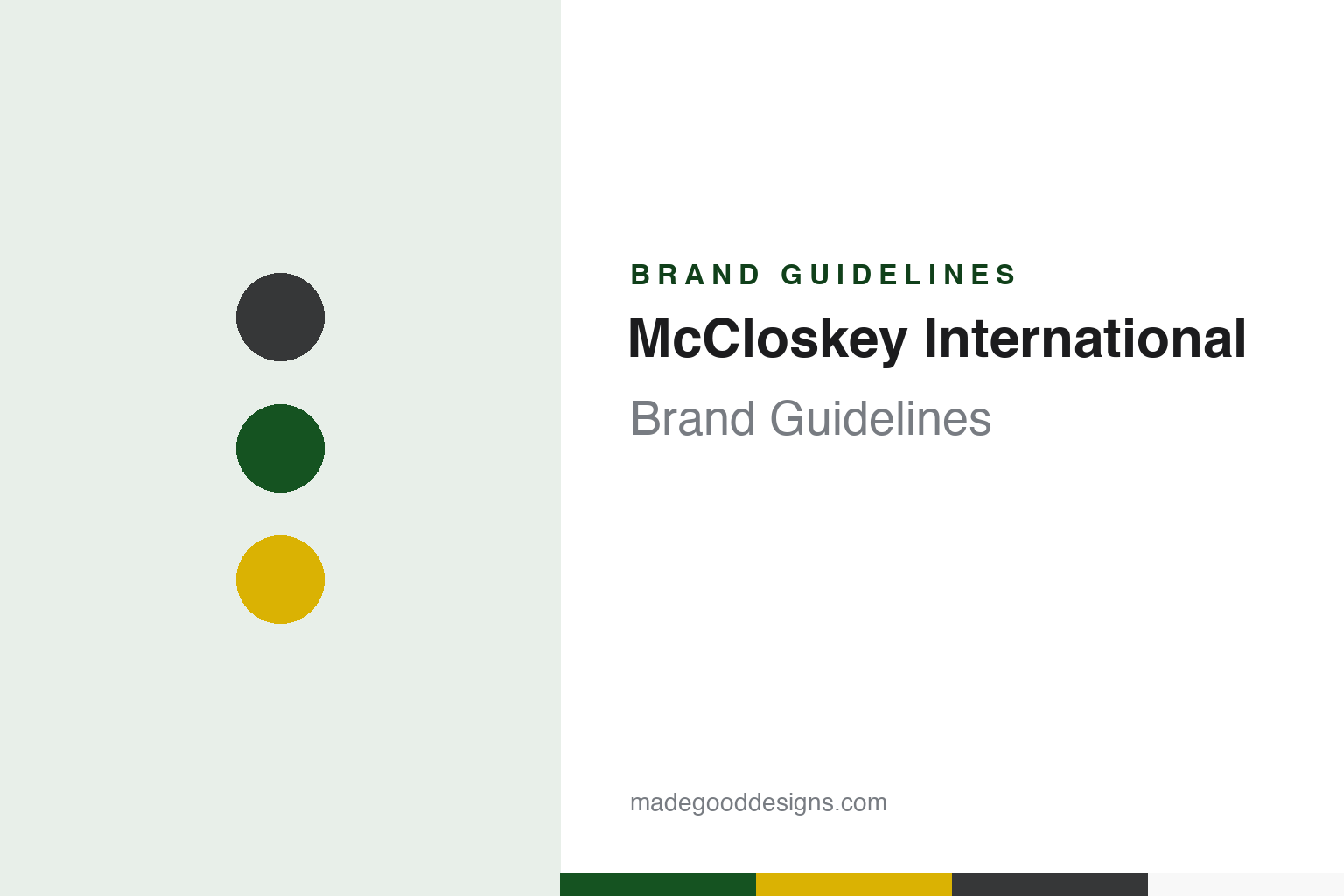
Two constants: a green, yellow and charcoal palette and a condensed gothic register. Abstract homage — not a McCloskey product or mark; no machine, logo or nameplate is reproduced.
Trommels first
A fabrication shop and a line of drum screens.
McCloskey International was founded in 1985 by Paschal McCloskey, the Irish Times reported in June 2019. The paper described him as born in County Derry, trained through a metalworking apprenticeship as a teenager, and arriving in Canada during the recession of the 1980s. After working there for a time, it said, he got the chance to buy a fabrication business that had gone bankrupt, and he built his machinery company from that purchase.
The company’s own account, published for its 40th anniversary in March 2025, adds the product. It says McCloskey emigrated in the early 1980s, began working in conveyor manufacturing, saw an opening in the market and started to produce his own line of trommels, the rotating drum screens used to sort material by size. It dates that first line to the late 1980s and says steady growth followed.
The business stayed Canadian in its headquarters while it grew on both sides of the Atlantic. On-Site magazine reported in June 2019 that its head office and main plant, 410,000 sq ft in size, stood just east of Peterborough, Ontario. Its website now gives the Canadian address as Keene, Ontario, and lists Coalisland in County Tyrone as its European office, along with an office at Gurugram in India and a parts base in Milwaukee, Wisconsin.
By the time of its sale the company employed about 900 people in Canada, the United States and Northern Ireland, according to the stock exchange release Metso issued on 10 June 2019.
Colour
Coalisland, Granville and the Tyrone factories.
Northern Ireland is the second half of the story. The Irish Times said McCloskey’s facilities there had been running since 2002, with sites at Coalisland and Granville employing more than 260 people in 2019. The company says that by the early 2000s it had expanded manufacturing to Northern Ireland, Canada and Wisconsin. KHL, the construction trade publisher, wrote in January 2022 that much of its manufacturing capacity was in Northern Ireland.
The quarrying title Hub-4 reported on a tour of the County Tyrone sites in December 2018. Granville, a 120,000 sq ft building, was described as a final assembly and test site with lines for crushers, screens and wash plants. The operations director said Killyman had become a fabrication and research centre, and that around 70% of sub-assemblies were done in-house. He also said the company runs and tests each machine before taking it apart for shipping. The washing range was first made at Clonoe, County Tyrone, the head of that division said; the washing division launched officially in 2016.
In March 2025 the company said Granville was being extended, with the build expected to finish later that year.
The range widened from trommels to a set of mobile plant. The website now groups it as crushers (cone, impact and jaw), screeners in R-Series and S-Series, stackers, trommels and washing systems. Hub-4 reported the recent purchase of Lippmann-Milwaukee, an American crusher maker, in December 2018, and KHL noted in April 2019 that it was still being folded into the group. At Bauma that month, KHL said, McCloskey showed the S250 screen, its entry into large-scale screening, together with the ST100 TF radial stacker and a redesigned 154R impact crusher. In 2026 the company took its J5 jaw crusher to CONEXPO in Las Vegas and then, for the European launch, to Hillhead at Buxton, its news pages say. In September 2026 it published a brochure for its electric and dual-power machines.
Typography
Design and documentation.
Crushing and shredding makers sell machines that are hard to photograph badly. The usual picture is a tracked crusher on a quarry bench, its conveyor throwing stone onto a stockpile, with the plant small against the rock face. A mobile screen in the maker’s signature colour, parked on the same bench, does the work of a logo at a distance, and many of these brands treat paint as part of the identity. Metso, for one, set out its machine colours in a dated release in 2021.
Waste machinery has a different picture. Shredder makers show the inside of the machine: a cut-away rotor with its cutters on display, or bales of plastic heading into a hopper. Compost screens and trommels appear in long windrows, and recycling yards are often shot from a drone, so the sorted heaps form a pattern from above.
Trade fairs give the sector its calendar. Bauma in Munich, CONEXPO-CON/AGG in Las Vegas and Hillhead in Britain gather the quarry trade, and IFAT in Munich gathers the waste and recycling trade. Metso’s Lokotrack went to Munich in 1986, Metso says, and Powerscreen used CONEXPO and Hillhead to mark its 60th anniversary in 2026. Fair stands are where these brands show new models beside restored old ones, and where dealers, who do much of the selling, meet the factory.
Product names carry unusual weight. Ranges are named as families, and a name can outlast the company that made it: several brands in this guide sit inside larger groups and keep their own names, colours and dealer networks. Ownership changes often, so each entry here gives dates for who owns what, and what each company says about where its machines are made.
Aa
A tall condensed gothic — the face McCloskey’s website uses for its headings. (Specimen set in League Gothic, a STAND-IN; NOT the McCloskey International logo.)
A brand kept apart
Metso’s second channel.
Metso, the Finnish industrial group, announced its agreement to buy McCloskey on 10 June 2019, describing it as a Canadian mobile crushing and screening manufacturer. Paschal McCloskey was then founder, president and chief executive; the Irish Times called the company one of Northern Ireland’s largest manufacturers. Metso combined its minerals business with Outotec in 2020 to form Metso Outotec, and the group took the name Metso again in May 2023, according to Wikipedia, citing the company.
The deal’s most useful detail for a brand reader is the promise attached to it. Metso said it planned to keep developing “the McCloskey brands and distribution channels independent of the Metso channel.” Toni Laaksonen, the McCloskey senior vice president interviewed by KHL in January 2022, described a strategy of reaching the market through several brands, with McCloskey strong among contractors. He also said that a new range of mobile cones had been introduced in cooperation with Metso Outotec, using technologies shared between the brands, and that McCloskey had opened some production in India.
The company’s website leads with its own name and products; its legal section lists terms for “Metso McCloskey USA.” The logo on the site is a heavy italic wordmark with INTERNATIONAL spaced out beneath it. The site’s stylesheet sets headings in League Gothic and body text in Arimo, with a dark green, a yellow hover colour and a charcoal menu. For its 40th year the company issued an anniversary version of the logo. Its aftermarket arm trades as MPP Aftermarket, and its telematics service as 365 SiteConnex.
The anniversary release leans on one phrase: McCloskey as a “trusted strategic partner” for dealers and customers. It speaks of an entrepreneurial spirit, and its vice president Darren McKnight says customers and dealers share that ambition. It sells through dealers, 90 companies by KHL’s count in April 2019.
For a design guide, McCloskey International shows how a bought company can stay a separate brand when its new owner has a reason to keep two channels. Compare Metso, its owner, and Powerscreen, another mobile crushing and screening name in County Tyrone, owned by Terex. For this guide we use a dark green, a yellow and a charcoal with a sans, an unofficial interpretation; no product or logo is reproduced.
Explore & save
Keep McCloskey International’s identity on hand — save it to a board in the Made Good inspiration library.
McCloskey International identity set
Pin the McCloskey International green, yellow and charcoal palette and the condensed gothic register to your own board.