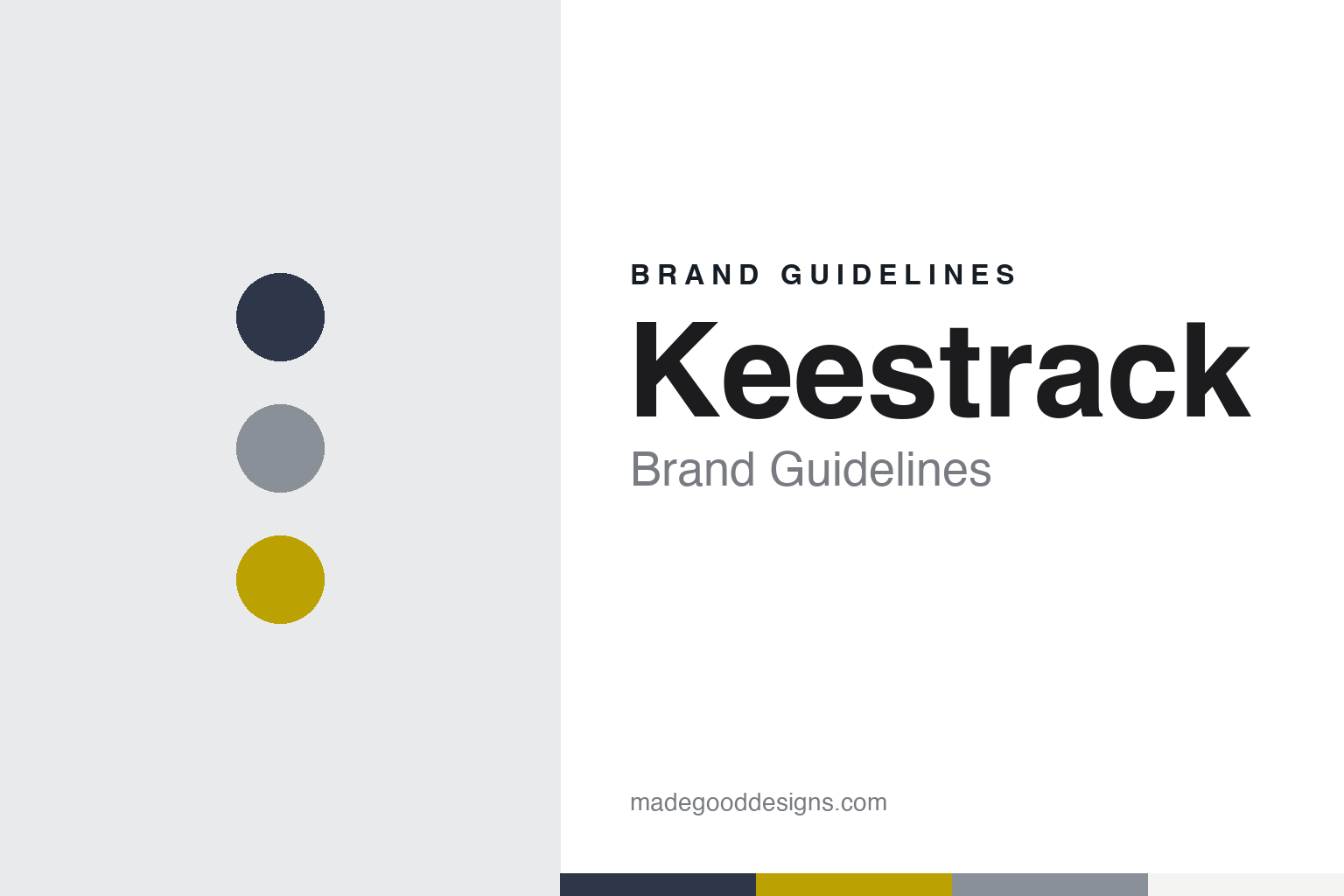
Keestrack Brand Guidelines
The Belgian family screen maker that Terex agreed to buy in 2026.
Aa
Two constants: a gold, grey and slate palette and a heavy grotesque register. Abstract homage — not a Keestrack product or mark; no machine, logo or nameplate is reproduced.
A trading firm and a screen
Two dates, one couple.
Keestrack has two founding dates in print. The company’s website says 1988, when Kees Hoogendoorn and his wife Annet Schoenmaker began a trading company, and Terex used the same year in October 2026. Made in, the Flemish business title, reported on 12 March 2021 that Keestrack was set up in 1996 by the same couple, who had moved from the Netherlands to Belgian Limburg in their twenties. 1996 is also the year the company gives for its first machine.
Its history page tells that part simply. In 1994 Hoogendoorn had the idea for a direct-feed scalper and pitched it to manufacturers, who showed no interest. So in 1996 he designed and built the first himself. The company names that machine as the forerunner of today’s K6, which its product page calls “the original” in the range.
In 2022 its marketing manager gave another origin detail: the company had started with crushers and screens used mainly in recycling, he said, because the Netherlands and Belgium lacked raw materials.
The head office stays in Belgium. The website footer gives Bilzen-Hoeselt, in Belgian Limburg; the Red Dot listing and its contact page use Munsterbilzen, and Made in called it a Bilzen family firm with only about 30 people at head office in 2021.
Colour
Šternberk, Ponzano Veneto, Chuzhou.
Most of Keestrack’s staff work outside Belgium. Its history page sets out the spread: a production site in the Czech Republic in 2001, a Chinese subsidiary at Chuzhou in 2007, and in 2010 the purchase of OM, an Italian jaw crusher maker. An American headquarters opened at Krum, Texas, in 2016; an Indian subsidiary followed in 2017 and a Turkish one in 2023.
The Czech plant is at Šternberk, according to the company’s contact page, and English Wikipedia names Keestrack CZ as the largest industrial company headquartered in that town, with more than 500 employees. Made in counted about 500 there in 2021, out of 820 worldwide. The company’s current website says more than 1,100 employees. In 2022 it described Italy, the Czech Republic, China and India as production countries, with parts, logistics and administration in Belgium; the Italian site is at Ponzano Veneto, near Treviso, and the Indian operation trades as Etrack Crushers, which the company says began manufacturing in 2019. Dealroom, in its report on the Terex deal, added Turkey to that list of production sites.
The range grew in steps the company dates itself: impact crushers in 2004, cone crushers in 2011, stackers in 2014, a reversible impact crusher, the I4e, in 2022 and a shredder in 2024. It is lettered by type, with B for jaw crushers, H for cones, R for impact crushers and K for scalpers.
The company dates its first plug-in electric machine to 2012, and in 2021 it introduced the ZERO range, with machines that run entirely on plug-in electricity and carry no combustion engine. The product pages describe e-drive as a hybrid of diesel and electric, and ZERO-drive as fully electric. In October 2026 Keestrack-CZ reported third place in a Czech award for Industry 4.0, given by the Czech Confederation of Industry and the Ministry of Industry.
In March 2021 the group went outside its field. It agreed to buy Goldoni, the Italian maker of small tractors founded in 1927, whose factory at Migliarina di Carpi, near Modena, had been for sale. Made in reported that Keestrack was the only bidder.
Typography
Design and documentation.
Crushing and shredding makers sell machines that are hard to photograph badly. The usual picture is a tracked crusher on a quarry bench, its conveyor throwing stone onto a stockpile, with the plant small against the rock face. A mobile screen in the maker’s signature colour, parked on the same bench, does the work of a logo at a distance, and many of these brands treat paint as part of the identity. Metso, for one, set out its machine colours in a dated release in 2021.
Waste machinery has a different picture. Shredder makers show the inside of the machine: a cut-away rotor with its cutters on display, or bales of plastic heading into a hopper. Compost screens and trommels appear in long windrows, and recycling yards are often shot from a drone, so the sorted heaps form a pattern from above.
Trade fairs give the sector its calendar. Bauma in Munich, CONEXPO-CON/AGG in Las Vegas and Hillhead in Britain gather the quarry trade, and IFAT in Munich gathers the waste and recycling trade. Metso’s Lokotrack went to Munich in 1986, Metso says, and Powerscreen used CONEXPO and Hillhead to mark its 60th anniversary in 2026. Fair stands are where these brands show new models beside restored old ones, and where dealers, who do much of the selling, meet the factory.
Product names carry unusual weight. Ranges are named as families, and a name can outlast the company that made it: several brands in this guide sit inside larger groups and keep their own names, colours and dealer networks. Ownership changes often, so each entry here gives dates for who owns what, and what each company says about where its machines are made.
Aa
A heavy grotesque — close in weight to the bold name in Keestrack’s logo. (Specimen set in Archivo, a sans STAND-IN; NOT the Keestrack logo.)
The R3e and the logo
A crusher with a designer’s credit.
Keestrack’s clearest design record is a single machine. The R3e, a mobile impact crusher with electric drives and a plug-in connector, won a Red Dot award for product design in 2018. The Red Dot listing credits RDD Design Network and Rainer Atzlinger, of Ried im Traunkreis in Austria, as designers. It cites openable lightweight panelling that gives access to the components, and dynamic lines; the jury wrote that the “modern, powerful design” expresses “strong self-confidence.” The trade magazine AT Minerals reported in 2018 that the panelling used composite materials. The company’s history page says the R3e took several design awards that year.
Keestrack’s website logo shows a grey angled shape above the name, which is set in a bold golden yellow. The logo is gold and grey, and the site adds a dark slate. The family resemblance reached Goldoni: when the tractor brand revealed a restyled logo in February 2022, its statement said the design refers to the Keestrack company logo, while keeping Goldoni’s red.
Its language is that of a family firm. The “Our story” page opens with “We are family” and says the business has been continuously 100% privately owned since its foundation; “A lasting track of motion” heads the history page.
On 30 October 2026, Terex, the American group, announced a definitive agreement to acquire Keestrack, the company’s own news page and Heavy Equipment Guide reported. Financial terms were not disclosed. The transaction was expected to close in the fourth quarter of 2026, subject to regulatory approvals and closing conditions, with Keestrack operating independently until then. Terex said Keestrack would continue as an independent brand within Terex Materials Processing, the division whose brands include Powerscreen. Peter and Frederik Hoogendoorn were to stay in leadership roles, while Kees and Annet Hoogendoorn would support the business during a transition. Kees Hoogendoorn was quoted as co-founder and president of Keestrack Group. The announcement put the network at more than 70 distributors in more than 65 countries.
For a design guide, Keestrack shows how a family maker can build a design record around one machine. Compare Terex, the agreed buyer, and Powerscreen, the mobile screening brand it would sit beside. For this guide we use a gold, a grey and a dark slate with a sans, an unofficial interpretation; no product or logo is reproduced.
Explore & save
Keep Keestrack’s identity on hand — save it to a board in the Made Good inspiration library.
Keestrack identity set
Pin the Keestrack gold, grey and slate palette and the heavy grotesque register to your own board.