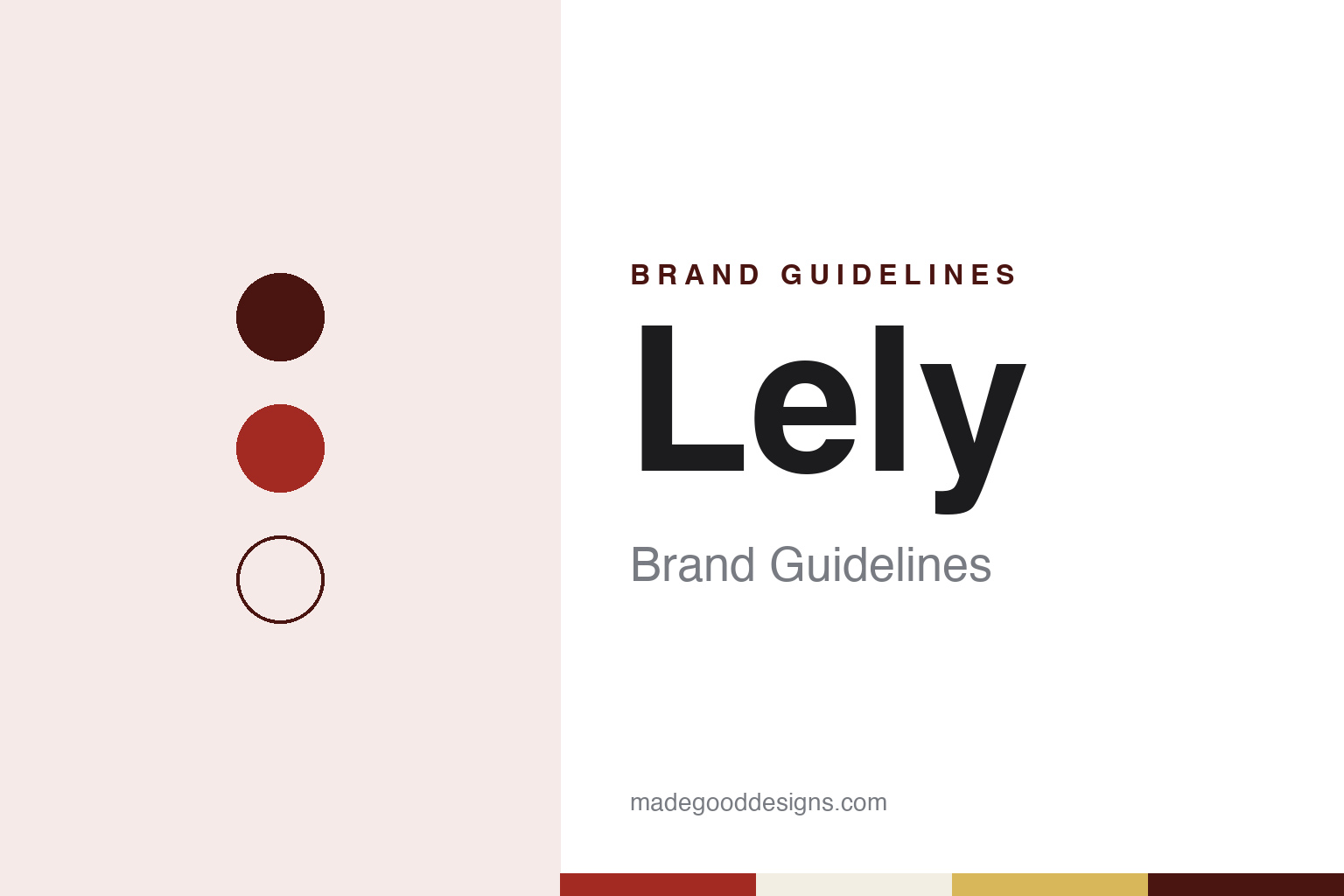
Lely Brand Guidelines
Two brothers, a finger-wheel rake and a robot named for its freedom to move.
Aa
Two constants: a Lely barn red and cream palette and a Geometric sans register. Abstract homage — not a Lely product or mark; no machine, logo or nameplate is reproduced.
Beside the farm
Two brothers and a licensed rake.
Lely began on a farm. The Historisch Jaarboek Westland, in a 2017 history of the company by Mellanie Vellekoop-Spuij, says the brothers Cornelis and Arij van der Lely grew up on the family farm on the Weverskade, then in Maasland, and started their business beside it. Around 1964 a boundary change moved the site into Maassluis, which is why Dutch Wikipedia gives Maasland as the place of founding and English Wikipedia gives Maassluis. The yearbook says a small part of the company is still based at the old address.
The first product was an idea rather than a machine. Lely says its first successful patent was registered on 2 June 1948, for a finger wheel rake called the Lely Acrobat, and it counts that date as the company’s start; Dutch Wikipedia says the patent was made public that September. The brothers held the patent and did not build the rake themselves. They licensed it to other makers, the yearbook says, and did the same with later inventions. Dutch Wikipedia says the business became a public limited company in 1953.
Building its own machines came next. Lely says its single-disc fertiliser spreader, which it dates to 1957 and the yearbook to 1958, was the first product it made in series itself. The Lotus hooktine followed, in 1965 according to the yearbook and 1967 according to Lely, and the Lelyterra power harrow of 1968 took the company abroad, with about fifteen other manufacturers building it under licence, the yearbook says. There were sidesteps too. From 1965 to 1981 Lely made prefabricated bungalows in its old hall, and in 1963 it took a majority stake in the German combine maker Dechentreiter, whose plant later went to Fendt, according to Dutch Wikipedia. The yearbook credits Cornelis alone with some 2,000 inventions, from tractors to hovercraft, watches and parasol stands.
Colour
The Astronaut.
The company’s turn to robots started with a hire. Dutch television showed a research milking robot from Oenkerk in Friesland in December 1984, the yearbook says, and in 1985 the brothers took on a young electrical engineer, Karel van den Berg, with a single task: to build a system that could milk cows without a person present. Two employees worked on it at first, in parallel with colleagues at Lely’s site in Switzerland. By 1988 it had given up on detecting teats with sound waves and moved to laser. The European Patent Office says the first two patent applications were filed in 1986.
In August 1992 the first Astronaut went into use on a Dutch dairy farm, according to the yearbook; Lely says prototypes went to two farms that year. Dates for the market launch differ: the European Patent Office gives 1994, and Lely gives 1995. The yearbook says one robot was sold in 1992, two in 1993 and four in 1994, and that visits to working farms and live milking at the 1997 Landbouw-RAI fair in Amsterdam helped change opinion.
The name has a story of its own, and the European Patent Office tells it: an astronaut is linked to the spacecraft by a cord yet free to move, and the arm under the cow was meant to give it the same freedom. Van den Berg and Alexander van der Lely, son of Cornelis, were finalists in the Industry category of the 2019 European Inventor Award, when the Office put the number of Astronauts on farms at around 30,000.
The range then spread through the barn: the Discovery manure robot of 2005, the Juno feed pusher of 2008 and the Vector automated feeding system of 2012. Lely says it has since sold 10,000 of its Discovery Collector, and that the Horizon platform replaced its older T4C farm software in 2020.
Typography
Design and documentation.
Farm technology makers sell to a small, expert audience, and they tend to show the machine at work rather than on a plinth. A milking robot is photographed in a working barn with a calm herd around it, often under the cool blue light of a modern parlour. A feed robot, usually in clean red and white, glides along a barn aisle with no driver in sight. The pictures make one argument again and again: the work carries on while the farmer is elsewhere.
Poultry and hatchery equipment has a different geometry. Long feed lines and drinker lines run down the length of a house to a vanishing point, and hatchery trays stack into tall, regular grids. These are images of repetition, and they suit a trade in which a single building holds a very long run of identical equipment. Irrigation goes the other way, from inside to overhead: drip lines are shown from the air, running through green rows in thin, straight strokes.
The trade meets face to face at a handful of fairs. EuroTier and Agritechnica in Hanover, World Dairy Expo in Madison, Wisconsin, and the VIV shows for the poultry and livestock industries are where new ranges appear, and some of the awards these companies quote come from such events.
Many of these names are old, and many have changed hands. Family firms, industrial groups and investment companies all appear in this guide, and a founder’s surname often outlives the founder’s company. This guide sets out what can be checked about each brand: who started it, who owns it now, and what it says about where its products are made.
Aa
A geometric sans — a machine register for a family firm. (Specimen set in Sora, a sans STAND-IN; NOT the Lely logo.)
Lely
From grassland machines to dairy robots.
Lely narrowed itself in stages. Until 2000 it still made mowers, tedders, harrows and spreaders alongside robots, and the yearbook says management then concluded it made too many things: in 2001 it dropped the arable machines, including the Lelyterra, to concentrate on cattle farming. The second step came in March 2017, when the Irish Farmers Journal reported that AGCO, the American group that also owns Fendt, had reached an agreement in principle to buy Lely’s forage division, which made balers and loader wagons; English Wikipedia names its German plants as Waldstetten and Wolfenbüttel. Dutch Wikipedia says Lely has since concentrated on robots and data systems for dairy farms.
That division had also brought Lely a design award. The Lely Welger RPC 445 Tornado baler, developed with Flex/the Innovation lab, won in the product category of the Dutch Design Awards in 2010, with a jury that praised its automotive approach to a farm machine.
Ownership has stayed in the family while management has not. Lely calls itself an international family-owned business and says that in 2020 André van Troost became its first CEO from outside the family, as a new Supervisory Board was set up under Alexander van der Lely. Alexander had been chief executive since 2004, the European Patent Office says.
The company says it now has 2,800 employees and works with more than 44,000 farmers in over 50 countries. Dutch Wikipedia gives its production sites as Maassluis and Pella, Iowa, where English Wikipedia says North American assembly began on the Vermeer campus in 2011 and moved to a new building in 2022. The Maassluis Lely Campus was occupied in 2013, the yearbook says, opened officially in 2014, Lely says, and expanded in 2022. Colour has become part of the language: Lely marked its 75th year in 2023 as “Red Impact,” and calls its product launch events the “Yellow Revolution.”
For a design guide, Lely shows how a good product name can carry a company’s whole change of direction. Compare DeLaval, its Swedish counterpart in milking robots, and Fendt, which runs through Lely’s history twice. For this guide we use a barn red, a cream and a straw with a sans, an unofficial interpretation; no product or logo is reproduced.
Explore & save
Keep Lely’s identity on hand — save it to a board in the Made Good inspiration library.
Lely identity set
Pin the Lely barn red and cream palette and the Geometric sans register to your own board.