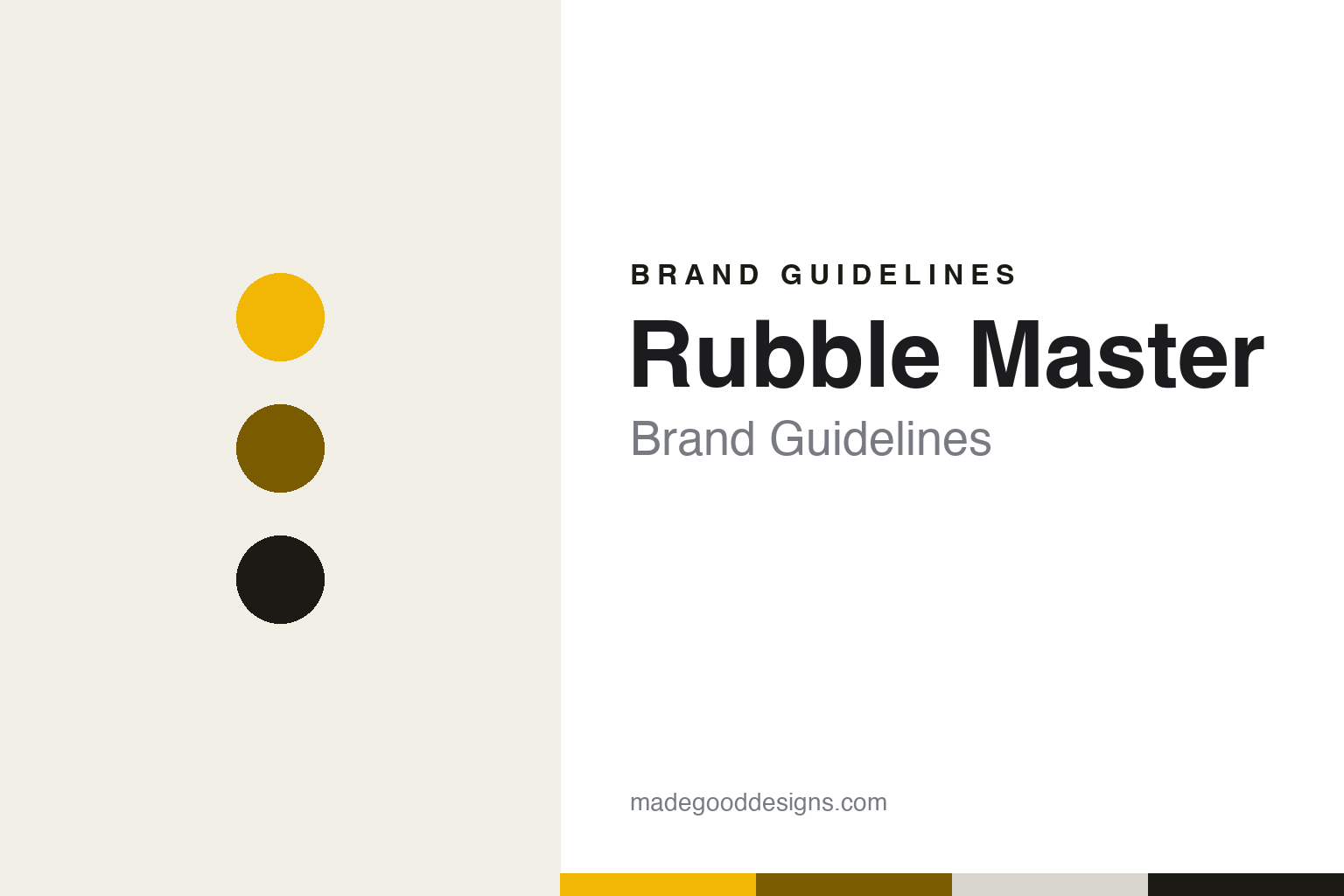
Rubble Master Brand Guidelines
The Linz firm that built its name on compact crushers.
Aa
Two constants: a yellow, ochre and steel palette and a compact sans register. Abstract homage — not a Rubble Master product or mark; no machine, logo or nameplate is reproduced.
A garage in Linz
A compact machine for recycling on site.
Rubble Master was founded in Linz, Austria, in 1991 by Gerald Hanisch. The City of Linz, in a company profile published by its economy department, says Hanisch, an engineer, saw in the early 1990s that there were no suitable compact machines for recycling construction waste, and that the firm set out to build them for small construction companies and municipalities. The aim, the same profile says, was to reuse mineral building materials such as concrete and asphalt after demolition.
The start was small. The trade publisher KHL, in a profile of Hanisch in June 2017, wrote that the first research and development department was housed in a garage. The company’s own account speaks of a small office in Linz and a rented unit. Hanisch told KHL the firm was determined to work internationally from the beginning, and he recalled working in sales, service and parts himself in the early days, in contact with customers in the field.
The first machine named in that history is the RM50, a compact recycling crusher launched soon after the company began. Five years passed before the next model, the RM60, which Hanisch described to KHL as crucial to the development of the company because of its crushing chamber and mono block impact curtain.
Bigger products needed more room. KHL dates the move to a new factory to 2001 and an expansion to seven years later; the company dates its Linz-Pichling headquarters to 2001 and an extension to 2009. The site is in the Südpark industrial park, where the firm has stayed for most of its history, the City of Linz says.
Colour
From a single crusher to the RM Group.
The new factory, Hanisch told KHL, made possible the RM70, the RM100 and the GO! range. It coincided with what KHL calls the company’s international breakthrough, with the RM80, a flexible impact crusher; the magazine AT Minerals dates the breakthrough to 2000. In 2003 the firm launched its first screens and a mobile oversize material separator, and in 2004 it opened a service centre in Linz, KHL reported.
For its 25th anniversary the company held an event for customers and dealers called Xperience Days, with outdoor demonstrations at the Linz site. A large part of the demonstrations, KHL reported, went to the RM120GO!, which Hanisch said was developed so that a mobile RM crusher could work in both recycling and natural stone. The same event introduced Go!Smart, a machine monitoring system designed to work with phones and tablets.
In 2018 the group grew by acquisition. Hub-4 reported on 13 April that year that Rubble Master had become majority owner of Maximus, a maker of mobile tracked screens founded in Northern Ireland in 2004. Maximus was based at Coalisland, County Tyrone, and at first both brands were to continue, with a jointly developed compact screen, the RM HS3500M, as the first result. Hanisch said at the time that the Maximus products matched RM’s crushers and its expansion plans.
That arrangement lasted less than two years. KHL reported on 21 January 2020 that Maximus had taken the group’s name and was now RM Dungannon, with a product range in the same yellow branding as the Linz machines. Hanisch called the change the next logical step towards one brand name, the RM Group.
The headquarters kept growing too. Hub-4 reported an expansion of the Linz-Pichling site in October 2019, under the managing directors Hanisch and Günther Weissenberger. The regional paper Tips reported in April 2022 that the group had bought an office and production building in the Südpark in 2021, and that it aimed to deliver 1,000 crushers and screens a year by 2027. A profile of the group by die Macher mentioned a further production hall at Linz.
Typography
Machines that move to the job.
Crushing and shredding makers sell machines that are hard to photograph badly. The usual picture is a tracked crusher on a quarry bench, its conveyor throwing stone onto a stockpile, with the plant small against the rock face. A mobile screen in the maker’s signature colour, parked on the same bench, does the work of a logo at a distance, and many of these brands treat paint as part of the identity. Metso, for one, set out its machine colours in a dated release in 2021.
Waste machinery has a different picture. Shredder makers show the inside of the machine: a cut-away rotor with its cutters on display, or bales of plastic heading into a hopper. Compost screens and trommels appear in long windrows, and recycling yards are often shot from a drone, so the sorted heaps form a pattern from above.
Trade fairs give the sector its calendar. Bauma in Munich, CONEXPO-CON/AGG in Las Vegas and Hillhead in Britain gather the quarry trade, and IFAT in Munich gathers the waste and recycling trade. Metso’s Lokotrack went to Munich in 1986, Metso says, and Powerscreen used CONEXPO and Hillhead to mark its 60th anniversary in 2026. Fair stands are where these brands show new models beside restored old ones, and where dealers, who do much of the selling, meet the factory.
Product names carry unusual weight. Ranges are named as families, and a name can outlast the company that made it: several brands in this guide sit inside larger groups and keep their own names, colours and dealer networks. Ownership changes often, so each entry here gives dates for who owns what, and what each company says about where its machines are made.
Aa
A heavy, compact sans for a firm known for compact machines. (Specimen set in Archivo, a sans STAND-IN; NOT the Rubble Master logo.)
One brand name
Yellow, and the initials RM.
KHL described the Dungannon range as carrying the same yellow branding after the 2020 name change. The company itself uses the name in capitals, RUBBLE MASTER, and shortens it to RM in its machine names, from the RM 70GO! 2.0 and RM 120 X crushers to the RM HS7500M scalping screen.
The range widened again with the RM J110X, the firm’s first jaw crusher, which AT Minerals reported in 2024 as available with a diesel-hydraulic drive or as an electrified hybrid. Hanisch, whom the magazine called the “founder, owner and face of the RM Group,” compared the move to “David against Goliath.” The company’s website now lists impact crushers, a mobile jaw crusher, scalping screens, incline screens, compact screens and electric crushing.
Rubble Master is still in its founder’s hands. Its press page reports that Weissenberger, earlier the chief financial officer, has succeeded Hanisch as chief executive, while Hanisch withdraws from the operational business and concentrates on his role as owner.
The company’s website marks Linz as its headquarters and factory and Dungannon as a second factory, with sales offices in Switzerland, at Ennis in Texas and in Singapore; die Macher reported that the Singapore office opened in 2023. AT Minerals gave an export rate of 96% for 2023, and the City of Linz gives 95 to 98%, with more than 300 employees worldwide, most of them in Linz.
For a design guide, Rubble Master shows how a single colour and two initials can carry a brand across an acquired factory and a widening range. Compare Keestrack, another European maker of tracked crushers and screens, and McCloskey International. For this guide we use yellow, ochre and steel with a sans, an unofficial interpretation; no product or logo is reproduced.
Explore & save
Keep Rubble Master’s identity on hand — save it to a board in the Made Good inspiration library.
Rubble Master identity set
Pin the Rubble Master yellow, ochre and steel palette and the compact sans register to your own board.