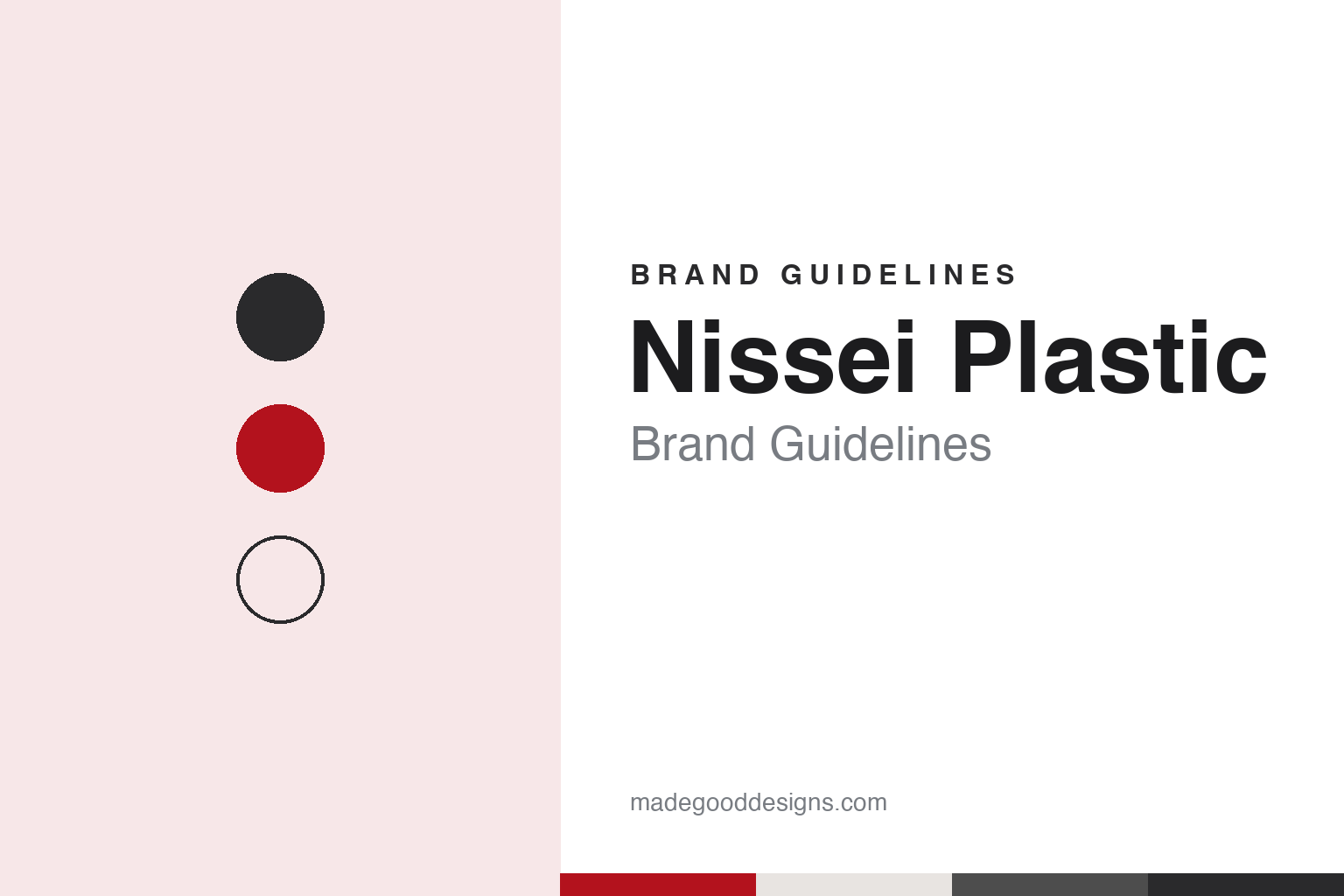
Nissei Plastic Brand Guidelines
The Nagano workshop that spelled its idea out in RED.
Aa
Two constants: a Nissei red and warm grey palette and an Engineering sans register. Abstract homage — not a Nissei Plastic product or mark; no machine, logo or nameplate is reproduced.
Sakaki
A plastics workshop in a Nagano hometown.
Nissei Plastic Industrial began in October 1947. Its company history says the founder, Katashi Aoki, came back from Manchuria after the war and started a business “for the purpose of engaging in plastics processing and development of related machinery” at the site the company still occupies, in his hometown of Sakaki in Nagano. Its profile gives the date as 15 October 1947, and Japanese Wikipedia gives the same day for the founding. The legal form came later: a limited partnership, Nissei Plastic Seisakusho, in July 1951, and the present Nissei Plastic Industrial Co., Ltd. in May 1957.
The company’s account of itself is a processor’s account. Nissei America’s history sheet says the firm makes moulding machines with “their founding spirit of being a molding processor as its root,” and gives Aoki’s motto as “Going Specific, Deeper, and Unlimited.” The company’s website repeats the idea that he took what he had learned on factory floors into the design of machines.
Aoki’s personal record is well documented outside the company. The Plastics Hall of Fame credits him with 932 patents, the Medal with Purple Ribbon from the Japanese government in 1963 and the Order of the Sacred Treasure in 1983; Plastics Machinery Manufacturing reported in 2018 that he was inducted into the Hall of Fame in 2011. Nissei says he became the first chairman of the Japan Plastics Machinery Association in 1975.
There is an unexpected footnote in toy history. Japanese Wikipedia says Aoki worked with Wako Jushi on a plastic model of the Nissan Datsun 1000, finished around October 1958 and sold through the Marusan company, and it describes the kit as Japan’s first domestic car plastic model. It adds that Nissei later made its own model kits of injection moulding machines as trade show and factory-tour gifts, in five versions at 1/20 and 1/12 scale, the first developed with help from Tamiya.
The family line continued into the present management. Aoki’s grandson Hozumi Yoda joined in 1989, Plastics Machinery Manufacturing reported in 2018, and became president in 2001, according to the company.
Colour
From YD-2 to electric drives.
Nissei’s technical timeline is its main public story. The first model, the YD-2, went on sale in 1957. The AU-1 became its first export in 1960, shipped to the United States. In 1961 it developed the rotary ram type in-line screw injection mechanism, which the company lists among its most important patented mechanisms; Yoda named the same development first when Plastics Machinery Manufacturing asked him in 2018 which of the company’s developments had mattered most.
The list continues through several machine types. Nissei dates the vertical TN-25B to 1962, the two-colour DC type to 1964, and the IB-M to 1967, which it calls the world’s first injection blow moulding machine. The low-noise FS-75 followed in 1971 and won the 3rd Annual Plastics Grand Prize, the company says. In 1983 came the MM-5, which Nissei describes as “the world’s first electric servomotor driven injection molding machine,” a claim Yoda repeated in the 2018 interview.
Since then the company has kept two drive families. Its website says that when other Japanese makers moved to all-electric machines as their main products, it developed a hybrid machine in which a servomotor drives the hydraulic pump, and that it offers “both all-electric and hybrid drives as their two pillars.” The all-electric NEX Series dates to 2002, and the hybrid PNX Series with the X-Pump system, which Yoda holds a patent on, to 2005. X-Pump machines received an energy-conservation machinery award from the Japan Machinery Federation in 2007, the company says. The later FWX hybrid series reached the FWX2050III-1100L, for which orders opened in 2021.
Plastics Machinery Manufacturing summarised the range in November 2025 as small-tonnage all-electric machines plus hydraulic and hybrid presses in a wide range of sizes, including super-large presses of more than 2,000 tons of clamping force, used in markets such as automotive, housing and construction.
Materials are a second thread. Nissei dates its N-PLAjet system for moulding plant-based polylactic acid to 2010, and says thin-wall champagne glasses, 0.65 mm at the thinnest point, were moulded in the material at K 2019 in Germany. A Japanese content series, NISSEI RED NOTE, covers the same subject. The company also opened the Nissei School for training in 1968, and its profile lists hundreds of staff who hold national injection moulding qualifications. Cumulative sales reached 100,000 machines in January 2006 and 140,000 in December 2020, by its count.
Typography
Machines as brand.
Injection moulding machine makers sell equipment that most people never see, so their visual language is built for a trade audience. The machine itself is usually the hero: a long horizontal body photographed side-on in factory light, often in a paint scheme the maker has kept for years. A colour on the guarding can do the work of a logo across a crowded production hall.
The second recurring picture is the open machine. Platens stand apart with a mould half showing, and a robot arm reaches in to lift a part from the tool. Close-ups of screws and barrels show the plasticising end of the process, where granulate becomes melt, and walls of moulded samples turn an abstract capability into objects a visitor can pick up: closures, housings, gears and containers. Where makers serve cleanroom production, the same machines appear inside enclosed, brightly lit cells.
Trade fairs give makers a place to show a machine running: K in Düsseldorf, Fakuma in Friedrichshafen, NPE in the United States and Chinaplas in Asia. Live moulding demonstrations make parts in front of visitors.
Behind the machines sits a quieter layer of typography and naming. Series names, short codes and clamping forces in kilonewtons carry much of the information, and controllers have become design objects in their own right, with screens and panels of their own. Many makers remain family-held or sit within larger groups, so names and marks can outlast changes of ownership, and the history is often part of the pitch.
Aa
An engineering sans for a company that spells out RED. (Specimen set in IBM Plex Sans, a sans STAND-IN; NOT the Nissei Plastic logo.)
Nissei Plastic
A listed company for 34 years, now a subsidiary.
The ownership story has changed recently. Nissei listed on the Nagoya Stock Exchange in 1991 and in Tokyo in 2000, moving to the first sections in 2001. On 14 November 2025 it and TOYO Innovex of Akashi, in Hyogo, signed an agreement to form a joint holding company, and on 1 April 2026 GMS Group was established in Tokyo with both as wholly owned subsidiaries. Japanese Wikipedia dates Nissei’s delisting to March 2026. Nissei’s own profile now names GMS Group as its parent with 100% ownership. Plastics Machinery Manufacturing reported that Yoda would be chairman and chief executive of the group and Yoshiaki Tabata of TOYO president and chief operating officer, and the trade title Logistics Today reported in January 2026 that the group would use the phrase “Global Molding Solution.” TOYO Innovex, formerly Toyo Machinery & Metal, traces its start to 1925, Japanese Wikipedia says, and makes die casting machines as well as moulding machines.
Nissei had already begun buying abroad and at home. In 2017 it set up Nissei Homma Machinery in Akashi to take over the business of Homma Machinery. In January 2020 it took 75% of the Italian moulding machine maker Negri Bossi, which it says dates from 1947, after Plastics Machinery Manufacturing reported in December 2019 that it wanted a stronger reach in Europe.
Production has followed the same path. The company’s head office and factory remain at Sakaki, with parts made by Nissei Metal Works at Joetsu. Its first overseas production subsidiary opened at Taicang, China, in 2009, followed by Rayong in Thailand, where its factory began work in 2013, and Haiyan, China, in 2024. A factory in San Antonio, Texas, opened in 2018, Negri Bossi builds at Cologno Monzese near Milan, and the corporate profile now lists a site at Ahmedabad in India.
Its brand language plays on three letters. Under the heading “UNIQUE VALUE,” the website sets out the words “NISSEI Reinforcing an Engineering Design” with the initials R, E and D marked separately, and another page gives its aspiration as “Never Stop Exploring.” The name of the NISSEI RED NOTE series uses the same three letters.
For a design guide, Nissei Plastic shows how a machine maker can build a line of copy around three initials. Compare Haitian, another Asian maker that has bought a brand abroad, and Sodick, another Japanese moulding machine maker. For this guide we use a red, a charcoal and a warm grey with a sans, an unofficial interpretation; no product or logo is reproduced.
Explore & save
Keep Nissei Plastic’s identity on hand — save it to a board in the Made Good inspiration library.
Nissei Plastic identity set
Pin the Nissei red and warm grey palette and the Engineering sans register to your own board.