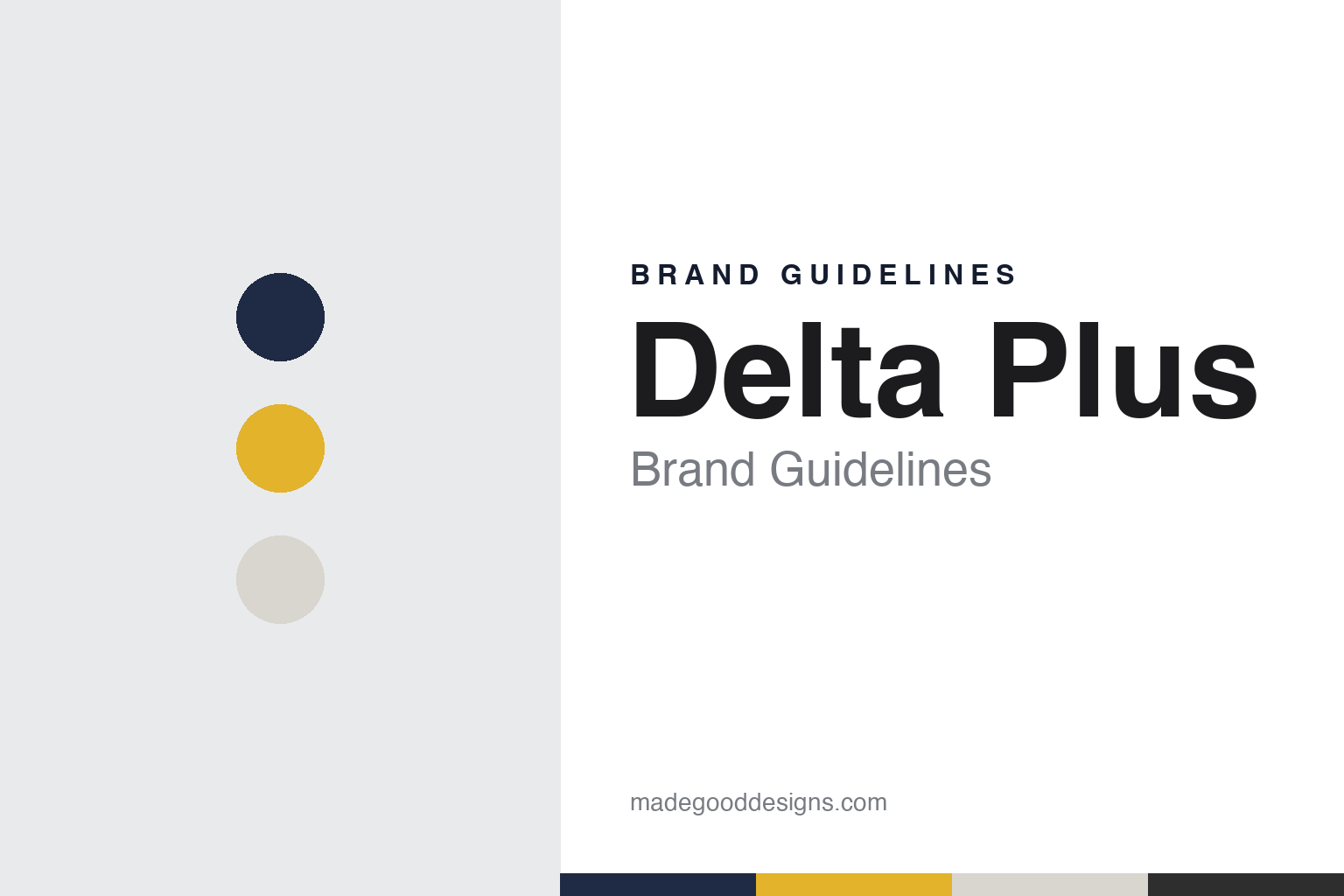
Delta Plus Brand Guidelines
The Apt family firm that grew from rainwear to head-to-toe protective equipment.
Aa
Two constants: a navy, yellow and limestone palette of our own and a condensed sans register. Abstract homage — not a Delta Plus product or mark; no garment, logo or label is reproduced.
Apt, 1977
Rainwear, boots and gloves from a small town in Provence.
Delta Plus began in 1977 in Apt, a market town in the Vaucluse in Provence. The company says Jacques Benoit based the business there that year, at a time when, in its words, the personal protective equipment trade “still had a long way to go.” French and English Wikipedia give the same year and the same town, and Apt is still the group’s base: Le Journal des Entreprises described Delta Plus in April 2026 as a family-run, independent group based in Apt.
It started as a seller rather than a maker. The company says Benoit first marketed rainwear and protective boots, then work gloves, and French Wikipedia describes Delta Plus in the 1980s as a trader and importer of protective equipment, mainly leather gloves and rain gear. In that decade Benoit created a rain suit called the 304, which the company calls “a huge success.”
French Wikipedia dates the first foreign subsidiaries to Italy in 1981 and Spain in 1986, followed by Poland and Hungary in 1997 and Portugal in 1999, and says the company joined the Second Marché of the Paris Bourse on 2 July 1999. Later it moved to the Euronext Growth market in Paris, where Le Journal des Entreprises placed its listing in 2026.
The move into manufacturing is dated differently by different sources. French Wikipedia says the group began making its own products from 1993, opening its first factories in Asia, with production in China starting in 2004; the company’s own history says simply that “in the 2000s, Delta Plus started manufacturing.”
The founding family still runs the business. In 2011, the company says, Jérôme Benoit, Jacques Benoit’s eldest son, then 28 and a graduate of the HEC business school, succeeded his father; in December 2020 the American trade publication ASI quoted him as president and chief executive of Delta Plus Group.
Colour
Five families of equipment and a set of fixed systems.
Delta Plus now describes itself as a designer and manufacturer of personal and collective protective equipment for professionals. Its catalogue is grouped into what it calls the five main families of personal protective equipment: head protection, including helmets, hearing protection, eyewear and respiratory equipment; safety gloves; protective clothing, from technical and outdoor wear to disposable garments; safety footwear; and fall protection, from harnesses and connectors to rescue equipment.
Alongside these it sells permanent installations for roofs and structures — horizontal lifelines, rails, guardrails, caged ladders and anchors — under range names such as ALTIRAIL, VERTILIGNE and LADDERAIL. The company says its offer runs to more than 1,100 models and more than 7,200 references, and that it organises them by sector, from construction and energy to food processing, transport and mining.
On manufacturing, the company is specific about its own claim: it says it makes 85% of its products itself, through 20 production facilities around the world, and it uses the line “Made in Delta Plus” to describe that approach. Those figures are the company’s own.
The company frames its design around a short list of words. Its website says its products are built on three ideas — protection, comfort and design — and elsewhere describes its offer as resting on “Protection, Comfort and Value.” It also says it applies eco-design to new specifications, has developed its own eco-score to rate the environmental impact of products, and has reduced packaging on some lines; those are the company’s own descriptions.
The group is large and spread out. The company says it has 49 subsidiaries in 31 countries, sells in more than 110 countries and employs 3,700 people; Le Journal des Entreprises reported 3,748 employees and 47 subsidiaries in 31 countries in April 2026.
Typography
Design and documentation.
Personal protective equipment is sold on sight as much as on specification, and the makers in this guide present themselves in a shared visual language. The strongest signal is colour: fluorescent yellow and orange, the tones of high-visibility vests, jackets and rainwear, appear across catalogues, packaging and trade-show stands, usually set against a dark navy, charcoal or black.
Photography does much of the work. Catalogues and websites show safety glasses, earmuffs and hard hats on workers rather than on a white background alone: a welder behind a visor, a road crew in reflective stripes, a warehouse picker in cut-resistant gloves. Construction sites, factory floors and utility work are the usual settings, and many makers add a second, outdoor register for shooters, hunters and anglers, with camouflage, sunglasses styling and range photography.
Product pages lean on order. Gloves are shown in grids by coating, cuff and size; glasses in rows by lens tint; earplugs and earmuffs by type. Standards and ratings are printed as part of the design, in badges and code numbers, and ranges are often organised by the hazard or the trade they are sold for rather than by style alone.
The trade meets at fairs. A+A in Düsseldorf, the international trade fair for safety and health at work, gathers makers and distributors from around the world, and in the United States the National Safety Council’s Safety Congress & Expo serves a similar role. Many makers also sell through distributor networks and buying groups, so brochures, counter displays and sell sheets carry as much of the identity as the logo itself. This guide sets out what can be checked about each brand — who founded it, who owns it and where it is based — and attributes claims to the company where they rest on its own word.
Aa
A condensed sans for a workwear register. (Specimen set in Barlow Condensed, a sans STAND-IN; NOT the Delta Plus logo.)
Delta Plus
A family group that grows by buying specialists.
Much of Delta Plus’s recent growth has come from acquisitions. The company says it completed 11 acquisitions between 2020 and 2025. French Wikipedia lists the purchase of the fall-protection specialist Vertic in 2017 and, in 2022, of the Italian firm Maspica; the dated reports we read cover several others.
In December 2020 ASI reported that Delta Plus Group, “Apt, France-based,” had bought ERB Industries, a maker of safety equipment in Woodstock, Georgia, which had moved there in 1972. Jérôme Benoit called it “the perfect complement to earlier acquisitions in the U.S.,” and Delta Plus said it intended to keep ERB in Woodstock. Financial details were not released.
In April 2026 Le Journal des Entreprises reported the purchase of Athenas, a Brazilian fall-protection specialist founded in 2005 with about a hundred staff. The paper placed it in a longer Brazilian story for the group, after the integration of Pro Safety in 2013 and White Lake in 2020, as part of Delta Plus’s stated aim of becoming a reference supplier of protective equipment in Brazil.
Through all of this the company presents itself as family-controlled and independent — “the hallmark of our independence,” its website says — and the Benoit name has run through the business from the founding in 1977 to the present chief executive.
For a design guide, Delta Plus shows how a catalogue brand covering everything from gloves to roof rails can hold together with one name and a plain, functional register. Compare Portwest, another family-run workwear group, and Uvex, a European maker of protective equipment. For this guide we use navy, a worksite yellow and limestone with a sans, an unofficial interpretation; no product or logo is reproduced.
Explore & save
Keep Delta Plus’s identity on hand — save it to a board in the Made Good inspiration library.
Delta Plus identity set
Pin the Delta Plus navy, yellow and limestone palette and the condensed sans register to your own board.