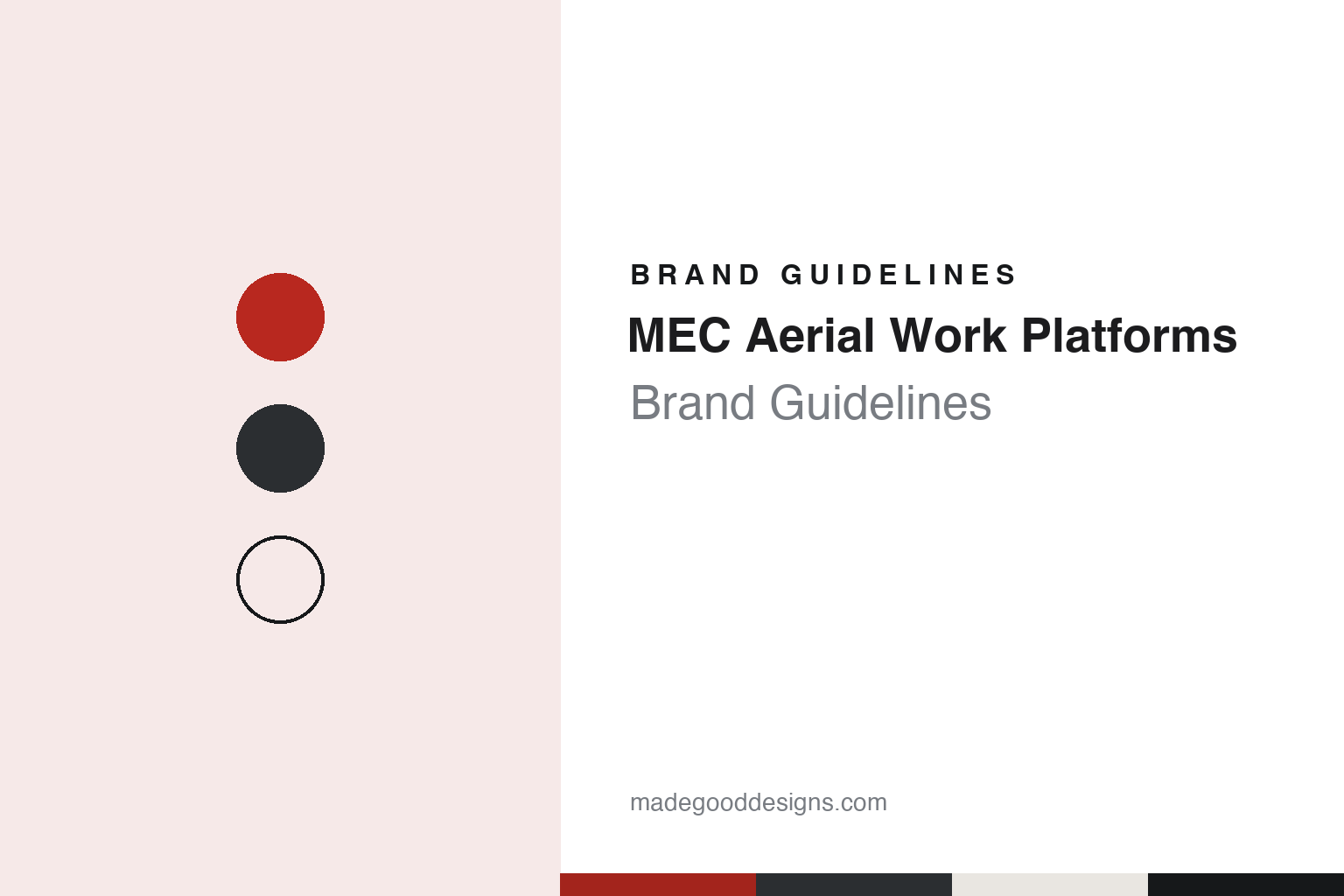
MEC Aerial Work Platforms Brand Guidelines
Mayville scissor lifts, revived in California’s Central Valley.
Aa
Two constants: a red and charcoal palette and a condensed sans register. Abstract homage — not an MEC product or mark; no machine, logo or decal is reproduced.
Mayville
A Wisconsin scissor lift that outlived its maker’s exit.
MEC began in Mayville, Wisconsin, as the aerial lift line of the Mayville Engineering Company. The company now says it was established in 1976; the trade magazine Vertikal, in a short history published in December 2017, puts its start in the late 1970s and describes it as a pioneer of ultra-compact and push-around scissor lifts. Vertikal also credits it with originating the automatic pothole protection system that later spread across the industry, and recalls model names such as the Hefty Herman.
The Wisconsin chapter ended at the close of the 1990s. According to Vertikal, Mayville decided to stop building MEC lifts when the lift market slumped at the same moment that its other business, metal boxes and enclosures for the computer industry, was booming. The name did not disappear. In 2002 Equipment Parts Wholesale, an aftermarket parts company based in Fresno, California, bought the name, design rights, manufacturing fixtures and parts-supply rights, Vertikal reported, and in 2004 it formed California Manufacturing & Engineering Company, or CMEC, to build updated versions of the scissor lifts. The company’s own timeline tells the same story: the aerial work platform division was acquired and relocated to California, and CMEC continued the line from designs bought from Mayville Engineering.
The first California plant was in Selma. In late 2009 the company moved about 30 miles north-west to a much larger building in Kerman, in Fresno County, American Lift & Handlers and Lift and Access both reported in December 2009; the new site had separate areas for research and welding, a training centre and a rail spur, and the move was linked to new scissor models such as the Speed Level 3084 and the 5492RT. Kerman is still where the company says its headquarters and factory sit.
Colour
Scissors first, then booms and masts.
MEC built its California business on scissor lifts and widened from there. The company’s timeline lists the Titan Boom 40-S of 2010, a machine that mixes boom reach with a large deck; electric rough-terrain scissors from 2011; straight booms from 2015; articulated booms and the small Micro scissors from 2018; and vertical mast lifts from 2021. In 2024 it showed the DualReach 85-J, which the company describes as a boom that works in both telescopic and articulated modes, at The ARA Show, where International Rental News also saw its NetZero range of all-electric slab scissors and masts. In 2025 came the MAX Series booms, the 135-RJ and 66-RJ, and in 2026 the company listed a 9-ton carry-deck crane among its launches.
Details carry the identity as much as model names do. MEC holds patents for its Leak Containment System, a set of trays under its slab scissors meant to keep hydraulic leaks off finished floors, and for the fold-down Xtra-Deck platform extension on its Micro scissors. It points to a nylon roller at the end of its telescopic booms’ jibs as its “Big Black Wheel,” and its mission line is “A Better Solution.” Lift and Access, whose LLEAP awards the company lists several times on its timeline, is among the trade titles that have covered its launches.
Where the machines are made is a mixed picture, and the company has been open about it. In March 2024 the then president told International Rental News that the California plant builds and assembles a small range, that a large share of production takes place at Dingli’s factory in China, and that MEC also uses a couple of manufacturers in Korea, with each product’s source decided by freight, cost and volume. Vertikal had reported in 2017 that MEC was already selling a version of Dingli’s smaller slab scissors under its own brand. In 2025 the company opened an Eastern Hub near Spartanburg, South Carolina, for parts, training and support, and an Engineering Center of Excellence at Kerman.
Typography
How the category presents itself.
Aerial work platform makers present themselves through the machines first. Scissor lifts, articulated booms, telescopic booms, truck-mounted platforms and tracked spider lifts are usually painted in a single strong colour, such as an orange, a blue, a red or a yellow, with the maker’s name and the model code set large on the chassis or the boom. Seen across a site, the colour does much of the work a logo would do elsewhere.
Much of the industry sells to rental companies rather than to the people who use the machines, and its pictures often show that. Brochures and websites favour long rows of identical scissors and folded booms in a rental yard, machines lined up on a delivery truck, and close views of control boxes, battery packs and parts that a fleet workshop would care about. Product names tend to be strings of letters and numbers that encode working height, width or drive type.
The other stock image is the machine at work: a platform raised against a steel frame, a warehouse ceiling or a building facade, with operators in hard hats and harnesses at height. Electric and hybrid drive, lithium batteries and low-noise indoor use have become common themes in recent launches, described in the makers’ own words.
Trade fairs and awards fill the rest of the calendar. New models are often unveiled at The ARA Show in the United States, at bauma in Munich and at APEX, the access-equipment show in the Netherlands, while the industry press runs its own prizes, such as the International Awards for Powered Access. This guide sets out what can be checked about each brand — who founded it, who owns it and where it says its machines are made — and marks clearly what rests on the company’s own word.
Aa
A condensed sans, the register of a spec plate and a rental-yard sign. (Specimen set in Barlow Condensed, a sans STAND-IN; NOT the MEC logo.)
MEC and Dingli
From manufacturing partner to majority owner.
The Chinese platform maker Zhejiang Dingli Machinery is now the decisive name behind MEC. The company says the two became manufacturing partners in 2016. In December 2017 Vertikal reported Dingli’s plan to take a 25 percent stake in California Manufacturing & Engineering, quoting Dingli’s announcement that the investment fitted its strategy of expanding in the United States. In November 2023 Vertikal and Lift and Access reported that Dingli would raise its holding to 49.8 percent as a first step towards buying the rest of the company, and Yicai Global reported on 31 October 2023 that Dingli had signed an agreement for the remaining 50.2 percent and would keep the MEC brand in North America. By March 2024, International Rental News described Dingli’s holding as 49.8 percent, with full ownership the stated plan. The company’s own announcement in 2023 spoke of “business as usual,” with new investment going into a California research centre and an East Coast parts centre.
Colour is one of the few identity details an independent source has noted. Vertikal, writing about the 2017 deal, remarked that MEC and the Italian telehandler maker Magni, in which Dingli had also invested, use a very similar red livery. Leadership has also changed in recent years: the company announced in October 2025 that Brian MacFarland had been promoted to president.
For a design guide, MEC Aerial Work Platforms shows how an equipment name can be carried by its designs and its colour long after the original maker leaves the market. Compare Dingli, its majority owner, and JLG, another American access-equipment maker. For this guide we use a red and a charcoal with a condensed sans, an unofficial interpretation; no product or logo is reproduced.
Explore & save
Keep MEC Aerial Work Platforms’s identity on hand — save it to a board in the Made Good inspiration library.
MEC identity set
Pin the MEC red and charcoal palette and the condensed sans register to your own board.