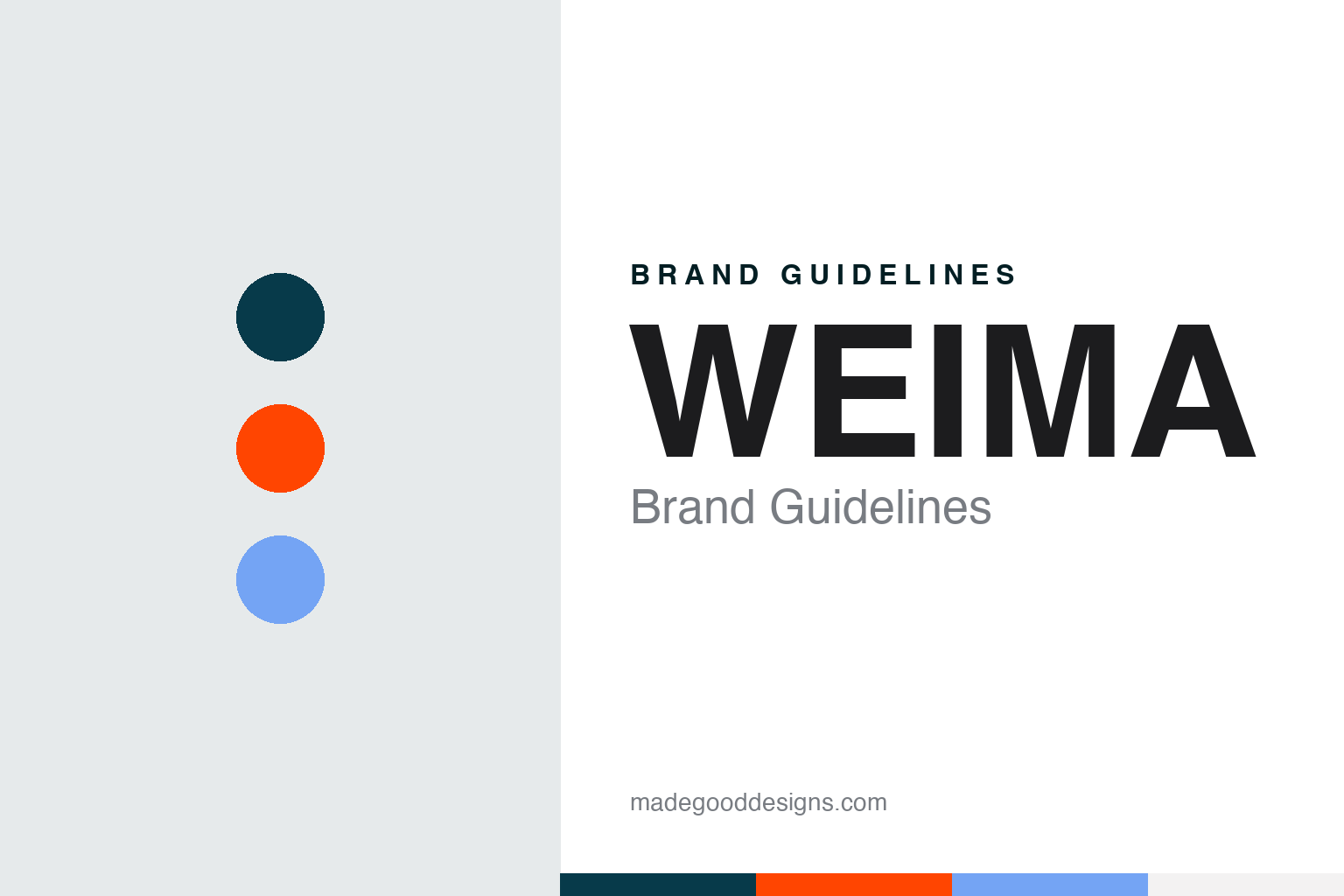
WEIMA Brand Guidelines
Weinsberger Maschinenfabrik, shortened to five letters and grown from wood shredders.
Aa
Two constants: a WEIMA petrol and coral palette and a Rounded geometric sans register. Abstract homage — not a WEIMA product or mark; no machine, logo or nameplate is reproduced.
Weinsberger Maschinenfabrik
Wood shredders for joinery workshops.
WEIMA is short for Weinsberger Maschinenfabrik. The company says Peter Rössler founded it in 1980 and developed “one of the first industrial wood shredders” for carpentry and joinery workshops. WEIMA America’s announcement of 2021 and the PETplanet industry wiki use the same year.
Other dates are in print. A WEIMA anniversary article from 2016 says “since its establishment in 1986.” The online woodworking-machinery lexicon Höchsmann lists an establishment in 1972 and says the firm was newly established by Rössler in 1985, crediting him with inventing the sledge chipper. The company’s current history starts at 1980.
In the company’s account, the portfolio widened quickly. By 1982 briquetting presses were being built in new production halls on the Ilsfeld industrial estate, and WEIMA received the Bavarian State Prize; Höchsmann says the prize was for the first hydraulic briquette press. The lexicon tentatively places the first machines of the WL 4 series in 1986, and says experiments with plastics brought setbacks around 1992 before that market became a second main pillar during the decade.
Höchsmann also records a run of smaller deals: RSN in 2000, the Gross name, from a rival shredder maker, in 2004 and Votecs in 2008. WEIMA itself dates the purchase of the dewatering specialist PÜHLER, of Bergneustadt, to 2018; updated presses carrying that know-how followed in a June 2021 release.
WEIMA says it has been owner-managed since Rössler founded it, and that in 2003 Martin Friz joined and became managing partner alongside him. The trade site plasticker reported in 2008 that Friz had held management responsibilities in the group since 2003 as partner and managing director, and in 2024 it named him and Andreas Mack as the managing directors. The company’s website now calls him the “WEIMA owner.”
Colour
Shredders, briquette presses and dewatering presses.
The range still reflects those wood origins. In the 2016 anniversary article, WEIMA said two-thirds of the machines sold to that point had gone into wood applications. The WL 4 single-shaft shredder, which the company says runs in thousands of wood-processing plants, manufacturers and recycling applications worldwide, remains on sale, alongside WLK machines such as the WLK 1500 for pallets and waste wood.
Other lines reach beyond wood. The W5 series is aimed at plastic waste, and the W5.22 had its premiere at K 2025 in Düsseldorf. The PowerLine W8 series is built for municipal and commercial waste and refuse-derived fuels; at IFAT 2026 in Munich, WEIMA showed a new high-torque drive in the W8.15. Briquette presses such as the TH 1500 and dewatering presses such as the C.200 complete the programme.
WEIMA says it has placed more than 40,000 machines since 1980, up from about 30,000 in 2016, and calls itself the world market leader for shredding and compaction machines. It also says it handled more than 1,300 customer-specific jobs last year. plasticker gave the workforce as around 300 in 2024.
The work closest to design sits at the small end of the range. WEIMA says it is a technology partner of Precious Plastic, the community project started in 2013 by the Dutch designer Dave Hakkens during his studies at the Design Academy Eindhoven. Together they developed the Shredder Pro as an open-source project for small-scale recycling, the company says.
In the winter semester of 2024, WEIMA also supported “Ripped-Up,” a project on the Industrial Design course at the State Academy of Fine Arts in Stuttgart. The company gave a guest lecture and provided a compact Precious Plastic shredder, almost 60 kg of granulate and a hand-operated injection moulding machine; students produced bags, plates, furniture, jewellery and modular semi-finished products.
A third partnership runs to the chainsaw carver Marcus “Locke” Scholz of Holzkunst Scholz, who uses a WL 4 for his workshop’s wood waste, the company says.
Typography
Design and documentation.
Crushing and shredding makers sell machines that are hard to photograph badly. The usual picture is a tracked crusher on a quarry bench, its conveyor throwing stone onto a stockpile, with the plant small against the rock face. A mobile screen in the maker’s signature colour, parked on the same bench, does the work of a logo at a distance, and many of these brands treat paint as part of the identity. Metso, for one, set out its machine colours in a dated release in 2021.
Waste machinery has a different picture. Shredder makers show the inside of the machine: a cut-away rotor with its cutters on display, or bales of plastic heading into a hopper. Compost screens and trommels appear in long windrows, and recycling yards are often shot from a drone, so the sorted heaps form a pattern from above.
Trade fairs give the sector its calendar. Bauma in Munich, CONEXPO-CON/AGG in Las Vegas and Hillhead in Britain gather the quarry trade, and IFAT in Munich gathers the waste and recycling trade. Metso’s Lokotrack went to Munich in 1986, Metso says, and Powerscreen used CONEXPO and Hillhead to mark its 60th anniversary in 2026. Fair stands are where these brands show new models beside restored old ones, and where dealers, who do much of the selling, meet the factory.
Product names carry unusual weight. Ranges are named as families, and a name can outlast the company that made it: several brands in this guide sit inside larger groups and keep their own names, colours and dealer networks. Ownership changes often, so each entry here gives dates for who owns what, and what each company says about where its machines are made.
Aa
A rounded geometric sans, close in spirit to the website’s type. (Specimen set in Outfit, a sans STAND-IN; NOT the WEIMA logo.)
Swabian roots
Three German sites and a trademarked phrase.
WEIMA describes itself with a short, regional line: “Swabian roots. Global player.” Its website, credited to Studio Naam, sets its type in Okomito, and its stylesheet pairs a deep petrol with a colour it labels coral. Those are website settings rather than a published brand standard.
The manufacturing story is stated plainly: “Made in Baden-Württemberg and Saxony-Anhalt.” WEIMA says it produces the complete range at three locations, Ilsfeld, Abstatt and Annaburg, and describes a high level of vertical integration; a WEIMA article of 2016 said production ran from the steel structure through rotors to individual gearboxes. It moved the main part of shredder production to Annaburg in 2006, and it says a further 4,000-square-metre hall went into service in 2023.
Outside Germany, the picture is more varied. WEIMA America opened in Fort Mill, South Carolina, in 1999 as a sales office with final assembly and a service centre, and Madison Burt was named its CEO from 1 January 2022. A joint venture in Yantai, begun in 2014, makes machines for the Chinese market only, the company says. A second joint venture, agreed in northwest India in 2019, focuses on service.
One phrase comes from the American business. Destroy Responsibly™ is WEIMA’s name for an on-site shredding programme at trade shows, run with the woodworking fair AWFS since 2011 and extended to plastics at NPE2018 in Orlando, where a WLK 15 and a granulator were set up in a tent outside the convention centre.
For a design guide, WEIMA shows how a plain abbreviation of a factory name can become a global mark, and how a machine maker can work with design students and independent makers. Compare Vecoplan, another German shredder maker, and UNTHA, an Austrian one with a coined name of its own. For this guide we use a deep petrol and a coral with a sans, an unofficial interpretation; no product or logo is reproduced.
Explore & save
Keep WEIMA’s identity on hand — save it to a board in the Made Good inspiration library.
WEIMA identity set
Pin the WEIMA petrol and coral palette and the Rounded geometric sans register to your own board.