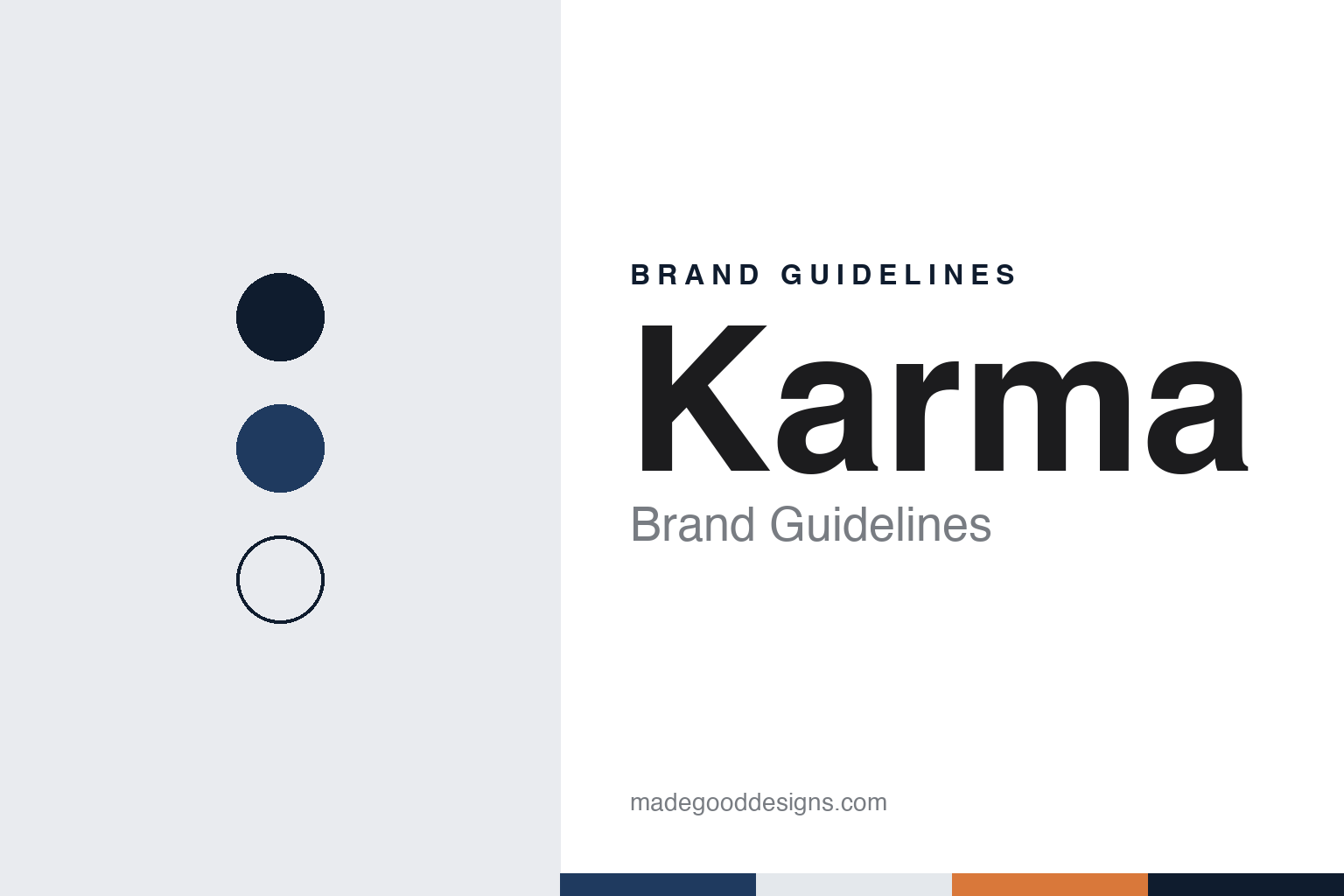
Karma Brand Guidelines
The Taiwanese wheelchair maker built on lightweight aluminium.
Aa
Two constants: a Karma blue, aluminium and persimmon palette and a Light sans register. Abstract homage — not a Karma product or mark; no wheelchair, logo or nameplate is reproduced.
A lighter chair
Kenny Chen and the aluminium problem.
Karma is the brand of Karma Medical Products Co., Ltd., known in Chinese as 康揚. It was founded in 1987 in Taipei by Kenny Chen, the name the company uses in English; the Taiwanese press writes it 陳英俊. Its British distributor trades as Karma Mobility; the maker is Taiwanese.
The company tells its origin as a rainy afternoon in Taipei, when Chen saw a woman struggling to fit her father’s heavy wheelchair into the boot of her car and asked himself whether wheelchairs had to be that way. It says he drew on a background in industrial engineering and management. A 2019 profile in Business Weekly, republished by TVBS in Taiwan, adds the industrial side. Chen had been plant manager at a wheelchair factory, at a time when Taiwan had only steel chairs weighing more than 20 kilograms. He had seen lighter aluminium alloy wheelchairs from the United States, disagreed with his employers over developing new products, and left in 1987 to start his own firm.
The start nearly ended the company. Business Weekly reported that Taiwan had no suitable material: the local 6063 alloy suited window frames, while a wheelchair needed the more workable 6061, an alloy used in aerospace. Liberty Times reported in 2015 that the start-up capital went on failed trials in under a year, leaving three people in the company. Karma’s own history dates that low point to 1989. Short of money, Chen moved south from Taipei and found premises in Minxiong, a rural township in Chiayi County, where the company’s research centre remained in 2019.
The breakthrough came about two and a half years in, Business Weekly said. Karma’s history dates it to 1990 and calls the result the first aluminium alloy wheelchair in Asia, excluding Japan. Liberty Times in 2015 and THIIS in 2020 both described it as Taiwan’s first. The name, the company says, comes from the Sanskrit for “action”: it wanted a word that told it not to be idle.
Colour
Export first, then copies.
Karma looked abroad early. Its aluminium chairs cost far more than Taiwan’s steel ones, so Chen turned to international markets, Business Weekly reported, and at trade fairs met European buyers who doubted that Taiwan could make such a product. The company’s timeline records the steps. Its chairs reached Spain in 1990, through a partner it names as Shortes España, and in 1991 Japan, where it says it was the first foreign aluminium alloy wheelchair imported. Its first aluminium power wheelchair followed in 1992, and by 1997, it says, the brand was sold in more than 20 countries. That year it set up a contract-manufacturing base at Korat in Thailand. The SOMA brand followed in 1998, to separate products for different markets.
In 1999, with a British partner, it set up Karma Mobility Ltd. THIIS, reporting in September 2020, gave the same year and described Karma Mobility as the exclusive distributor of Karma Medical’s ranges for the UK and Eire, working only through the trade. A Spanish company, Karma Mobility España, followed at Gijón in 2015.
The early 2000s brought a problem that shaped the product. By the company’s account, imitations made in China began to appear in its markets around 2003. Its response was to spend on research and medical engineering and to patent what it made. It developed the S-Ergo seat cushion in 2005 and launched the S-Ergo 105 wheelchair in 2006, a design it describes as breaking with the dull look of older chairs. By 2007 it counted more than 100 patents. The VIP 515, a foldable tilt-in-space wheelchair, arrived in 2008, and a stand-up power wheelchair, developed with the French maker Life Stand, in 2009.
China itself proved harder. Karma set up in Shanghai in 2006, and Chen told Business Weekly that entering at the top of that market had been the wrong approach. India went better, the magazine reported, once the company moved from a joint venture with a local agent to sole ownership and sold low-cost steel chairs, the type buyers there wanted. Karma’s timeline shows a company in Kolkata from 2008, and both it and the magazine date its own factory in China to 2012, at Huzhou in Zhejiang Province by the company’s account.
Typography
Showrooms and trade halls.
Wheelchairs, walkers and scooters have their own route to market. Writing in 1991, the journalist Joseph Shapiro noted that, unlike virtually every other product, wheelchairs were not sold directly to users but marketed through occupational and physical therapists and medical supply dealers. Today’s makers still describe much the same route: Platinum Equity said in 2024 that Sunrise Medical sells through homecare dealers and distributors, and Invacare’s 2024 announcement named home medical equipment providers alongside retail and online channels.
Catalogues in this trade deal in frames, seats and options. The International Directory of Company Histories described one popular Sunrise chair of the early 1990s as made in one-inch steps of back height, seat depth and seat width. Colour sits on the same order form: Sunrise Medical’s 2025 frame palette gave its shades names of their own, such as Midnight Blue and Turbo Green.
Trade fairs are the category’s public stage. Rehacare, which German Wikipedia says began in 1977 and has been run by Messe Düsseldorf since 1999, shows aids including mobility products to users and relatives as well as to specialists; its organisers list the next edition for September 2027. Medtrade, in the United States, is a trade conference for medical supplies, according to English Wikipedia.
The people in the pictures matter too. Shapiro wrote that Quickie’s brochures showed its chairs in use by active people, at the office and elsewhere, and Sunrise Medical’s American website today quotes named wheelchair users in their own words on work and travel. This guide sets out what can be checked about each brand: who founded it, who owns it, and what it says about where its products are made, with the company’s own claims marked as such.
Aa
A light sans — KARMA in capitals. (Specimen set in Inter Tight, a sans STAND-IN; NOT the Karma logo.)
Karma
“A Better Wheelchair, A Better Fit!”
Karma’s history records a “brand reengineering process” in 2010 and, in 2011, seminars for therapists in Taiwan on a new core value and “Fit” prescription guidelines. “Fit” has stayed: the company’s site carries the line “A Better Wheelchair, A Better Fit!” and a section called KARMA Fit, alongside the phrase “The Next Generation of Lightweight Mobility.” It writes its name in capitals, and explains the name through a line that “good karma flows back like waves.” Its user stories run under the heading “Life on Wheels.” One it tells is of a Korean wheelchair user who set out in the winter of 2004 to cross the United States on a Saber power wheelchair, covering more than 10,000 kilometres and 17 states in five months.
Its products have also won design awards. Liberty Times reported in May 2015 that the EVO Lectus power wheelchair had won a German iF award, calling Karma the first Taiwanese assistive-device maker to do so; the company says a Dutch design team worked on the chair. Karma lists the EVO Altus power standing wheelchair as a 2018 Red Dot winner, and Business Weekly reported a Red Dot-winning power chair on the Minxiong production line. The company also lists Taiwan Excellence awards, the scheme run by the Ministry of Economic Affairs and the Taiwan External Trade Development Council, whose site lists Karma’s Leon power wheelchair.
The scale is international. Business Weekly reported more than 300,000 Karma-branded chairs in 2018 and sales in more than 40 countries, with the company selling through its own or partly owned businesses in eight or nine of them, including Britain, Spain, Thailand and India. An academic at Yang-Ming University’s assistive technology centre told the magazine that Karma was the first Taiwanese maker to build an international brand. In 2025 the company referred to its global headquarters in Taiwan and its factory in Thailand. Leadership has now changed: Karma announced that Roger Kuo, previously general manager of Karma China, became Group CEO on 1 July 2026, with Chen staying on as chairman.
The company reports showing carbon fibre rims at Rehacare in Düsseldorf in 2002, and it invited visitors to its stand there in each year from 2023 to 2026.
For a design guide, Karma shows how an engineering problem, a lighter chair, can become a brand promise about fit. Compare WHILL, a Japanese maker of power mobility, and Sunrise Medical, another wheelchair maker. For this guide we use a blue, an aluminium grey and a persimmon with a sans, an unofficial interpretation; no product or logo is reproduced.
Explore & save
Keep Karma’s identity on hand — save it to a board in the Made Good inspiration library.
Karma identity set
Pin the Karma blue, aluminium and persimmon palette and the Light sans register to your own board.