Charles Bargue spent much of his working life making images that teach. His drawing course, published in Paris by the firm Goupil & Cie with the collaboration of the painter Jean-Léon Gérôme, broke famous sculpture and drawings down into a sequence of plates: first a few straight lines that fix the outline, then a shadow shape, then gradual tonal finish. That step-by-step structure is the reason the course is still reprinted and studied, and it is the part designers can use. Alongside it, Bargue painted small, highly finished genre and Orientalist pictures, two of which hang in The Met. To set his work beside other cleared historical images, browse the MGD museum inspiration collection.
Who was Charles Bargue?
Bargue was born in Paris; The Metropolitan Museum of Art gives his birth year as 1825/26, while the Dahesh Museum of Art gives 1826/27. Both record his death in Paris in 1883. He trained and worked as a lithographer, reproducing other artists’ pictures for the print trade, before turning increasingly to painting in the later part of his career.
His main commercial partner was Goupil & Cie, the Paris publisher and dealer that sold reproductive prints and paintings across Europe and America. Goupil published the Cours de dessin, and Bargue’s small cabinet pictures circulated through the same art market. The dates usually given for the course’s publication run from the mid-1860s to the early 1870s (1866–71 in some accounts, 1868–73 in others), and the total is usually given as roughly two hundred plates.
Gérôme, a professor at the École des Beaux-Arts, is named as collaborator on the course. Several accounts describe him choosing the casts and master drawings used as models for the early parts, with Bargue drawing and lithographing the plates himself.
The Charles Bargue drawing course, plate by plate
The course is organised in three parts. The first works from plaster casts of sculpture: eyes, ears, noses, hands, feet and heads, then whole fragments of ancient and Renaissance sculpture. The second reproduces drawings by older masters. The third is a set of academic figure studies drawn from the model, made for art-school practice. The images here leave that last part aside and concentrate on the method, which is the same throughout.
Many plates are printed as pairs. On the left is a construction stage: the subject reduced to a handful of straight lines that mark its widest points, its tilt and its main angles, with the shadow shape mapped as a single flat area. On the right is the finished drawing, with modelled half-tones and soft transitions. The student copies both, learning to see the simple scaffold under the finished surface.
Students are commonly taught to copy the plates at the same size as the original, standing back to compare their drawing and the plate side by side. Contemporary realist ateliers often call this sight-size practice; the Art Renewal Center, which has written about the course’s revival, describes it as a core text for such schools today.
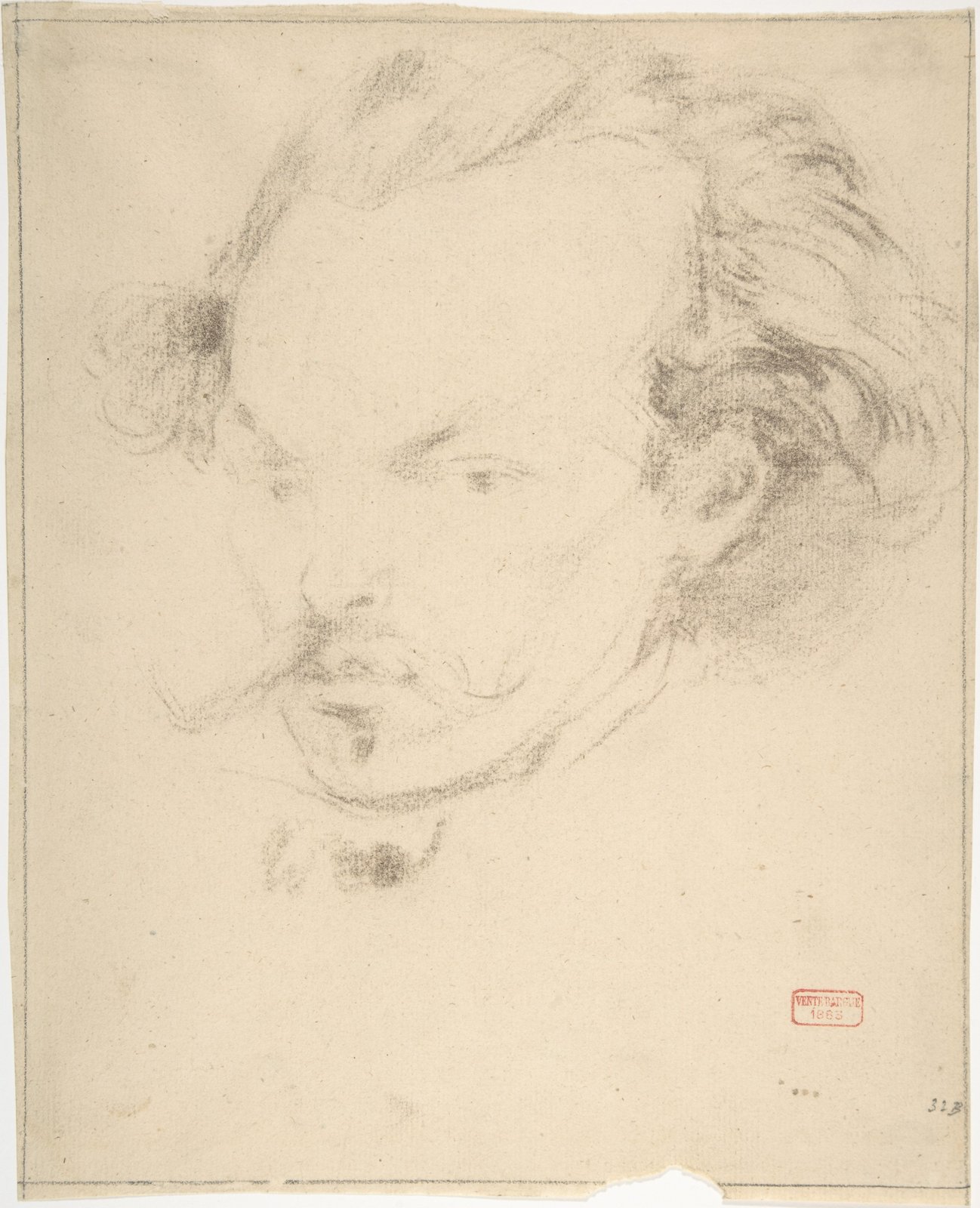
Why Van Gogh copied the plates
A well-documented reader of the course is Vincent van Gogh. His letters to his brother Theo, published with notes by the Van Gogh Museum, show him working through Bargue’s Cours de dessin and the related Exercices au fusain (charcoal exercises) in 1880, first at Cuesmes in Belgium and then in Brussels. In a September 1880 letter he wrote that he intended to finish the course before moving on to anything else. The same annotations note that a sheet from the course, a head of Anne of Brittany, already hung in his room in 1877.
The point for a designer is not the anecdote but what Van Gogh valued: a fixed sequence of exercises that turns seeing into a repeatable skill.
What to look at: line, light and finish
Bargue’s finished drawings and paintings share three habits worth studying.
Line as structure, not outline. In the construction plates the first lines are long and straight even when the form is round. A cheek becomes two angled strokes; a skull becomes a polygon. Only later are curves introduced. The pencil sketch of houses in The Met, dated 1845 with a question mark, shows the same instinct applied to architecture: the façades are set down as stacked rectangles before any detail appears.
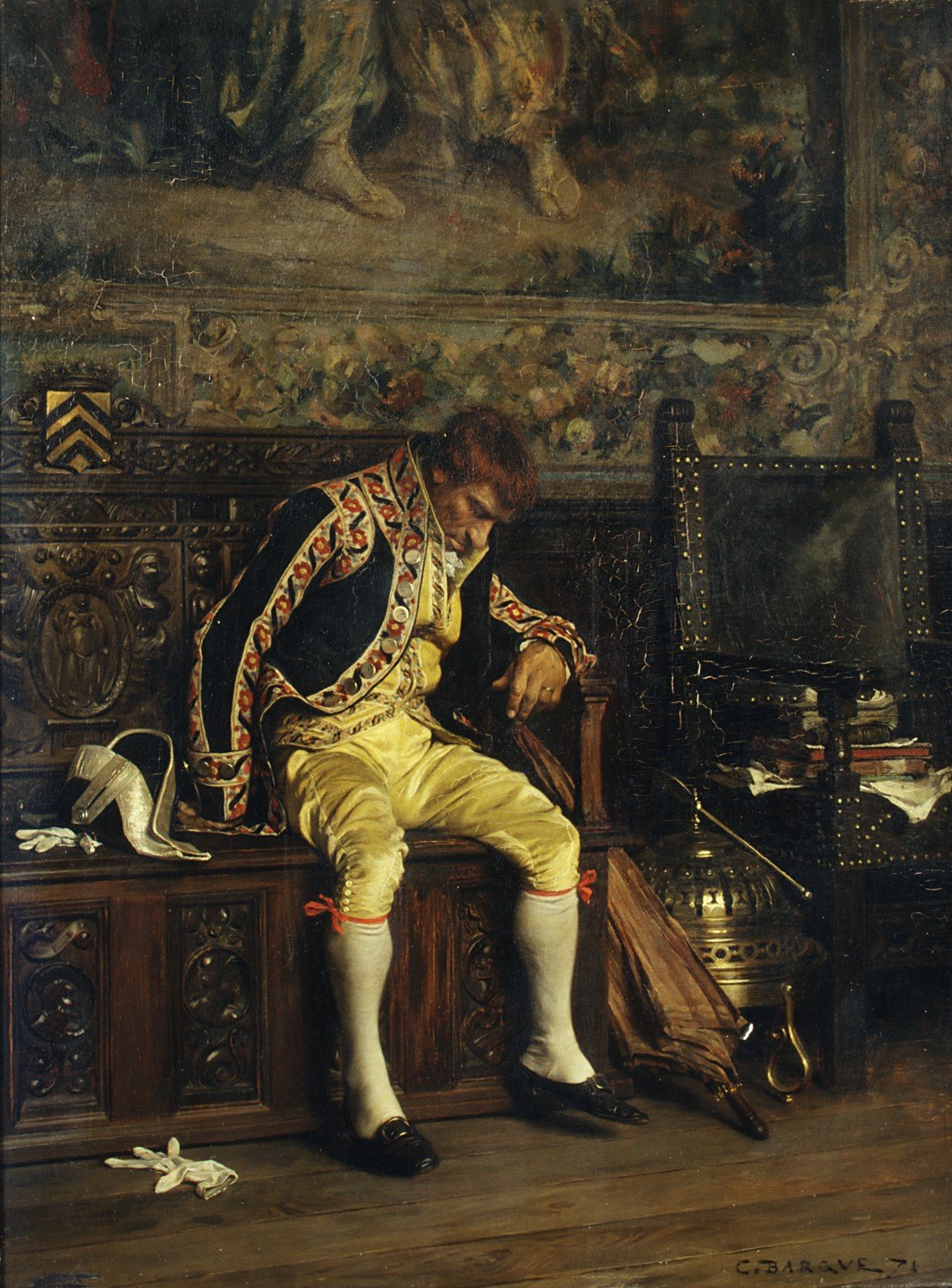
Light as two or three shapes. Each plate separates light from shadow with a clear boundary, then adds a reflected light inside the shadow and a half-tone at the edge. Squint at A Footman Sleeping (1871) and the picture resolves into the same few values: a pale glove and stocking, mid-tone gold breeches and wood, and a deep background.
Finish concentrated where the eye lands. In both Met paintings the detail is densest on the figure’s face, hands and costume, while the background tapestry and wall stay softer and darker. The finish directs attention as clearly as a typographic hierarchy.

The paintings: small formats, high finish
The Met holds two Bargue oils. A Footman Sleeping, oil on wood, is dated 1871 and came to the museum in 1881 as a bequest of Stephen Whitney Phoenix. It shows a servant in eighteenth-century livery dozing on a carved bench, his hat and gloves set aside, against a tapestry and a gilded metal vessel.
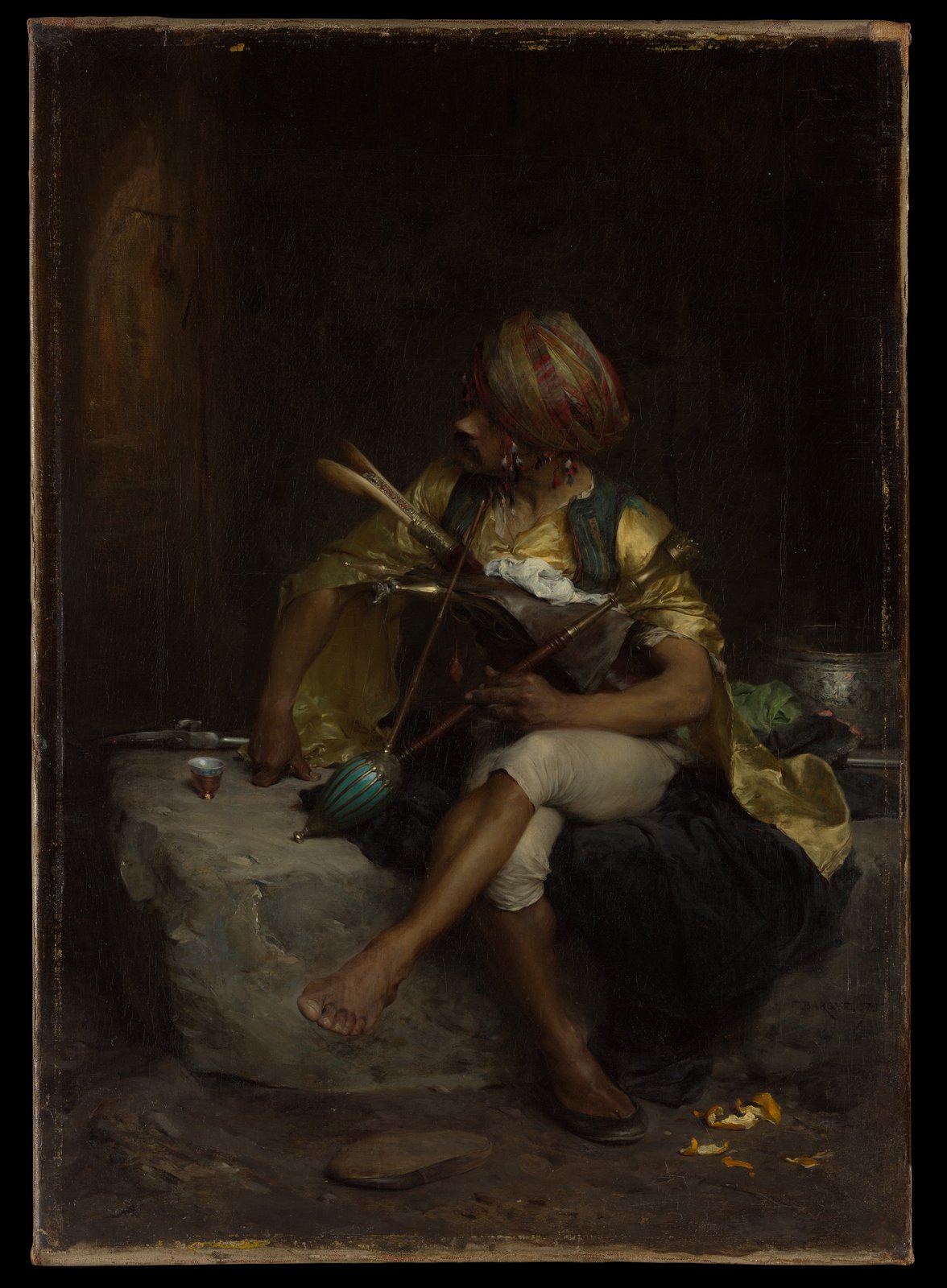
A Bashi-Bazouk, oil on canvas, is dated 1875 and came to The Met in 1887 with the Catharine Lorillard Wolfe Collection. It shows a seated irregular soldier in an embroidered gold jacket, turban and sash, set against a dark wall. The subject belongs to the nineteenth-century French taste for Orientalist themes that Gérôme also painted. Today such pictures are read critically as Western constructions of the Ottoman world, and the costume and props are more usefully studied as studio arrangements rather than documentary records.
Colours measured from the museum’s scan of A Footman Sleeping (PIL quantize on the downloaded image) include near-black #1a1b1b, umber #362b21, olive brown #5c4c31 and a muted gold #8f7c49. These are scan values, not original pigments, but they show a narrow palette in which the gold reads as bright only because its surroundings are dark.
Technique: from cartoon to finished picture
A sheet in the Cleveland Museum of Art shows how Bargue planned a picture. Catalogued as a cartoon for The Opinion of the Model and dated c. 1840s–1883, it is drawn in graphite with red coloured pencil on a sheet about 29 by 22 centimetres. The figures, easel and studio furniture are set down in light, even contour lines with almost no shading, so that the composition can be judged and transferred before any tone is committed.
The same separation of stages runs through the course: structure, then shadow shape, then finish. As a lithographer, Bargue worked on stone, where marks are hard to remove, which helps explain a method that settles decisions early.

How designers can borrow from Charles Bargue
- Block in with straight lines. When drawing an icon, mascot or illustration, start with a polygon that captures proportion and tilt. Curves come later. This keeps silhouettes strong at small sizes.
- Design in three values first. Before choosing colours, reduce a layout or illustration to light, mid and dark. If it reads in three values, it will read in colour. Lithography as a medium rewards the same discipline; see our guide to lithography and its print effects.
- Show the steps. The paired plates are a model for tutorials, onboarding screens and brand-guideline pages that teach construction: the grid version beside the finished version.
- Spend detail where attention goes. Keep backgrounds quiet and push finish into the focal point, as Bargue does with faces and hands.
- Sample a narrow palette. Pull values from a public-domain scan with the image colour picker and build a dark, warm scheme with a single gold accent.
For the teacher behind the course and his own approach to finish and Orientalist subject matter, read our guide to Jean-Léon Gérôme. For the wider nineteenth-century push toward observed, everyday subjects, see realism in art.
Frequently asked questions
What is the Charles Bargue drawing course?
It is a set of lithographed teaching plates, the Cours de dessin, published by Goupil & Cie in Paris in the late 1860s and early 1870s with Jean-Léon Gérôme as collaborator. It moves from plaster casts to master drawings to figure studies, and many plates pair a straight-line construction stage with a finished drawing.
Did Van Gogh use the Bargue course?
Yes. His letters to Theo, annotated by the Van Gogh Museum, show him copying Bargue’s Cours de dessin and Exercices au fusain in 1880 in Cuesmes and Brussels.
Where can I see Charles Bargue’s paintings?
The Metropolitan Museum of Art holds A Footman Sleeping (1871) and A Bashi-Bazouk (1875), along with several drawings. The Cleveland Museum of Art holds a cartoon for The Opinion of the Model.
Are Charles Bargue’s works public domain?
Bargue died in 1883, and the images used here are flagged public domain by The Met or CC0 by the Cleveland Museum of Art in their open-access programmes. Modern reprints and facsimile editions of the course may carry their own copyright in new text and layout.