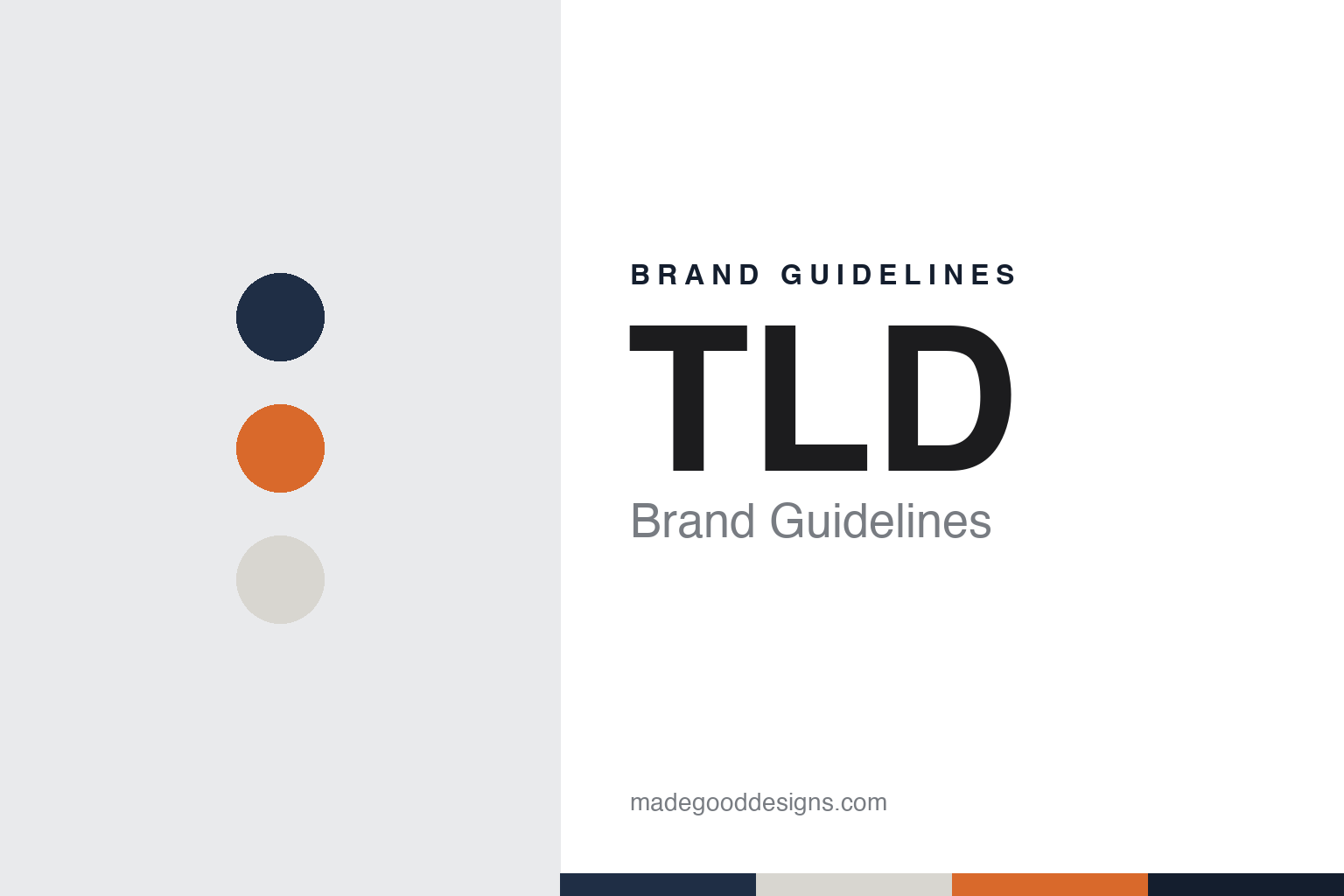
TLD Brand Guidelines
From Lyon silk to aircraft tractors, under three initials.
Aa
Two constants: a navy, orange and concrete palette and a condensed sans register. Abstract homage — not a TLD product or mark; no vehicle, logo or nameplate is reproduced.
Mulatier et Dupont
From silk weaving to metal, and on to the airport.
TLD’s story starts in the silk trade of Lyon. The company’s own heritage page traces it to Mulatier et Dupont, a silk-weaving workshop of 1897; French Wikipedia places the first workshop as early as 1860 and gives 1897 as the year it became Mulatier et Dupont. Over the following decades the business moved from silk into metal weaving and steel, and TLD says a cooperation with Compagnie Générale d’Électricité, begun in the 1930s, lasted more than twenty years.
In 1951 the company was listed on the Paris stock exchange as Tissmétal Lionel-Dupont. It spread into electromechanical engineering, automated handling, synthetic fibres, industrial filtration and aeronautical equipment, according to both French Wikipedia and the company. When it sold its metal business in 1985 it was renamed Téléflex Lionel-Dupont, the name behind the three letters the company still uses.
The airport business was assembled by acquisition. Already present at airports through baggage-handling systems, the group bought Tracma, a maker of baggage and aircraft tractors, and Albret, which made passenger stairs and lavatory and water trucks; the company dates both purchases to 1990, French Wikipedia to 1991–92. Erma, with belt loaders, transporters and catering trucks, followed in 1991, as did Devtec in the United States, with subsidiaries including one in Hong Kong. In 1992 TLD added Lantis, a Californian maker of cargo loaders, which the company refers to as Cochran Western–Lantis. Between 1992 and 1998 the group sold its filtration, baggage-handling and aeronautical-equipment divisions to concentrate on ground support equipment.
Colour
Five names folded into one, and factories on three continents.
For a decade the acquired companies kept their own names. In 2002, the company says, it stopped using Tracma, Albret, Erma, Devtec and Cochran Western–Lantis and put everything under one brand: TLD. The same year it moved cargo-loader production from California to Sherbrooke, Quebec, and its passenger stairs from Montpellier to Saint-Lin in western France.
The range today covers much of the equipment that works around a parked airliner. TLD’s product list runs from towbarless and conventional aircraft tractors and passenger steps to cargo and belt loaders, baggage tractors, ground power and air-conditioning units, and lavatory and water trucks. The company says it designed large cargo loaders in the 1990s for the Airbus Beluga, and was later chosen by Boeing to design and build the giant loaders and transporters that carry sections of the 787 Dreamliner into the Dreamlifter, a modified 747 freighter.
From 2009 TLD worked on the engineering and manufacture of TaxiBot, a towing vehicle controlled by the pilot from the cockpit so that the aircraft can taxi with its engines off. French Wikipedia says the project won France’s industrial innovation prize in 2013, and TLD says it opened a new factory for the programme in 2014.
The company says its products are designed and assembled in its own factories in Europe, North America and Asia, and describes what each one makes. Saint-Lin builds passenger stairs, belt loaders, baggage tractors and loaders, as well as the PFA-25 military cargo loader; Sorigny, in the Loire Valley, built in 2014, makes conventional and towbarless aircraft tractors and the TaxiBot. In China, Shanghai, opened in 1997, makes stairs, belt loaders, maintenance platforms and catering trucks, while Wuxi, opened in 2008 and moved to a larger site in 2012, assembles cargo loaders and tractors. Sherbrooke builds cargo loaders and the PFA-50 military loader; Windsor, Connecticut, makes ground power and air-conditioning units; and Kempston, near Bedford in England, acquired in 2019, makes ground power units. French Wikipedia also lists a Belgian plant, TLD Lebrun.
Typography
The ramp as a stage.
Ground support equipment is the machinery that works around a parked aircraft: tugs and pushback tractors, belt loaders at the hold doors, cargo loaders for containers and pallets, de-icers, catering trucks raised to the galley doors and passenger stairs. Its buyers are airlines, airports, cargo carriers, ground handlers and air forces, the customers that makers such as TLD and Oshkosh AeroTech name on their own websites.
The makers in this field present their machines where they work, on the apron: a tug pushing back an airliner at dusk, a belt loader pressed against a cargo door, a de-icing boom reaching over a wing in falling snow, a catering truck lifted level with a galley. Product pages show the equipment at work beside the aircraft it serves.
Trade shows are the other stage. inter airport Europe, held in Munich, is where Oshkosh AeroTech showed its boarding bridges and gate equipment in October 2025, and the International GSE Expo in Las Vegas is where it unveiled a compact deicer the month before. Makers also announce milestone deliveries — a numbered loader or tractor handed to a named operator — as press releases with photographs on the ramp.
Much of the current messaging is about electric and autonomous equipment: TLD runs a programme it calls “Leaner & Greener,” and Oshkosh AeroTech promotes battery-powered charging carts. This guide sets out what can be checked about each maker — who founded it, who owns it and what it says about where its products are made — and marks clearly what rests only on the company’s own word.
Aa
A condensed sans for three initials. (Specimen set in Barlow Semi Condensed, a sans STAND-IN; NOT the TLD logo.)
TLD
From a listed company to private-equity owners.
TLD stopped being a listed company in 2006, when it was bought by Alvest, a holding formed for the purpose by AXA Private Equity together with TLD’s management, the company says. Sage Parts, a supplier of replacement parts for ground support equipment, joined Alvest in 2008, and in 2013 the management and LBO France bought Alvest from AXA Private Equity. French Wikipedia describes TLD as a subsidiary of the Alvest group.
Ownership changed again in 2025. On 9 July 2025 PAI Partners announced that it and a wholly owned subsidiary of the Abu Dhabi Investment Authority had completed the acquisition of a majority stake in Alvest. Ardian kept a minority holding, alongside the group’s founders and management, who reinvested. The release described Alvest as headquartered in France, with more than 4,000 employees and 11 factories.
TLD names its customers as airlines, airports, cargo airlines, ground handlers and military organisations, and calls the phrase “Local support, total commitment” its trademark. Its current marketing is built around a programme it calls “Leaner & Greener,” featuring electric and autonomous equipment.
For a design guide, TLD shows how a group of acquired names can be folded into three initials that themselves come from an older company name. Compare Charlatte, another French maker of airport equipment, and Swissport, a ground handler of the kind TLD counts among its customers. For this guide we use a deep navy, a signal orange and pale concrete grey with a sans, an unofficial interpretation; no product or logo is reproduced.
Explore & save
Keep TLD’s identity on hand — save it to a board in the Made Good inspiration library.
TLD identity set
Pin the TLD navy, orange and concrete palette and the condensed sans register to your own board.