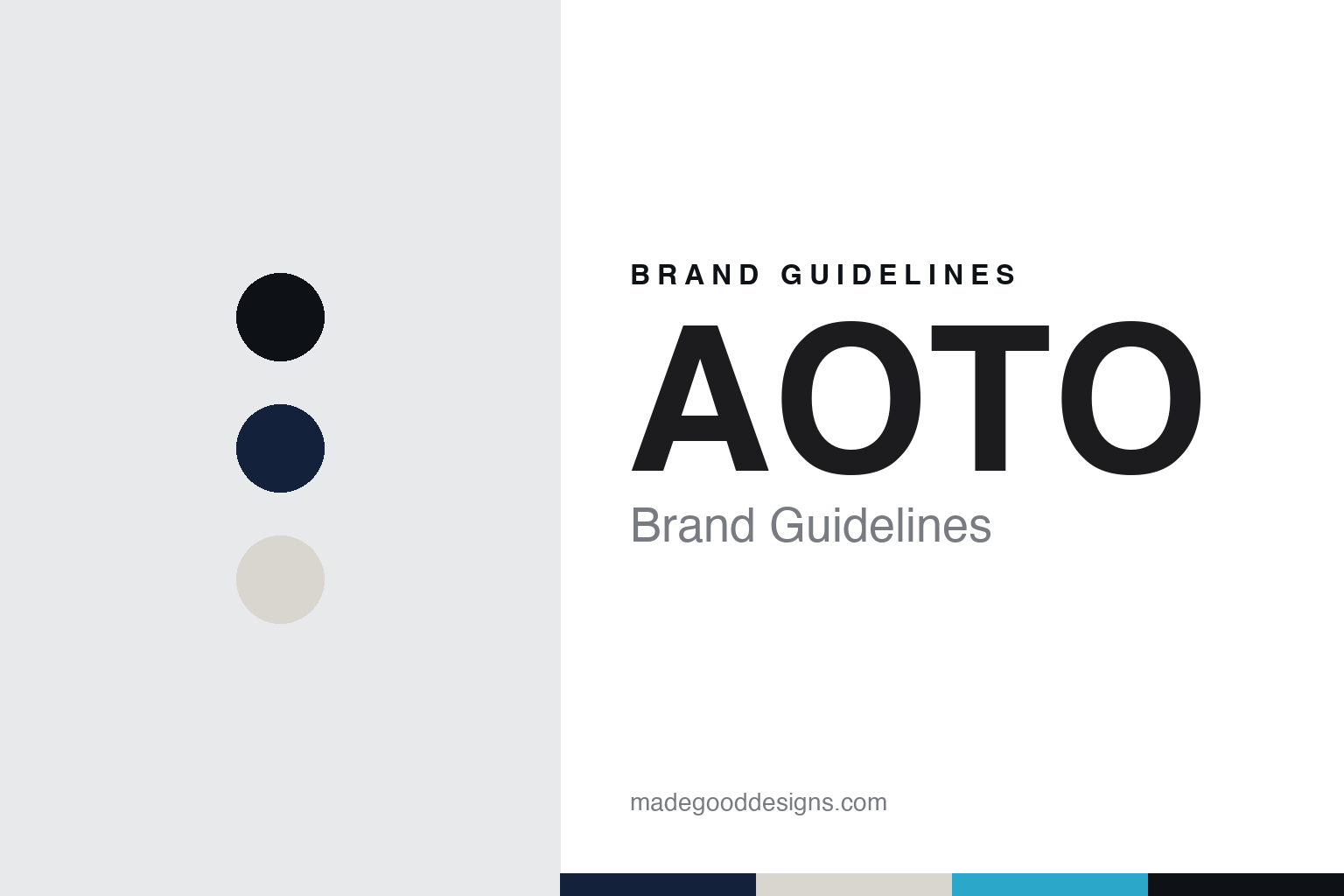
AOTO Brand Guidelines
The Shenzhen LED maker of 1993 behind virtual-production walls.
Aa
Two constants: a studio navy, cyan and warm grey palette and a technical sans register. Abstract homage — not an AOTO product or mark; no screen, logo or nameplate is reproduced.
Shenzhen, 1993
A maker of bank displays that became an LED screen house.
AOTO is a maker of LED display screens based in Shenzhen, in China’s Guangdong province. Its listed company is Shenzhen AOTO Electronics Co., Ltd., whose shares trade on the Shenzhen Stock Exchange. The company’s own timeline and company data from S&P Global Market Intelligence, as shown by StockAnalysis in November 2026, both give its founding year as 1993, in Shenzhen.
The company’s account of its early years is brief. It says that in 1994 it launched an LED information display for banks, and that financial customers remained an important market: in 1999, it says, it received a Guangdong provincial technology award for its financial products. It dates its move into markets outside China to 2003.
The following years, by the company’s timeline, brought a reorganisation into a joint-stock company in 2009 and a listing on China’s A-share market in 2011. It says it completed a facility in Nanjing in 2013 and set up a laboratory for glasses-free 3D display in Shenzhen in the same year. It also bought other businesses: Shanghai Hanming Computing Technology in 2015 and GoldLamp in 2016, a purchase it says took it into urban-renewal and landscape lighting. In 2021 it set up Shenzhen Gargantua Technology, which it describes as its entry into digital creative content.
AOTO now describes itself as a provider of “intelligent visual communication” solutions — LED screens combined with control systems and content platforms — and says it has about 20 subsidiaries, six of them outside China. S&P Global’s data put its staff at about 900; the company’s own website says more than 1,000.
Colour
The wall behind the camera.
Much of AOTO’s profile outside China rests on virtual production: film and broadcast studios in which performers work in front of large curved LED walls showing computer-generated backgrounds, so that scenes can be captured in camera. The company sells several ranges for this work, led by the RM series, which it describes as designed for virtual production and XR studios, alongside AE series panels made to be laid as a studio floor.
The trade press has documented some of the larger installations. In October 2023 Inavate reported on the CDD Virtual Studio in Shenzhen, run by the content department behind Tencent Games. The studio paired a 40-metre by six-metre, 240-degree curved LED screen with a movable LED ceiling of more than 100 square metres, built from AOTO RM2.3 panels with a 2.3-millimetre pixel pitch and driven by processors from the British company Brompton Technology. The panels were calibrated with Brompton’s Hydra measurement system so that colour stayed even across the whole wall. Its first major production, Inavate reported, was a live-streamed esports event for the game CrossFire.
In July 2026 the website of the American Society of Cinematographers reported the opening of a 5,000-square-metre virtual-production facility at Chengdu Film City. Its 820-square-metre LED volume was built from 3,240 AOTO RM2.3S panels, including a 60-metre by 12-metre curved wall and a movable ceiling, and the report called it another collaboration between Tencent and AOTO. The facility also has a 1,100-square-metre automated rotating stage. The same report, drawing on the company’s figures, said AOTO had delivered more than 130 virtual-production stages worldwide.
In Japan, AOTO said in December 2023 that it had supplied the LED wall and ceiling for a new virtual-production studio of the film company Toei in Tokyo, using its RM wall and MXH ceiling ranges.
Studios are only part of the business. AOTO also lists fixed-installation ranges for advertising, finance, retail and cultural tourism, from its fine-pitch CV series to its AF series for outdoor use. Its timeline also claims the largest global share of LED cinema screens in 2024, a figure we give as the company’s own.
Typography
Design and documentation.
LED display makers sell a product that is meant to disappear behind the picture it shows, so their brochures and websites lean on the places where their screens are seen. The usual picture is a stadium at night: a scoreboard or a ring of fence screens glowing above a full stand, with the maker’s own name nowhere in sight. Concert stages come next, with LED backdrops stacked behind the band and built from hundreds of small tiles hung from rigging.
Indoors, the showcase shifts to curved video walls in control rooms, broadcast studios and corporate lobbies, where the wall itself becomes part of the architecture. A newer image is the virtual-production volume, a ring or arc of LED panels around a film set that shows a moving background in camera, which lets makers present themselves to studios as well as to stagers and sign companies.
Much of the industry’s branding is shown first at trade fairs. Integrated Systems Europe and InfoComm in the United States are where new panel ranges, finer pixel pitches and rental frames are usually unveiled, and stands are often built as showpieces for the products, with the company’s name set on a screen rather than painted on a wall. Product names tend to be short codes and series letters, written for the integrators, rental houses and technicians who order the panels.
This guide sets out what can be checked about each maker: who founded it, where it is based and listed, where it says its displays are made, and what it has published about its own logo. Where a claim rests only on the company’s word, the guide says so, and the colours shown are our own interpretation rather than any official palette.
Aa
A technical sans for an engineering brand. (Specimen set in Archivo, a sans STAND-IN; NOT the AOTO logo.)
AOTO
Panels from Guangdong and Nanjing.
AOTO is headquartered in Shenzhen, and its website lists showrooms there and in Huizhou, an industrial city in the same province. In September 2026 the company announced that a new MicroLED manufacturing centre in Huizhou had begun production, adding capacity for very fine-pitch Micro and Mini LED products using both COB and COG packaging — chip-on-board and chip-on-glass methods. It describes the plant as largely automated and run under cleanroom conditions. Its timeline also names the Nanjing facility completed in 2013.
The company ties its name to big sporting and cultural events. Its timeline says it won a FIFA World Cup tender in 2008 and entered the market around the UEFA European Championship in 2012. It lists recognition from Chinese authorities, including national high-tech enterprise status in 2008 and a national patent award in 2014, and a joint laboratory set up with Shanghai Jiao Tong University in 2024. It also says it founded a charity foundation in 2019.
The palette and type on this page are our own interpretation.
For a design guide, AOTO shows how a display maker can build its name on the screens that stand behind the camera rather than in front of the public. Compare Leyard, another LED display maker, and LianTronics, also based in Shenzhen. For this guide we use a deep navy, a signal cyan and a warm grey with a sans, an unofficial interpretation; no product or logo is reproduced.
Explore & save
Keep AOTO’s identity on hand — save it to a board in the Made Good inspiration library.
AOTO identity set
Pin the AOTO studio navy, cyan and warm grey palette and the technical sans register to your own board.


