Francis Seymour Haden is a useful artist for anyone who designs with line. Many of his prints are small landscapes of English rivers, mill ponds and riverside trees, and almost all of them are built from three ingredients: a scatter of light, fast strokes, a few areas of velvety black, and open white paper doing the rest of the work. The Milwaukee Art Museum, which devoted the exhibition “From the Scalpel to the Needle: Seymour Haden and the British Etching Revival” to him from December 2025 to May 2026, describes his etching as a pastime and a diversion from his work as a surgeon. The results are anything but amateur.
The prints below come from the Cleveland Museum of Art, which releases them as CC0. You can browse more cleared images in the MGD museum inspiration collection.
Who was Francis Seymour Haden?
Haden was born in London in 1818, according to the University of Glasgow’s catalogue of Whistler’s etchings, which gives the date as 16 September. The same catalogue says he was educated at Derby School, Christ’s Hospital and University College London, then studied medicine in Paris and Grenoble. He became a member of the Royal College of Surgeons in 1842 and a fellow in 1857, and set up in private practice in Sloane Street in 1847.
The Milwaukee Art Museum says he first tried etching as a young man while travelling in the late 1830s, and took it up seriously about twenty years later. Tate holds a drawing of the Porta del Carmine in Naples dated 1844, which fits that early travel. He collected etchings too, especially Rembrandt’s. Both the Glasgow catalogue and Britannica connect him to Rembrandt: Glasgow says he was largely responsible for the 1879 Rembrandt exhibition at the Burlington Fine Arts Club and published The Etched Work of Rembrandt that year.
Milwaukee notes that he married Deborah Whistler, the half-sister of James McNeill Whistler, and Britannica describes the two men as brothers-in-law at the centre of etching in Britain. The Glasgow catalogue records that in 1858 Haden encouraged Whistler to work from nature, and that the friendship ended in a quarrel in 1867. Our guide to James McNeill Whistler covers the other side of that story.
In 1880 Haden founded the Society of Painter-Etchers. The Royal Society of Painter-Printmakers, as it is now called, says he set it up because the Royal Academy was reluctant to exhibit etchings and engravings, and that Queen Victoria granted it a Royal Charter in 1888. Glasgow records that he was knighted in 1894 and died on 1 June 1910.
What to look at in Haden’s prints
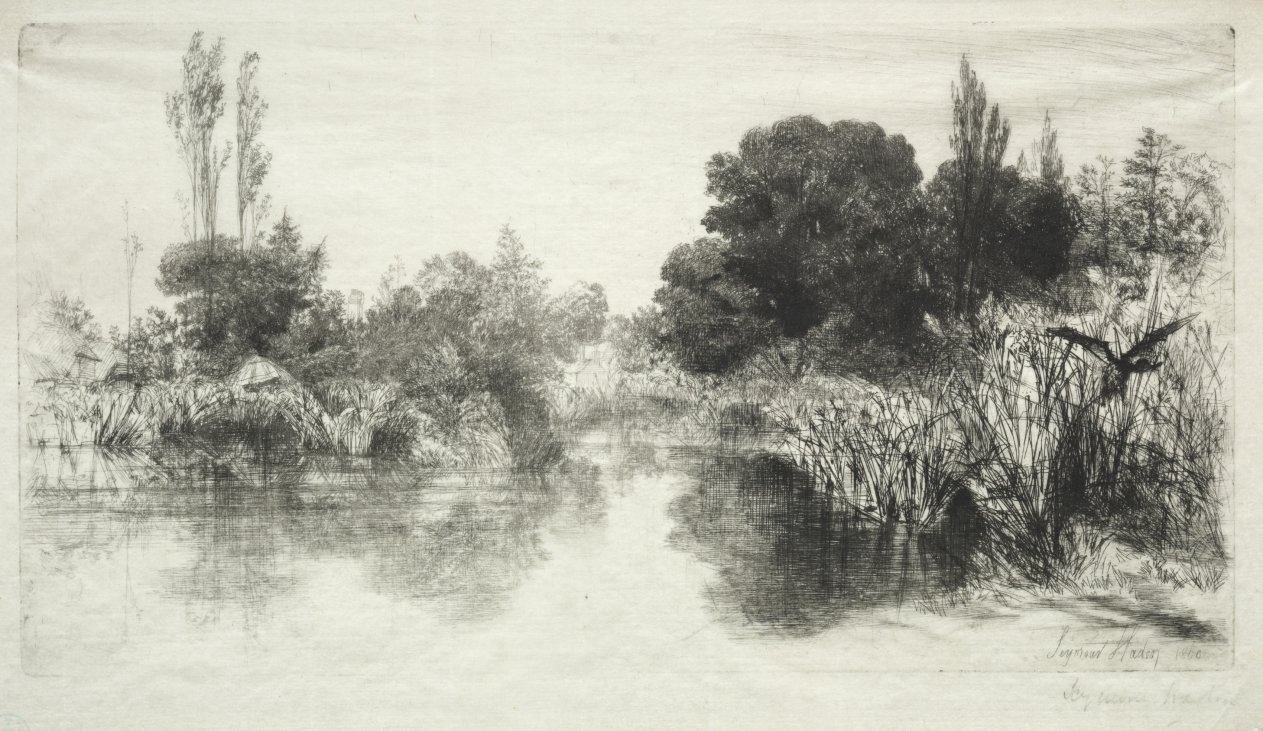
Open paper. In Shere Mill Pond (The Larger Plate), dated 1860 by Cleveland, most of the sheet is untouched. The water is a field of white broken by a few horizontal strokes and the soft reflections of trees. Haden lets the viewer’s eye fill it in. That is the same decision a designer makes when a layout is mostly white space with a single strong cluster of detail.
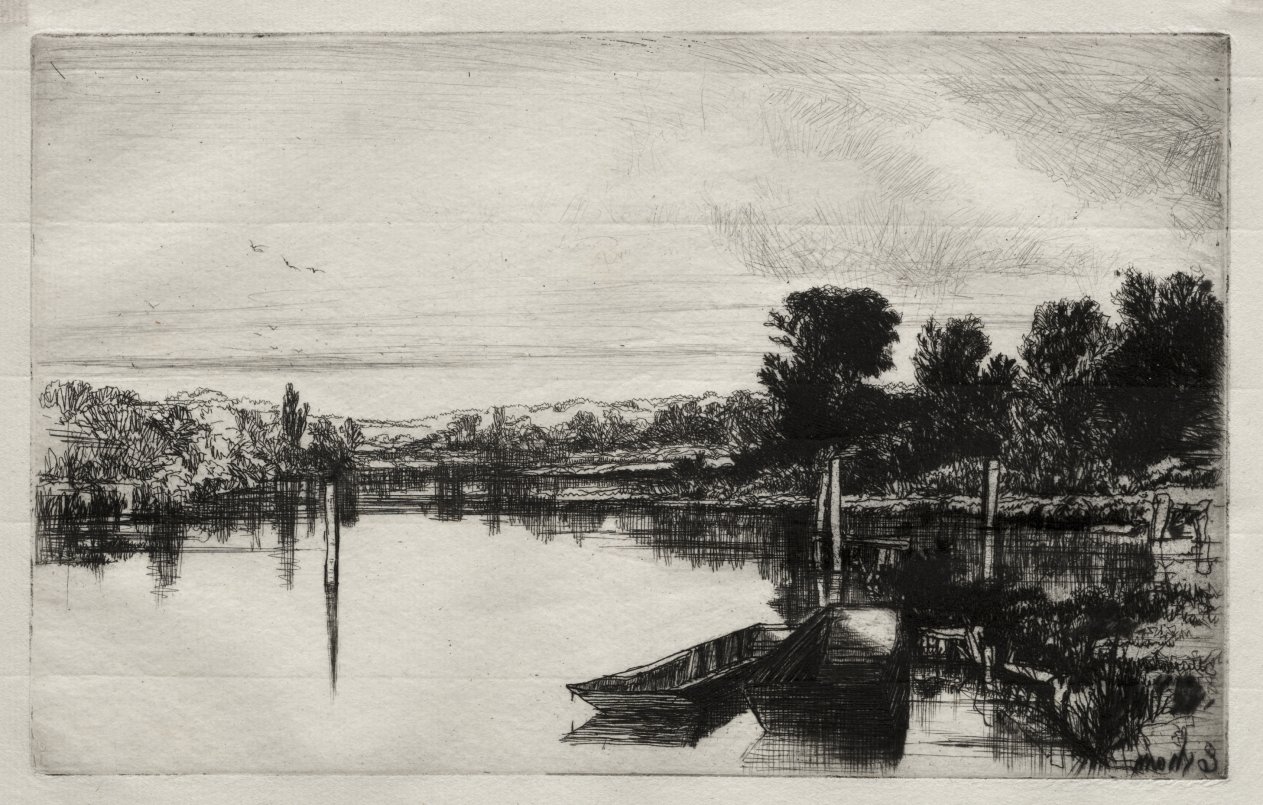
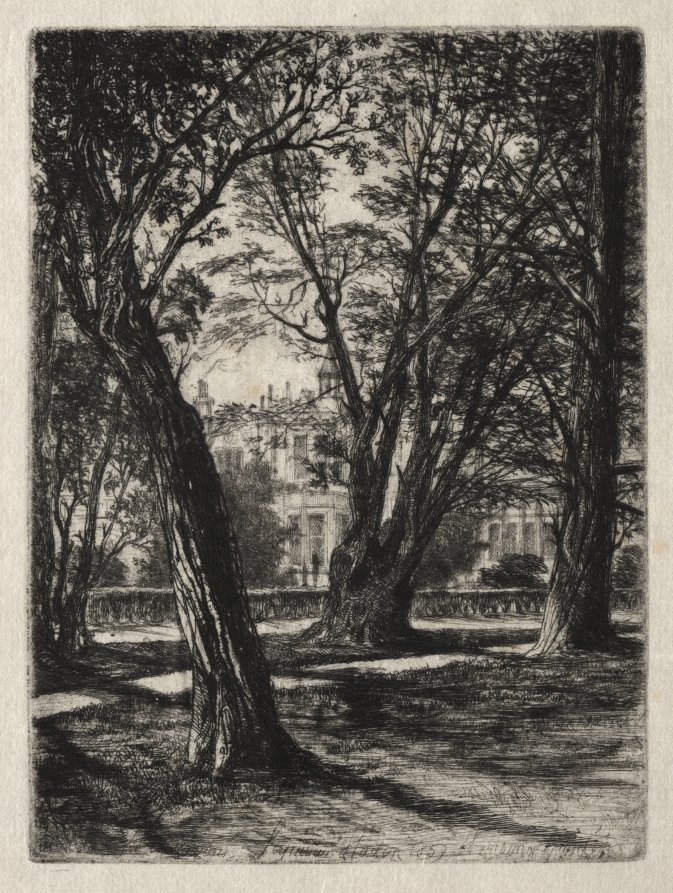
A single dark anchor. Each of these landscapes has one zone of deep, furry black, usually a tree mass or a bank in shadow. In Egham (1859) the dark trees sit on one side of the curving river and balance the light sky. Everything else is mid-tone or white. One heavy shape, carefully placed, carries the whole composition.
Speed in the line. His strokes are loose, short and directional. Grass is a flick, a distant hedge a wobbling line, a cloud a few hatches. The marks show the movement of the hand, which is part of what made the Etching Revival feel modern against the tight reproductive engraving of the period.
Low horizons and long views. Many plates set the horizon low and let the sky occupy the upper half, a reliable way to make a small print feel spacious.
Key works by Francis Seymour Haden
The dates below follow the Cleveland Museum of Art’s collection records.
- Kensington Gardens and Egham, both 1859: two riverside and park views from the late 1850s, when the Milwaukee Art Museum says he took up etching seriously.
- Shere Mill Pond (The Larger Plate), 1860, etching and drypoint: a broad, quiet view of a Surrey mill pond. The National Gallery of Art in Washington also holds an impression.
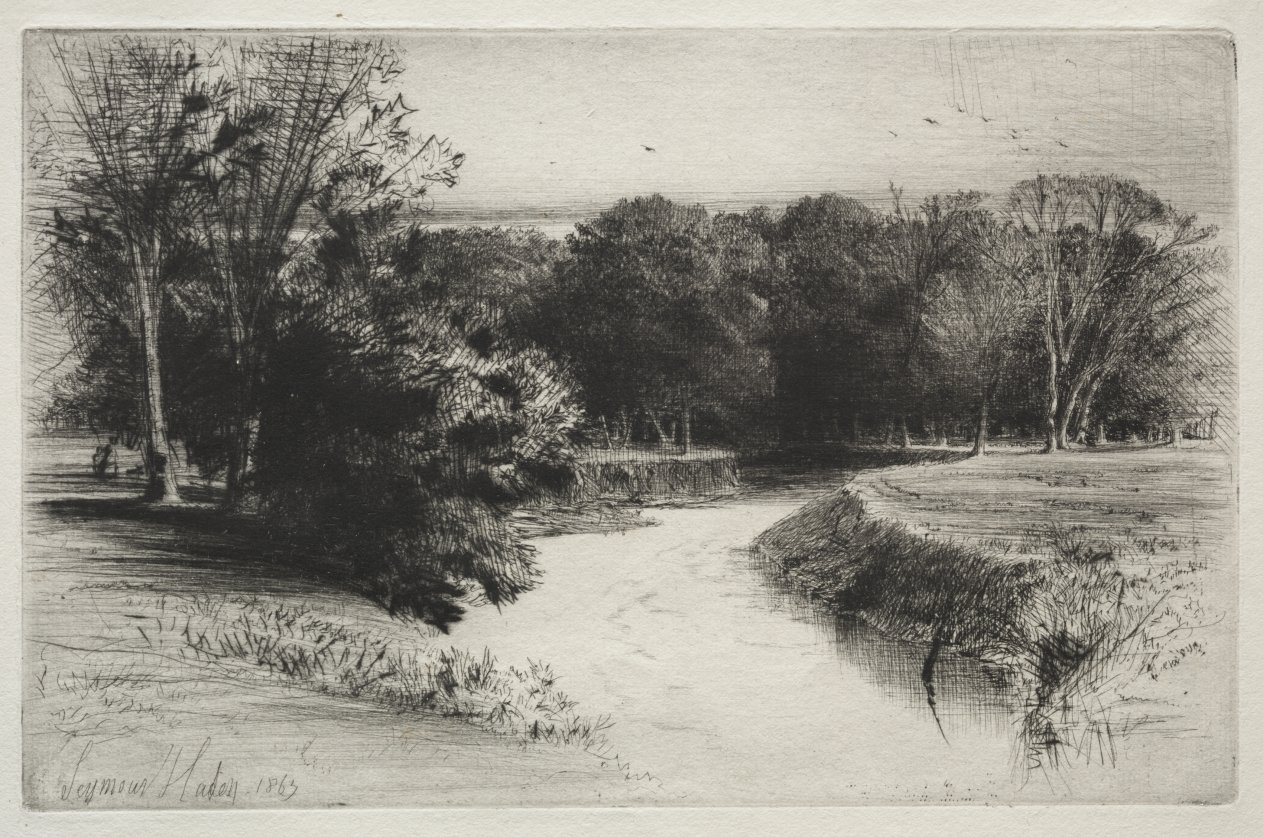
- A Sunset in Ireland, 1863, etching and drypoint: a river view where light is shown almost entirely by what is left out.
- Breaking Up of the Agamemnon, 1870, etching: the old warship moored on the Thames, which the Milwaukee Art Museum also exhibited.
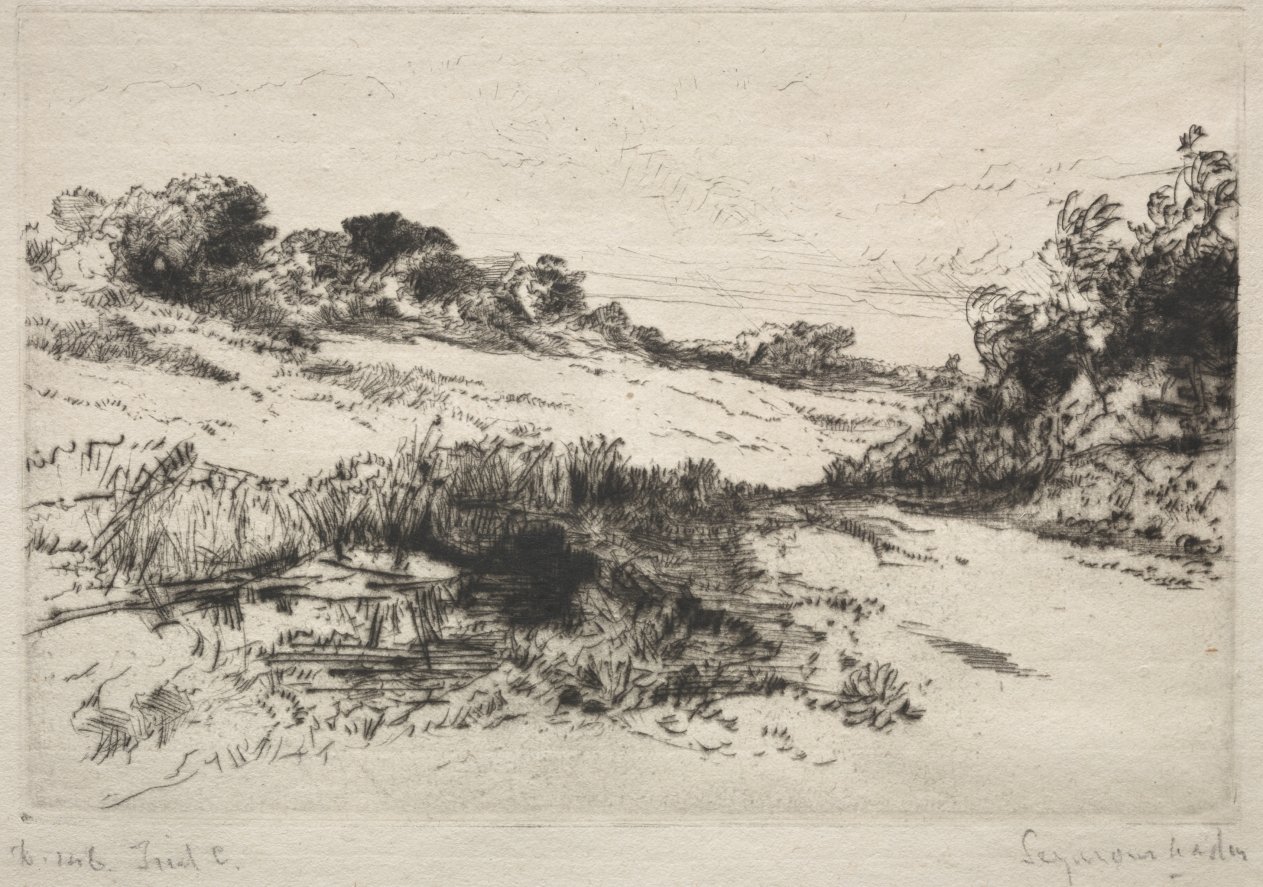
- Windmill Hill, No. 1, 1877, drypoint: a late, almost entirely drypoint plate.

Technique: etching and drypoint
Most of Haden’s prints combine two intaglio methods, and Cleveland lists many of them as “etching and drypoint.” In etching, the artist draws through a waxy ground on a copper plate with a needle, then lets acid bite the exposed lines. The line is free and even, which suits his sketch-like strokes. In drypoint, the artist scratches straight into the copper. The needle throws up a ridge of metal, called a burr, that catches ink and prints as a soft, velvety dark. That burr is where Haden’s rich blacks come from, and because it wears down quickly, early impressions of a drypoint are usually the strongest.
The Milwaukee Art Museum quotes the idea that Haden saw etching as a direct means of expressing the mind. You can see that in how little preparation the plates show. There is no elaborate under-drawing, just a quick record of a scene. For a wider look at the process and its history, read our guide to etching, and compare his views with the darker Paris plates of Charles Meryon.
Francis Seymour Haden and design today
Use restraint as a style. Haden’s plates prove that a small amount of line, placed well, reads as finished. Try it in illustration for packaging or editorial work: draw a scene, then remove half the lines and see what still carries.
Build one dark, keep the rest light. A single heavy shape against open space gives a layout a clear focal point. In a poster or hero image, let one element take the deepest value and keep everything else quiet.
Borrow the texture of drypoint. Soft-edged, slightly fuzzy darks next to crisp, thin lines create contrast without colour. Brush-pen and textured digital brushes can imitate that pairing in monochrome identity work.
Think in monochrome first. Haden worked in black ink on cream paper. Designing a layout in pure value before adding colour is a good discipline, and the printmaking theme in our museum collection has many more examples to study.
Mind the edges. Many of his compositions fade out toward the plate edge instead of ending in a hard frame. Vignetted edges can make a web banner or book cover feel more like a sketch and less like a box.
Using Haden’s prints in your projects
Haden died in 1910, and the prints shown here were made between 1859 and 1877. The Cleveland Museum of Art releases these images under CC0, so they can be reused. Check each museum’s record for its own terms when you use a different source. Some reproductions you find online are made from later impressions or restrikes, so name the museum and the object when you credit an image.
Because his prints are mostly white space, they work well as quiet background textures, chapter openers or section dividers, provided the line weight survives being scaled down. Test them at the final size, since fine drypoint lines can disappear on screen.
Frequently asked questions
Was Francis Seymour Haden a professional artist?
No. He was a surgeon by profession. The Milwaukee Art Museum describes his etching as a pastime alongside his medical career, although he became a central figure in British printmaking and founded the Society of Painter-Etchers in 1880.
How was Haden related to Whistler?
He married Deborah Whistler, whom the Milwaukee Art Museum describes as the half-sister of James McNeill Whistler. The two men were close in the late 1850s, but the University of Glasgow’s Whistler catalogue records a quarrel in 1867 after which they never spoke again.
What is drypoint?
Drypoint is an intaglio technique in which lines are scratched directly into a metal plate. The raised burr holds ink and prints as a soft, rich dark. Haden combined it with etching in many plates.
What is the Royal Society of Painter-Printmakers?
It is the society Haden founded in 1880 as the Society of Painter-Etchers. According to the society, it began because the Royal Academy was reluctant to show etchings and engravings, and it received a Royal Charter in 1888.


