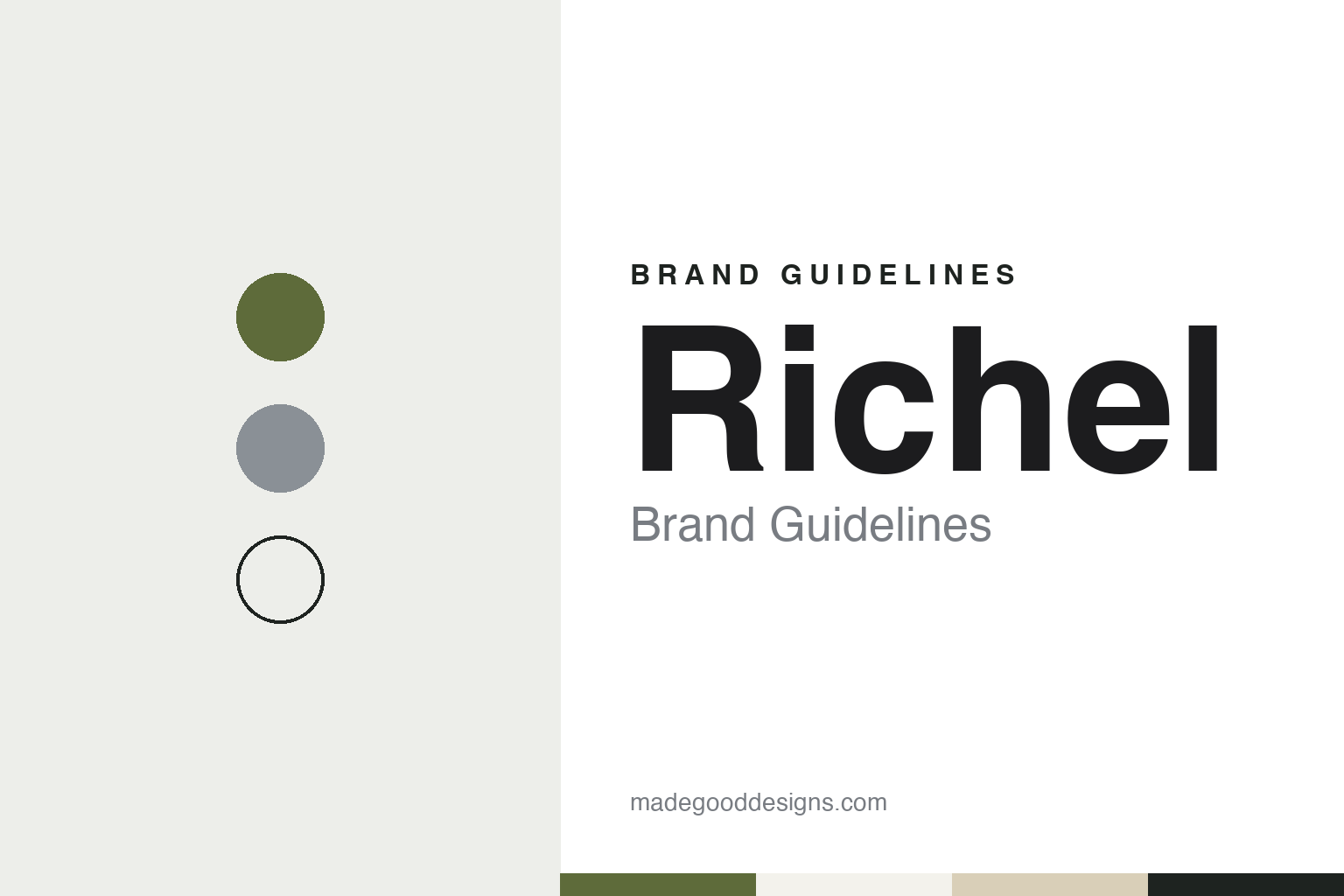
Richel Brand Guidelines
The Eygalières greenhouse maker founded by Pierre Richel in 1964.
Aa
Two constants: an olive, grey and film-white palette and an engineering sans register. Abstract homage — not a Richel product or mark; no greenhouse, logo or nameplate is reproduced.
Eygalières, 1964
Tunnel greenhouses from Provence.
Richel began in 1964 in Eygalières, a village in the Bouches-du-Rhône in Provence, where it was founded by Pierre Richel. The date and place are given by the company and repeated by French Wikipedia, which cites the trade site ConstructionBTP in 2014, and by HortiDaily, which wrote in July 2024, for the company’s sixtieth anniversary, that Richel at first concentrated on tunnel greenhouses and over the decades grew into an all-round greenhouse builder.
Manufacturing was part of the business early on. HortiDaily lists a 50 per cent ventilation system on an eight-metre-wide multi-span greenhouse in 1972 and the firm’s first tubing machine in 1975 among its early milestones. In the late 1970s Pierre Richel’s son, Christian Richel, joined after business school, and the company says he became chief executive in 1978. Exports followed: the French market “was not very dynamic at the time,” Brice Richel, the group’s communication director, told HortiDaily, so the company looked to Italy, India, China, the rest of Europe and the Middle East, with other markets following in the 1990s.
The scale changed with it. In a 2022 tribute to a long-serving operations manager, published by MMJDaily, the company said that in 1986 Richel had about 50 employees and a few machines in a hangar of around 2,000 square metres, and that it now employed some 350 people on premises of about 50,000 square metres, with machines that are mostly automated.
Colour
Plastic first, then glass and equipment.
Plastic-covered structures remain the core. The company’s current ranges include multi-span greenhouses, single and double tunnels and multi-tunnels, alongside Venlo glasshouses, semi-closed greenhouses and photovoltaic greenhouses. HortiDaily credits Richel with developments such as oval tubes, the beam gutter, the Richel clips and the double-inflated plastic greenhouse, a technique it describes as widely used around the world.
Glass came through an acquisition. In February 2001 the trade journal Glassonline reported that Serres Marchegay of Luçon, in the Vendée, described as France’s number two maker of glass greenhouses, had been bought by Richel Serres de France, then a maker of plastic greenhouses quoted on the Paris Marché Libre. The company dates its Venlo business to 2001 and says it grew after that purchase.
Equipment followed in 2007, when Richel bought Dimac, a supplier of equipment for greenhouses and garden centres, according to French Wikipedia, which cites a February 2007 notice; the company says this brought heating, irrigation, electrical work, control systems and fertilisation in-house. The same year, the company says, it built the first Venlo greenhouse with a photovoltaic roof in France, at La Rochelle. French Wikipedia, citing La Tribune in 2010, says Richel began designing and fitting photovoltaic roofs and buildings from 2008 in partnership with EDF EN. In 2014 the company launched Optim’air, a greenhouse with active climate control offered in both the Venlo and plastic ranges, which HortiDaily calls a semi-closed greenhouse.
Not everything it makes is for crops. Since 2000 the group has sold demountable storage buildings and metal-and-textile shelters, under the Toutabri name in France and Shelterall abroad, and in 2020 it added Toutabloc, modular concrete-block walls for bulk storage, French Wikipedia says. In 2025, it adds, regional business press reported a kiwi project at Loriol-sur-Drôme with the energy company Volta: two photovoltaic greenhouses covering five hectares.
Typography
Glass, film and climate.
Greenhouse builders sell something most people never see from the inside: a glass roof that can run for hectares, the steel and aluminium that holds it up, and the heating, cooling, water and climate systems below it. Their pictures tend to repeat a small set of scenes. Long glasshouse roofs catch low evening light; inside, tomato and pepper rows climb toward hanging gutters, shade screens sit half-drawn under the glass, and a climate computer glows on a grower’s desk. The images sell scale and control rather than a single product.
Much of the Dutch side of the trade grew up in and around the Westland, the district south-west of The Hague that Dalsem calls the traditional heart of Dutch horticulture. Certhon gives its headquarters as Poeldijk, in the Westland, and Dalsem gives its address as Den Hoorn, close by. Dalsem traces itself to a blacksmith who started work in the Westland in 1932, and Certhon says it began as a family business in 1896; both have since passed to larger groups, and the guides in this series set out who owns what today and when that changed.
The trade meets at fairs. GreenTech Amsterdam, held at the RAI exhibition centre, said in January 2018 that it would become an annual event, and builders use their stands as showrooms: in June 2022 Certhon said its stand had a large greenhouse deck hanging from the hall’s truss, with a harvesting robot on display beneath it. Trade titles such as Hortidaily report the projects, product launches and changes of ownership that follow.
This guide sets out what can be checked about each brand — when it began, who owns it, where it says it works and what it makes — and marks plainly what rests only on the company’s own word. The palettes and type are our own interpretation, not the companies’ identities.
Aa
An engineering sans for a steel-and-film builder. (Specimen set in Archivo, a sans STAND-IN; NOT the Richel logo.)
Richel today
Three generations, still in Eygalières.
Richel is still run by the family. The company says Benjamin Richel, the third generation, became chief executive in 2017; HortiDaily described him as president in 2024. In the same article Brice Richel said the company had been family-owned since it began and remained independent: “We have financial partners but remain in charge ourselves.” In 2010 La Tribune described Richel Serres de France as a family group co-led by Christian Richel, French Wikipedia says, and in 2017 Le Monde listed it among France’s best-performing family-owned small and mid-sized firms.
Manufacturing has stayed in Eygalières; guests at the 2024 anniversary toured the group’s historic manufacturing site there, HortiDaily reported. “Since we manufacture ourselves, we are in control of the quality,” Brice Richel told HortiDaily. ConstructionBTP reported in 2014 that the Eygalières site had a factory of 20,000 square metres, and a 2025 visit organised by the machinery association Axema described a site of about 75,000 square metres, 30,000 of them covered, French Wikipedia says. The company lists two sites in France — its 2024 celebrations were held in Angers as well as Eygalières — and subsidiaries in Mexico, Armenia, China and the United States, with sixteen sales offices and projects in 95 countries, a figure Le Journal des Entreprises also gave in 2022.
The company says it gained ISO 9001 certification in 2017 and a CSR commitment label from AFNOR Certification in 2021, with a second star in 2023. It describes itself as “a provider of agronomic solutions” and its customers as vegetable growers, nurseries, seed growers and young-plant growers.
For a design guide, Richel shows a builder whose identity rests on family continuity and on a factory it can point to. Compare Filclair, another French greenhouse builder, and Dalsem, a greenhouse builder from the Netherlands. For this guide we use olive, galvanised grey and film white with a sans, an unofficial interpretation; no product or logo is reproduced.
Explore & save
Keep Richel’s identity on hand — save it to a board in the Made Good inspiration library.
Richel identity set
Pin the Richel olive, galvanised grey and film-white palette and the engineering sans register to your own board.


