Zipline Brand Guidelines
The South San Francisco drone network that began in Rwanda.
Aa
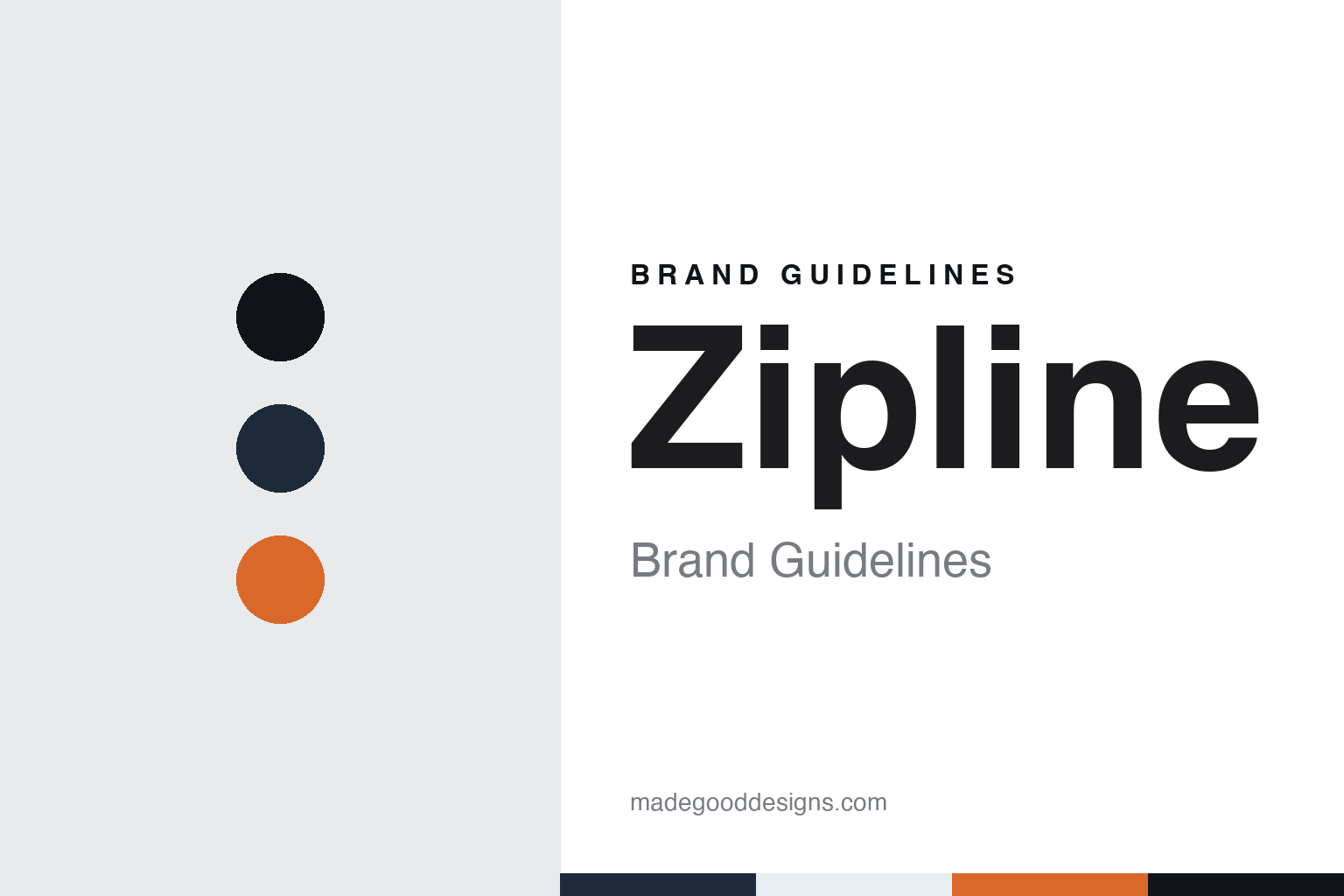
Two constants: a night navy, sky mist and signal orange palette and a geometric sans register. Abstract homage — not a Zipline product or mark; no aircraft, logo or wordmark is reproduced.
From Romotive to Rwanda
A robot start-up turns to medical delivery.
Zipline was founded in March 2014 in Half Moon Bay, California, according to English Wikipedia, which names its founders as Keller Rinaudo Cliffton, Keenan Wyrobek, Ryan Oksenhorn and William Hetzler. The company grew out of Romotive, a start-up founded by Rinaudo Cliffton in 2011 that made a small robot controlled by an iPhone. Wikipedia says Romotive stopped operating in 2014, after which the four began work on a fixed-wing drone meant for medical deliveries.
From the start Zipline built its own equipment. TechCrunch, reporting in April 2019, described the company as designing and manufacturing its own aircraft, its launch and landing systems and its logistics software. The company is Zipline International Inc., a privately held business with its headquarters in South San Francisco, Wikipedia says.
Its first service was in Rwanda. Under an agreement with the government, Zipline began flying blood and medical supplies to rural clinics from a distribution centre at Muhanga in October 2016, according to Wikipedia; a second Rwandan centre, near Kayonza in the east of the country, opened in December 2018. Zipline’s own website calls that first flight in Rwanda the beginning of its story.
The United States came next, slowly. In May 2018 Zipline was one of ten applicants chosen from 149 for the US Department of Transportation’s drone integration pilot programme, TechCrunch reported, and it began testing medical deliveries flown beyond the operator’s line of sight in North Carolina.
Colour
Fixed wings, parachutes and a tethered droid.
Zipline’s first aircraft, now called Platform 1, is a fixed-wing drone that is launched from a catapult, drops its package under a small paper parachute and returns to be caught by a wire, as Wikipedia describes it; it has an inner carbon-fibre frame and an outer foam shell. The US Federal Aviation Administration’s announcement of September 2023 refers to this aircraft as the Sparrow.
In March 2023 the company showed a second design. The Verge reported that the Platform 2 “Zip” hovers high above the delivery point and lowers a tethered “delivery droid” that steers itself down with its own small propellers, and that it can dock at a partner’s building to recharge and collect parcels. The idea, the magazine explained, is that one fleet can serve several businesses from shared docks, so that no single shop has to run its own drone operation. Wikipedia says Platform 2 entered service in April 2025, when Zipline began delivering for Walmart in the Dallas–Fort Worth area.
The African network kept growing. Zipline began flying in Ghana on 24 April 2019 under a government contract, TechCrunch reported that day. Wikipedia records later agreements in Nigeria, Côte d’Ivoire and Kenya, and a service in Japan’s Gotō Islands from 2022, run by Sora-iina, a Toyota Tsusho group company, with Zipline supplying the aircraft and the training. In Nigeria, Wikipedia says, the first hub opened in Kaduna State on 4 June 2022, part of plans for distribution centres with ultra-cold storage so that health facilities could order vaccines on demand.
At home, Wikipedia says, Zipline began a Walmart trial in Pea Ridge, Arkansas, in November 2021 and was approved by the FAA as a Part 135 air carrier in June 2022, then started deliveries in Salt Lake City with Intermountain Healthcare that October. On 18 September 2023 the FAA announced that it had authorised Zipline to deliver commercial packages around Salt Lake City with drones flying beyond the operator’s visual line of sight and without visual observers, and said the data from those flights would inform its rulemaking.
Typography
Drones as delivery networks.
Commercial drone makers sell instruments, not toys, and their pictures show it. The aircraft usually appear in the field rather than in a studio: a fixed-wing or vertical take-off airframe, often in white with a bright orange or another high-visibility colour, standing on gravel at a quarry edge, on a farm track or beside a pipeline before launch. The landscape matters as much as the machine, because the product being sold is the map, the model or the measurement that comes back.
Inspection and delivery makers have their own set pieces. Caged inspection drones are photographed inside boiler rooms, tanks, sewers and mines, lit only by their own lamps, with the protective frame as the defining shape. Delivery companies show a parcel being lowered on a line or dropped by a small parachute into a garden, a hospital yard or a field, so that the service, rather than the aircraft, carries the story.
People appear mainly as operators. A typical scene is a field crew in high-visibility clothing holding a tablet or a ground station, planning a flight or checking images on screen, with the drone small in the background. Brochures and websites follow the same order: the industry first, such as surveying, construction, mining, agriculture or public safety, then the workflow, then the hardware, with software screenshots and sample maps placed beside the aircraft.
Much of the industry still meets in person. Trade fairs such as Commercial UAV Expo and XPONENTIAL bring makers, software firms and operators to the same exhibition halls, where stands show airframes on plinths next to large screens of point clouds and orthophotos. In this guide we record what can be checked about each brand — who founded it, who owns it and what it says about where its products are made — and mark clearly what rests only on the company’s own word.
Aa
A geometric sans for an aircraft-led brand. (Specimen set in Manrope, a sans STAND-IN; NOT the Zipline logo.)
Zipline
From clinics to back gardens.
By January 2026 Zipline said it had passed two million commercial deliveries, The Robot Report reported, and it planned to begin serving Houston and Phoenix that year. The company now presents itself as an instant-delivery service for households and businesses as well as for health systems. Its website says it builds its hardware at its South San Francisco headquarters, under the line “Assembled in America.”
Not every market has grown. In Ghana, where the health ministry signed its agreement with Zipline in 2018 and later expanded it to eight distribution centres, Zipline stopped operating three of its six centres in late 2025 amid unpaid government bills. The Ghana News Agency reported in July 2026 that the Health Minister had told Parliament the ministry was working to clear the arrears, that Zipline was running three centres, and that the agreement was due to expire in September 2027.
Zipline’s public face has changed with its customers. Its old web address, flyzipline.com, now forwards to zipline.com, and the company publishes a press kit with logos, brand guidelines and a fact sheet.
For a design guide, Zipline shows how a company can keep one simple picture — a parcel arriving from the sky — while its customers move from rural clinics to suburban gardens. Compare Matternet, another Californian delivery-drone company whose early routes carried hospital samples, and Manna, another drone-delivery operator. For this guide we use a night navy, a pale sky grey and a signal orange with a sans, an unofficial interpretation; no product or logo is reproduced.
Explore & save
Keep Zipline’s identity on hand — save it to a board in the Made Good inspiration library.
Zipline identity set
Pin the Zipline night navy, sky mist and signal orange palette and the geometric sans register to your own board.