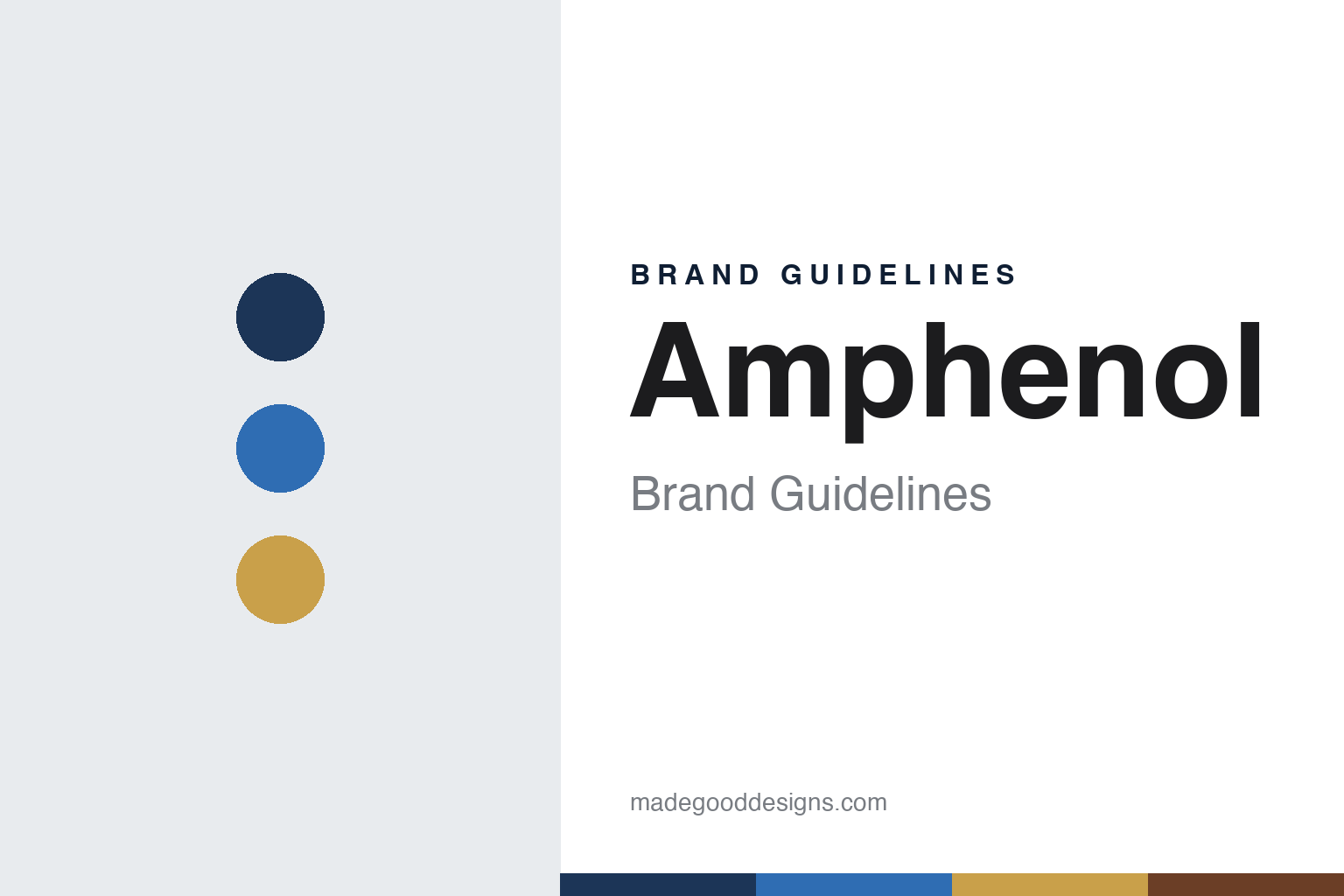
Amphenol Brand Guidelines
A 1932 Chicago tube-socket maker that kept its coined name through many owners.
Aa
Two constants: our navy, blue and contact gold palette and a technical sans register. Abstract homage — not an Amphenol product or mark; no connector, logo or nameplate is reproduced.
American Phenolic
A plastic tube socket in 1930s Chicago.
Amphenol’s name is a contraction of American Phenolic Corporation, the company Arthur J. Schmitt founded in Chicago in 1932, English Wikipedia says. Schmitt, an engineer and inventor, had found that an insulating plastic could be used to make sockets for radio tubes more quickly and simply than Bakelite or ceramic, according to Wikipedia’s article on him, and a tube socket for radio valves was the company’s first product. His name continues in the Arthur J. Schmitt Foundation, which funds scholarships and fellowships at Catholic universities in and around Chicago, the same article says.
The company was renamed Amphenol Electronics Corporation in 1942. The International Directory of Company Histories (2001) dates the company under that name to 1942 and describes a Chicago business making components for the young electronics industry, with plants in Illinois, Connecticut and California. During the Second World War it grew quickly as a main maker of connectors for military hardware, including aircraft and radios, English Wikipedia says; the article on Schmitt adds that the company built equipment for radios and for military use during the war, and for industry afterwards.
Its name is tied to some of the standard radio-frequency plugs of the period. English Wikipedia’s article on the BNC connector, a bayonet coaxial plug developed for the US Navy in the mid-1940s, says the term “BNC” appeared in Amphenol advertisements in 1948, and that Paul Neill and Carl Concelman, working at Amphenol in the late 1950s, invented the threaded TNC connector. English Wikipedia also credits the micro ribbon connector to Amphenol, citing a US patent.
Colour
Borg, Bunker Ramo, Allied, LPL and KKR.
Amphenol went public in 1957; the 2001 company history says it began trading on the New York Stock Exchange in May that year. In December 1958 it merged with the Wisconsin instrument maker George W. Borg Corp. to form Amphenol-Borg Electronics, a name later shortened again, and in 1961 it merged with FXR, which added microwave technology.
A long run under other owners followed. At the end of 1967, after a takeover contest, Amphenol agreed to merge with the computer maker Bunker Ramo; the combined company took the Bunker Ramo name, and Amphenol became its connector group, the same history says. In 1981 the chemical group Allied Corporation bought Bunker Ramo, and Amphenol carried on as a unit of Allied, later Allied-Signal. English Wikipedia says the Bendix connector business was merged into it after Allied acquired Bendix in 1983. The French connector maker Socapex, which had long been licensed to make Bendix connectors, was bought in December 1985 according to the 2001 history, and in 1986 according to English Wikipedia.
In 1987 the LPL Investment Group of Wallingford, Connecticut, bought Amphenol from Allied-Signal, and Wallingford is still the company’s headquarters. Debt from that purchase left Amphenol on the edge of bankruptcy in the early 1990s, the 2001 history says, before it became a public company again in 1991 and merged with LPL and the coaxial-cable maker Times Fiber Communications in 1992. In January 1997 the investment firm Kohlberg Kravis Roberts agreed to buy Amphenol, and it still owned about half of the shares in 2001. Today Amphenol Corporation is listed on the New York Stock Exchange under the symbol APH, English Wikipedia says.
Typography
How the trade presents itself.
Wire, cable and connector makers sell parts that disappear once they are installed, so their pictures tend to show the moment before that happens. Yards stacked with wooden cable drums, reels of insulated conductor and coils of copper set the scale of a cable business; close-ups of gold-plated contacts, crimped terminals and push-pull plugs show the precision of a connector maker. Bundles of colour-coded wires, laid out on a harness board, explain more about the trade than any slogan.
The customers shape the imagery. Many of these companies supply aircraft, rail vehicles, cars, factories and communications networks, and their brochures return again and again to the same scenes: a wiring harness threaded through an airframe, a connector on a train bogie, a cabinet of fibre-optic cable in a data centre. The product is rarely the hero on its own; it appears in the machine it serves.
Much of the industry’s public life happens at trade fairs. electronica, the electronics trade fair, is where component makers show connectors, sensors and assemblies to engineers and buyers, and Wire Düsseldorf gathers the makers of wire, cable and the machines that produce them. Stands are often built around cut-away samples, test rigs and walls of plugs in every size.
The names themselves reflect a long history of mergers. Several of the companies in this guide carry coined names, initials or the names of founders whose businesses were later bought and combined, and the same plug may be sold under a brand that has changed owner more than once. This guide sets out who founded each company, who owns it now and what it says about where its products are made, and marks clearly what rests only on the company’s own word.
Aa
A technical sans for a connector and cable maker. (Specimen set in IBM Plex Sans, a sans STAND-IN; NOT the Amphenol logo.)
Amphenol
Wallingford, and a long list of acquisitions.
Since the late 1990s Amphenol has grown largely by acquisition. English Wikipedia lists, among many others, Teradyne’s connector business in 2005, FCI Asia in 2016, the testing and sensing company MTS Systems in 2021, TPC Wire & Cable and Carlisle Interconnect Technology in 2024, and two parts of CommScope: its outdoor wireless and distributed antenna businesses, including Andrew, in 2025, and its connectivity and cable business in January 2026. The trade site I-Connect007 reported on 12 January 2026 that the last of these deals was complete and that it added fibre-optic interconnect capabilities for data communications and communications networks.
Its products now span connectors and interconnect systems, antennas, sensors, and coaxial, high-speed, fibre-optic and specialty cable, English Wikipedia says, sold for data centres, industry, cars, communications networks, defence, mobile devices and aerospace. Manufacturing has long been spread out. Wikipedia records a factory opened in Nogales, Mexico, in 1984; the 2001 history describes a plant in Sidney, New York, that made most of the company’s aerospace connectors in the mid-1990s, where about a thousand workers held a strike in October 1995, and an expansion of manufacturing in China, the Czech Republic, Mexico and Brazil by 2000.
Scale has changed the industry’s league table. A ranking by the research firm Bishop & Associates, reported by the Passive Components Blog in November 2026, placed Amphenol first among connector makers by 2025 sales, ahead of TE Connectivity, and called it the first change at the top of the ranking in 45 years.
For a design guide, Amphenol shows how a 1930s Chicago parts maker kept one coined name through several changes of owner and a move to Connecticut. Compare TE Connectivity, whose line runs back to AMP, and Molex. For this guide we use navy, signal blue and a contact gold with a sans, an unofficial interpretation; no product or logo is reproduced.
Explore & save
Keep Amphenol’s identity on hand — save it to a board in the Made Good inspiration library.
Amphenol identity set
Pin the Amphenol navy, blue and contact gold palette and the technical sans register to your own board.