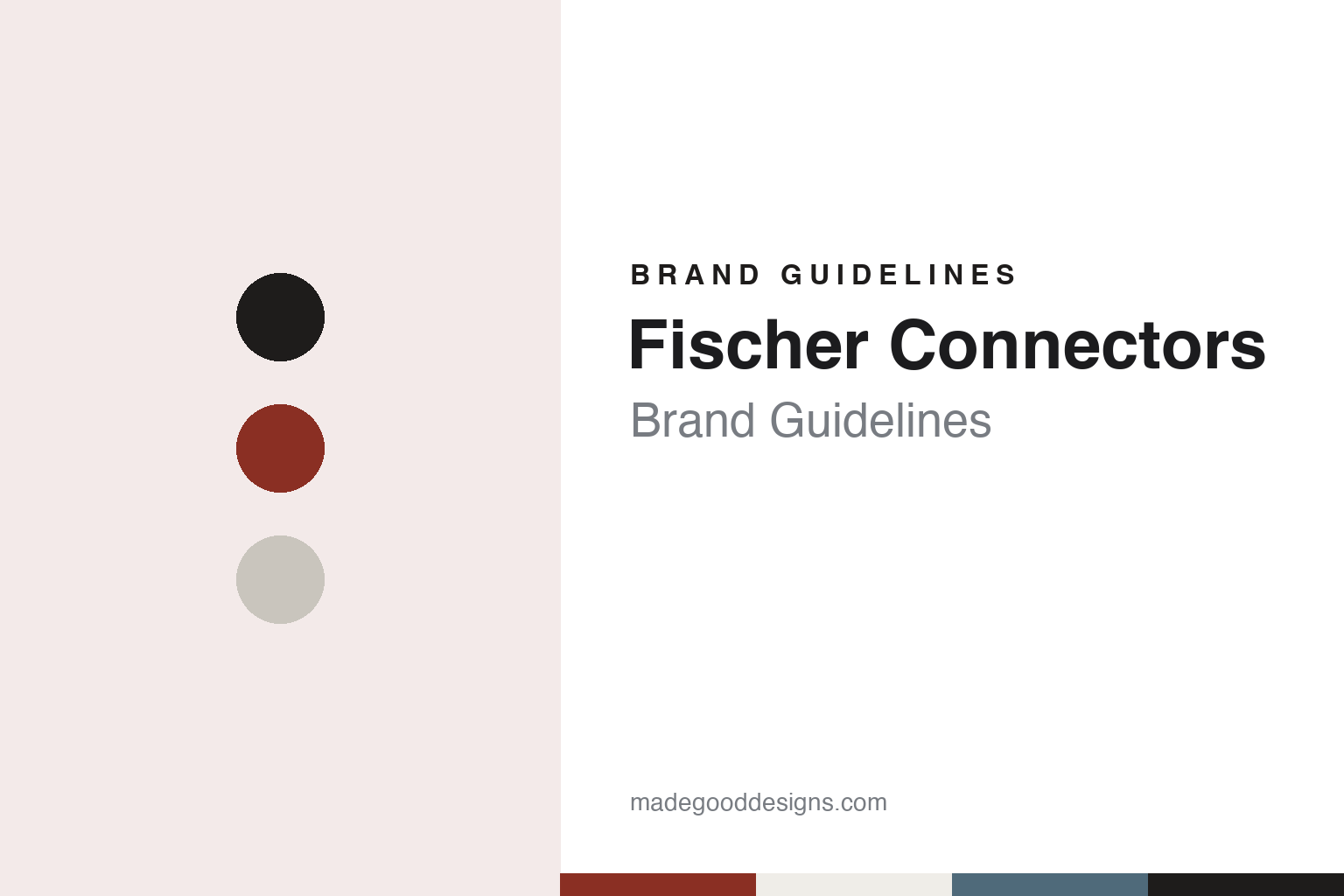
Fischer Connectors Brand Guidelines
Walter Werner Fischer’s sealed connector, from Morges to Saint-Prex.
Aa
Two constants: a red, graphite and steel-blue palette and a technical sans register. Abstract homage — not a Fischer Connectors product or mark; no connector, logo or nameplate is reproduced.
W. W. Fischer
A vacuum engineer and a sealed connector.
Fischer Connectors was founded in 1954 in Morges, on Lake Geneva, by Walter Werner Fischer, a Swiss engineer. The company’s history names the first business W. W. Fischer and describes its founder as an expert in vacuum technology; Wiley Industry News, reporting on the family’s succession in July 2023, also called him an expert engineer in vacuum technology. The present name, Fischer Connectors, dates from a rebranding in 2003, the company says.
The company built its reputation on sealing. It says it developed its first high-quality sealed connector, for industrial use, in its founding year, and English Wikipedia credits it with the first sealed connector. In 1962 it registered an international patent on its own push-pull locking system, according to both the company and English Wikipedia, and in 1964 it developed a hermetic connector — the Core Series in brass, which the company calls the world’s first hermetic connector, a claim Wiley Industry News repeated in 2023.
Growth meant moving within the canton of Vaud. The company says it moved to a new manufacturing site at Apples in 1975 to meet demand, and in 2008 to its present headquarters and plant at Saint-Prex, also in Vaud. English Wikipedia describes Saint-Prex as the main manufacturing site and research centre.
Colour
Core Series, UltiMate and Freedom.
The Core Series is the company’s long-running push-pull range, extended over the decades by material. The company dates the stainless-steel version, built to be sterilised, to 1970; a plastic version to 1995; single-use plugs to 2006; and lightweight aluminium connectors under the AluLite name to 2008. Around that core it added the rugged UltiMate range and a broadcast Core Series in 2010, and the FiberOptic and miniature MiniMax ranges in 2012, it says. It sells connectors in brass, stainless steel, aluminium and plastic, English Wikipedia notes, and in 2021, the company says, it adapted the UltiMate 80 to be compatible with NATO’s STANAG 4695.
A recent design is the Freedom Series, a low-profile connector that mates in any orientation through 360 degrees, designed to be built into wearable equipment. English Wikipedia dates the first model, the LP360, to 2018 and says it won several awards within a year, including a Military & Aerospace Electronics Innovators Award, a Design World LEAP Award and a Red Dot Award for Product Design; the company dates the launch to 2019. English Wikipedia also records that its FiberOptic Series won a Best of IBC award at the 2013 International Broadcasting Convention.
The range now reaches beyond connectors. Fischer Connectors sells cable assemblies, rugged flash drives — the first launched in 2011, the company says — and electronics such as data and power hubs; the Keystone hub for soldier-worn equipment was launched in March 2023. English Wikipedia lists markets including aerospace, broadcast, defence, medical, nuclear, robotics and underwater work. In November 2023 the company won the Vaud International Business Award in its best-company category, it says.
English Wikipedia puts the catalogue at more than 30,000 standard electrical, optical and hybrid connectors across five product lines, and records two earlier honours: in a PwC study presented at the Swiss Economic Forum in Interlaken in June 2017, the company was named a Swiss Champion for its Industry 4.0 approach, and the same year it became a partner of SolarStratos, a project to fly a solar-powered aeroplane into the stratosphere.
Typography
Design and documentation.
Wire, cable and connector makers sell parts that disappear once they are installed, so their pictures tend to show the moment before that happens. Yards stacked with wooden cable drums, reels of insulated conductor and coils of copper set the scale of a cable business; close-ups of gold-plated contacts, crimped terminals and push-pull plugs show the precision of a connector maker. Bundles of colour-coded wires, laid out on a harness board, explain more about the trade than any slogan.
The customers shape the imagery. Many of these companies supply aircraft, rail vehicles, cars, factories and communications networks, and their brochures return again and again to the same scenes: a wiring harness threaded through an airframe, a connector on a train bogie, a cabinet of fibre-optic cable in a data centre. The product is rarely the hero on its own; it appears in the machine it serves.
Much of the industry’s public life happens at trade fairs. electronica, the electronics trade fair, is where component makers show connectors, sensors and assemblies to engineers and buyers, and Wire Düsseldorf gathers the makers of wire, cable and the machines that produce them. Stands are often built around cut-away samples, test rigs and walls of plugs in every size.
The names themselves reflect a long history of mergers. Several of the companies in this guide carry coined names, initials or the names of founders whose businesses were later bought and combined, and the same plug may be sold under a brand that has changed owner more than once. This guide sets out who founded each company, who owns it now and what it says about where its products are made, and marks clearly what rests only on the company’s own word.
Aa
A technical sans for a Swiss maker of sealed connectors. (Specimen set in IBM Plex Sans, a sans STAND-IN; NOT the Fischer Connectors logo.)
Fischer Connectors
Three generations and a new group name.
The company has stayed with the founding family. The company’s history says the founder’s son, Peter Fischer, became chief executive in 1996 after many years running its commercial and industrial development; Wiley Industry News reported in 2023 that he had begun its international expansion in the 1980s and had chaired the board since 1999. The first subsidiary opened in the United Kingdom in 1988, followed by Germany in 1990, the United States in 1991, Italy in 1995, France in 1998, Hong Kong in 2000, India in 2012 and Japan in 2017, the company says.
In 2016 Jonathan Brossard, of the third generation, became chief executive. In 2019 the group created a spin-off, Wearin’, for connected wearable equipment, and in 2022 the family formed Conextivity Group to hold both businesses, Fischer Connectors and Wearin’. On 1 June 2023 Sabrina Brossard succeeded her father as president of the board, Wiley Industry News reported, adding that the group then employed nearly 700 people in 11 subsidiaries.
On manufacturing, the company says it has one group research and development centre in Switzerland, three main manufacturing sites and more than 700 employees. English Wikipedia describes cable-assembly facilities in Europe, North America and Asia-Pacific, and Wiley Industry News reported in 2023 that a new Fischer Connectors plant in Portugal was due to start operating by the end of that year. Saint-Prex remains the headquarters and main plant.
For a design guide, Fischer Connectors shows how a family maker can build an identity on one engineering promise — a sealed connection — and then stretch it to wearables. Compare LEMO, the push-pull maker that also started in Morges, and HARTING, another family-owned connector maker. For this guide we use a seal red, graphite and steel blue with a sans, an unofficial interpretation; no product or logo is reproduced.
Explore & save
Keep Fischer Connectors’s identity on hand — save it to a board in the Made Good inspiration library.
Fischer Connectors identity set
Pin the Fischer Connectors red, graphite and steel-blue palette and the technical sans register to your own board.