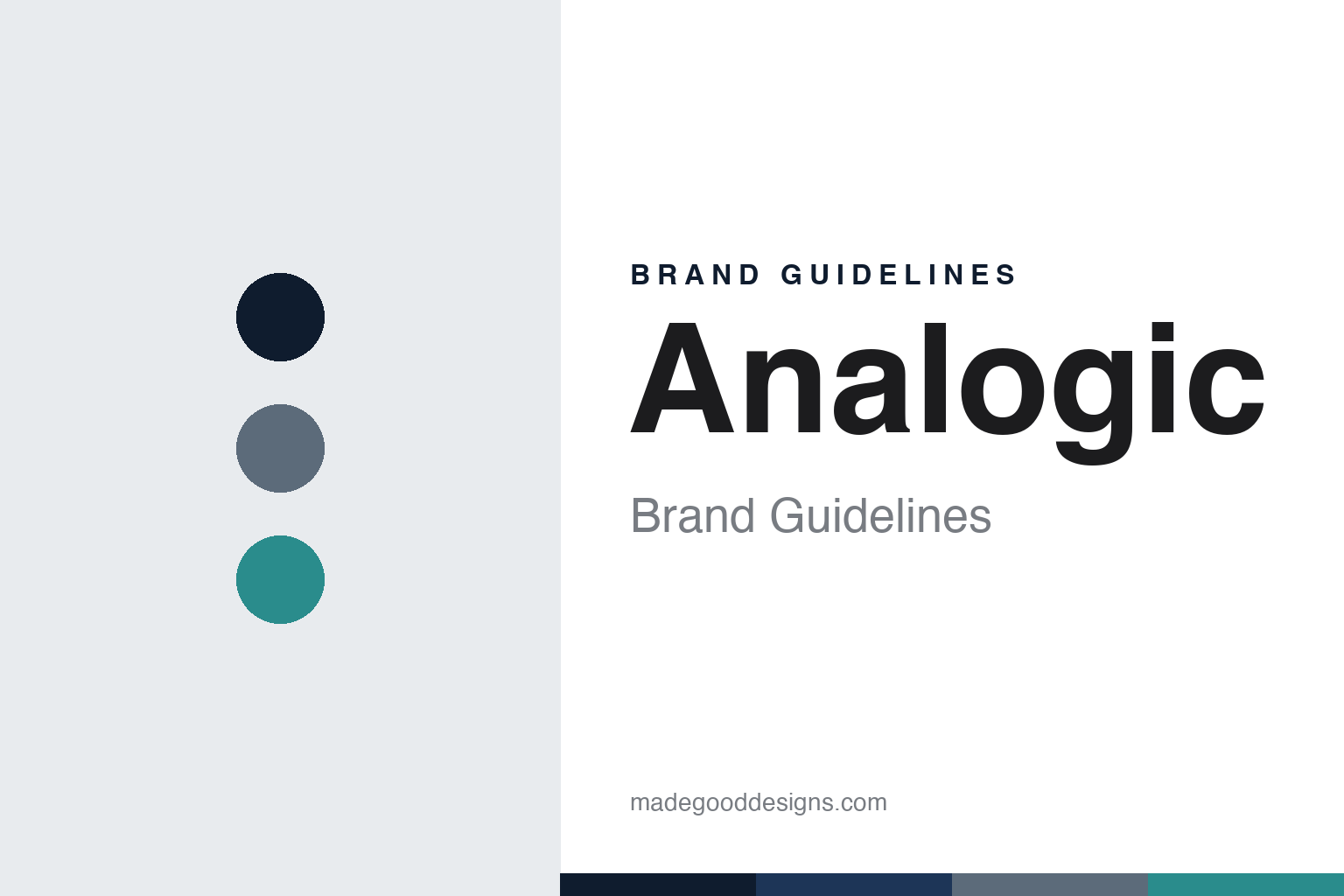
Analogic Brand Guidelines
The 1967 data-conversion firm behind CT baggage scanners.
Aa
Two constants: an Analogic navy, steel and teal palette and an engineering sans register. Abstract homage — not an Analogic product or mark; no scanner, logo or nameplate is reproduced.
Data conversion
An analog-to-digital specialist in Massachusetts.
Analogic dates itself to 1967. Its own history page says the engineer Bernard M. Gordon founded Analogic Corporation that year, with its first headquarters in Wakefield, Massachusetts. English Wikipedia gives an earlier start, saying Gordon founded Gordon Engineering in 1963 and that the business took the Analogic name in 1967. Wikipedia describes Gordon as an engineer and inventor considered “the father of high-speed analog-to-digital conversion,” and that specialism shaped the early company, which the history page says designed and made analog-to-digital and digital-to-analog converters, digital panel instruments and data-conversion subsystems for computers.
Medicine gave that specialism its largest use. The company says its patented conversion technology enabled computed tomography from 1975, when it introduced wide-dynamic-range and “instant imaging” CT techniques, and that its engineers invented a logarithmic analog-to-digital converter in 1979, after which it supplied CT data acquisition systems to imaging manufacturers around the world. Analogic listed on the NASDAQ exchange in 1978, according to its history page, and stayed a public company for four decades. In 1993, it says, its engineers developed a lightweight mobile CT scanner for a large medical manufacturer.
Much of this work went out under other names. English Wikipedia says Analogic’s CT, MRI and digital mammography products are sold to original equipment manufacturers, and the company’s about page describes partnering with “OEM and direct end-use customers.” The same page lists CT systems and subsystems, power systems for MRI scanners and selenium-based mammography detectors among its medical lines.
Colour
From the hospital scanner to the airport hold.
Analogic moved into aviation security in the late 1990s. Its history page says that in 1997, in response to the 1988 bombing of Pan Am flight 103, it was chosen as a partner to develop a CT-based baggage scanner called EXACT, short for Explosive Assessment Computed Tomography. After the attacks of September 2001, it says, it worked with L-3 Communications on a government order and delivered 425 of the systems before the end of 2003; the line is now known as the eXaminer 3DX.
The company then took CT from the hold to the passenger checkpoint. It says its COBRA system was installed at a checkpoint at Cleveland Hopkins International Airport in 2007, and that it introduced the ConneCT checkpoint CT scanner in 2016, designed so that laptops and liquids can stay in bags. In 2012, the history page says, it worked with Smiths Detection on the HI-SCAN 10080 XCT, a hold-baggage scanner using Analogic’s CT technology.
Other branches grew alongside. In 1999 the company formed ANRAD, built on assets bought from Noranda Advanced Materials, to make selenium-based flat-panel X-ray detectors for mammography. It bought Copley Controls, a Canton, Massachusetts, maker of MRI gradient amplifiers and motion-control drives, in 2007 according to the company and in 2008 according to English Wikipedia; Copley Controls still appears as a brand on Analogic’s website. Wikipedia also records a manufacturing plant opened in Shanghai in December 2009 and the purchase of the Vancouver ultrasound maker Ultrasonix in 2013.
Not every chapter was smooth. On 21 June 2016 the US Securities and Exchange Commission announced that Analogic and its Danish subsidiary, BK Medical, had agreed to settle parallel civil and criminal actions under the Foreign Corrupt Practices Act. The SEC said that from at least 2001 to early 2011 BK Medical had taken part in hundreds of transactions in which inflated invoices sent money to third parties named by its distributors, and that Analogic had failed to keep accurate books and records and adequate internal controls. The SEC said it took account of the company’s self-reporting and cooperation; BK Medical entered a non-prosecution agreement with the US Department of Justice.
Typography
Design and documentation.
Security screening and identity hardware is mostly seen in passing: the X-ray tunnel at an airport checkpoint, the arch a traveller walks through, the grey trays that slide back along a roller track. The companies that make this equipment sell to airports, customs services, border agencies, banks and governments rather than to the public, and their brands are built for procurement teams, regulators and trade-fair visitors.
Their imagery follows the equipment. Websites and brochures show security lanes with scanner tunnels and conveyor belts, walk-through metal detectors, cargo portals and gantries that a lorry drives through, and the operator screens on which bags appear as layered X-ray images. Identity makers work at a different scale: card printers small enough for an office desk, and the production lines on which passports, bank cards and ID cards are made and personalised.
Much of the business is about approvals and contracts. Makers name the regulators whose lists or standards their machines appear on, such as the US Transportation Security Administration or the European Civil Aviation Conference, and announce orders airport by airport and agency by agency. New products are shown at trade fairs such as Passenger Terminal Expo for airport equipment and Security Essen in Germany, where screening, access-control and identity companies exhibit side by side.
Ownership in this field changes often. Some of the makers in this guide were built from acquisitions or sit inside larger listed groups, and some have changed hands recently: Smiths Detection passed from Smiths Group to CVC Capital Partners in June 2026. This guide sets out what can be checked about each brand — who founded it, who owns it and where it says its products are made — and marks clearly what rests only on the company’s own word.
Aa
An engineering sans for a company of instruments and scanners. (Specimen set in IBM Plex Sans, a sans STAND-IN; NOT the Analogic logo.)
Analogic
Private since 2018, and larger since 2026.
Analogic’s years as a listed company ended in 2018. Its history page says that on 22 June 2018 it completed a merger in which an affiliate of Altaris Capital Partners, a New York investment firm focused on healthcare, acquired all of its shares, making it privately held. In January 2026 it moved its headquarters from Peabody, Massachusetts, to Salem, New Hampshire, the New Hampshire Business Review reported on 9 June 2026, bringing about 500 jobs with it; the Town of Salem reported that the new headquarters was opened with a ribbon cutting that day. The company says it also designs and manufactures in Shanghai, makes X-ray detectors in Montreal and designs power products in Canton, Massachusetts.
Its shape changed again later that year. On 15 April 2026 Altaris announced an agreement to combine Analogic with the Security Enterprise Solutions, Ports & Borders and Industrial Automation businesses of Leidos, the technology contractor based in Reston, Virginia; Pulse 2.0 reported that Leidos would keep a significant minority stake. On 5 October 2026 the companies announced that the deal was complete. The combined business operates under the Analogic name as a privately held company headquartered in Salem and led by chief executive Tom Ripp, with security imaging and detection for airports, ports, borders and critical infrastructure alongside its healthcare, power and automation work.
The public face of the brand stays close to engineering. Its homepage leads with the line “Innovation for Life” and describes its staff as “Builders. Tinkerers. Innovators. Teammates.” Its website is organised by technology — imaging and detection, power technologies and motion control — and still carries the Copley Controls name for its drives.
For a design guide, Analogic shows how a company long known for components inside other makers’ machines presents its own name; compare Smiths Detection, its partner on the HI-SCAN 10080 XCT, and Astrophysics, another American maker of screening equipment. For this guide we use a deep navy, steel grey and a cool teal with a sans, an unofficial interpretation; no product or logo is reproduced.
Explore & save
Keep Analogic’s identity on hand — save it to a board in the Made Good inspiration library.
Analogic identity set
Pin the Analogic navy, steel and teal palette and the engineering sans register to your own board.