Arjo Brand Guidelines
The Eslöv workshop that built a patient-handling brand.
Aa
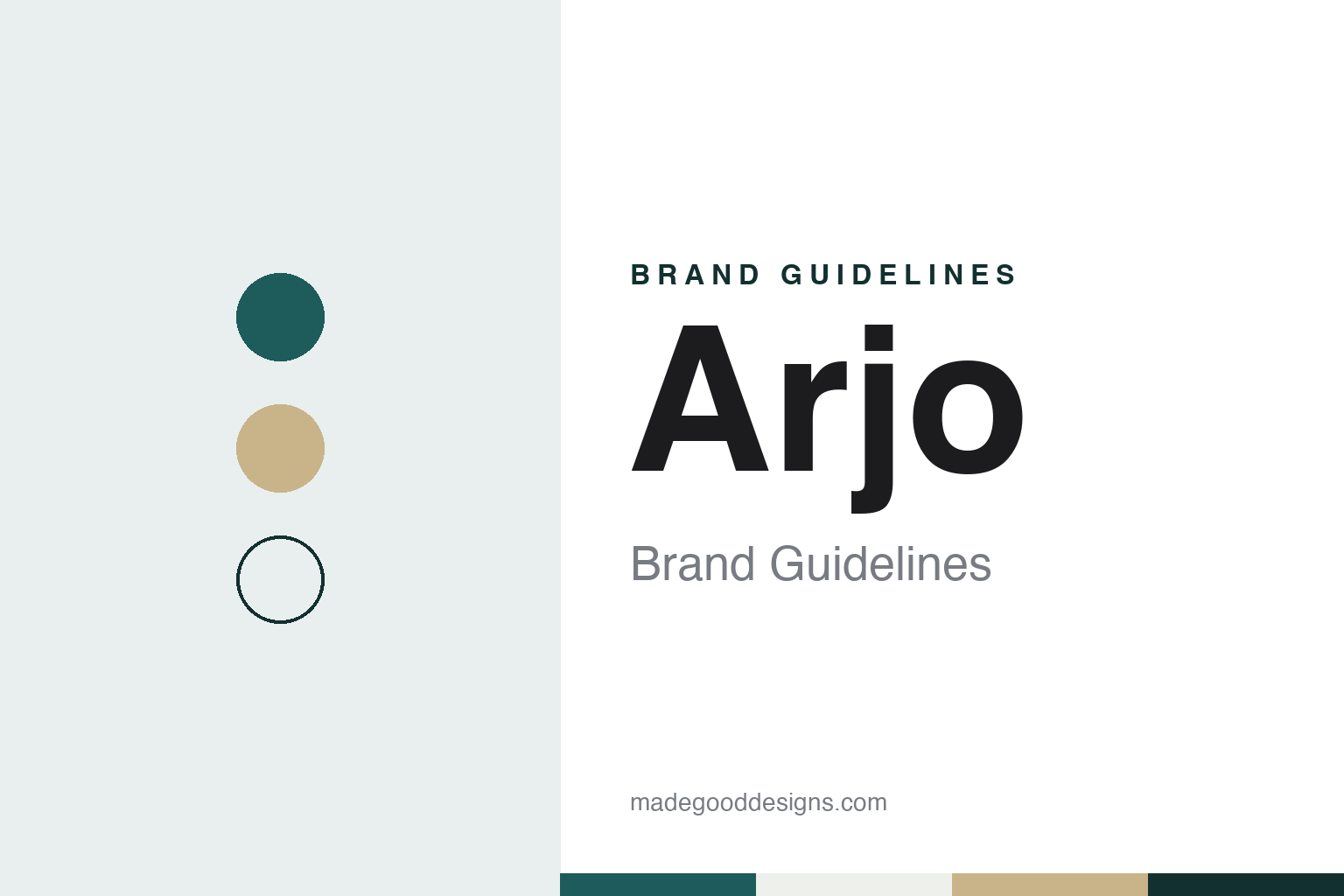
Two constants: an Arjo teal, birch and mist palette and a Scandinavian sans register. Abstract homage — not an Arjo product or mark; no lift, bed or logo is reproduced.
Arne Johansson
Two letters from each name.
Arjo was founded in 1957 in Eslöv, a town in southern Sweden, by Arne Johansson. The name is built from the first two letters of his first name and his surname, Arne Johansson, as both English Wikipedia and the company’s own history explain. Swedish Wikipedia describes the start as a mechanical workshop and contract manufacturer; the company says Arjo first made components and machine parts for other manufacturers, some of them makers of medical equipment.
Johansson then turned to products of his own. Arjo says he was among the first to see a need for bathing and transfer equipment in hospitals and elderly care, and for equipment that improved working posture for care staff. The company dates its first height-adjustable bathtub to 1972 and calls it the first of its kind. By the end of the 1960s, Arjo says, it was already exporting to western Europe, and it set up sales companies in Britain, Germany, France, Belgium and the United States.
Ownership changed in the 1980s. Swedish Wikipedia says Johansson sold Arjo in 1984 to Malmros International of Trelleborg, and that during the decade the company bought businesses abroad, including Century in the United States and Mecanaids in Britain, both of which the company’s own history also names. In 1993 Arjo shares were listed in Stockholm and London.
Two years later the independent run ended. In 1995 Arjo was bought by the Swedish medical-technology group Getinge, and it became the basis of Getinge’s Extended Care business area, still trading under its own name. The company says the purchase added hospital beds, patient lifts and bathing systems to Getinge’s range.
Colour
Lifts, baths, beds and mattresses.
Arjo’s range grew around moving and washing people with limited mobility. The company dates the first generation of its SARA stand-up aid, short for Stand And Raise Aid, to 1989, followed later by the Maxi Move patient lift. In 2004 it bought BHM Medical of Canada, which English Wikipedia says rounded off its range of ceiling lifts.
The biggest addition came in 2007, when Getinge bought the British company Huntleigh Technology and merged it with Arjo as ArjoHuntleigh. English Wikipedia traces Huntleigh to Flowtron Aire, set up in 1969, and the Huntleigh Group, formed in Luton in 1975; Huntleigh had floated on the London Stock Exchange in 1985 and bought the bed maker Nesbit Evans in 1993. After the merger, Luton became the headquarters of ArjoHuntleigh International. Arjo says Huntleigh’s first major product was the Nimbus mattress system, a name still in its range, and that Huntleigh brought pressure-care mattresses, intensive-care and nursing-home beds, compression products and diagnostic equipment.
Production was reorganised in 2013. Nordic Life Science reported on 27 March 2013 that Getinge had announced earlier that month that manufacturing of bath and hygiene products would move from Eslöv to its plant in Poznań, Poland, affecting all staff at Arjo Hospital Equipment in Eslöv, with the move to be completed during the second half of 2014. The same report said Getinge’s Extended Care business, then trading as ArjoHuntleigh, would open an innovation centre in Malmö for its mobility and hygiene products. Swedish Wikipedia confirms the original Eslöv factory closed in 2013 and names Växjö among the other sites where ArjoHuntleigh made products.
Today the company groups its range as patient transfer, hygiene, hospital beds, pressure-care surfaces, compression cuffs and pumps, disinfection and diagnostics, with the Huntleigh name kept for diagnostic equipment.
Typography
How bed makers present themselves.
Hospital bed and patient-handling makers sell to buyers who rarely see the product in a showroom. Purchasing teams, nurses and facilities planners meet it in catalogues, on websites and at trade fairs, so the way these companies present themselves leans heavily on photography, diagrams and film rather than on the object in the hand.
The most common image is the bed in a calm ward: a made-up mattress, soft daylight, a tidy bedside cabinet and very little else in the frame. Cutaway views and close-ups take over in technical literature, showing the frame, the castors, the side rails and the handsets and control panels that staff use every day. Hoists and stand-up aids are usually shown in use, in care homes and bathrooms as well as hospitals, with a carer and a resident in a staged transfer.
Trade fairs are a second stage. Large medical exhibitions such as MEDICA in Düsseldorf and Arab Health in Dubai give makers a stand on which beds, lifts and mattresses can be set out as a working room. Product films extend the same idea, often following a nurse at the bedside through a short routine to show how a control, a rail or a lift is meant to be used.
Behind those images sit long ownership histories. Many of the names in this field began as small workshops or furniture makers and passed through larger medical-technology groups, mergers and listings, so the brand on the bed today often carries decades of earlier companies with it. The guides in this round look at that history alongside the way each maker presents itself.
Aa
A plain Scandinavian sans for a name made of initials. (Specimen set in Work Sans, a sans STAND-IN; NOT the Arjo logo.)
Arjo
From Getinge division to listed company.
The Getinge years ended with a split. Arjo says that from 2015 it represented Getinge’s Patient & Post-Acute Care business area, and that in 2016 Getinge’s board announced it intended to divide the group into two businesses, Getinge and Arjo. At an extraordinary general meeting on 4 December 2017, Getinge’s shareholders voted to distribute all the shares in Arjo to themselves, and on 12 December 2017, in a release from Malmö, Arjo announced that its B shares had been admitted to trading on Nasdaq Stockholm. Swedish Wikipedia notes that this was the company’s second stock-market debut, after the 1993 listing. English Wikipedia places the spin-off in 2018, but the company’s dated release gives December 2017.
The company is now Arjo AB, with its head office in Malmö, not far from the town where it began. The ArjoHuntleigh name used during the Getinge years has given way to Arjo alone, while Huntleigh survives as a product name within the group. Arjo describes its work as products and services for people with reduced mobility and age-related health challenges, used in hospitals and in long-term care.
The founder’s initials have outlasted every change of owner: a private workshop, Malmros, a first listing, more than two decades inside Getinge and a second listing. The bathtub, lift and mattress names that run through the company’s history are presented by Arjo as part of one line of development from that Eslöv workshop.
For a design guide, Arjo shows how a name made of two pairs of letters can carry a brand through mergers and a change of home town. Compare Hillrom, the Indiana bed maker now owned by Baxter, and LINET, the Czech bed maker. For this guide we use a deep teal, a birch tone and a pale mist with a sans, an unofficial interpretation; no product or logo is reproduced.
Explore & save
Keep Arjo’s identity on hand — save it to a board in the Made Good inspiration library.
Arjo identity set
Pin the Arjo teal, birch and mist palette and the Scandinavian sans register to your own board.