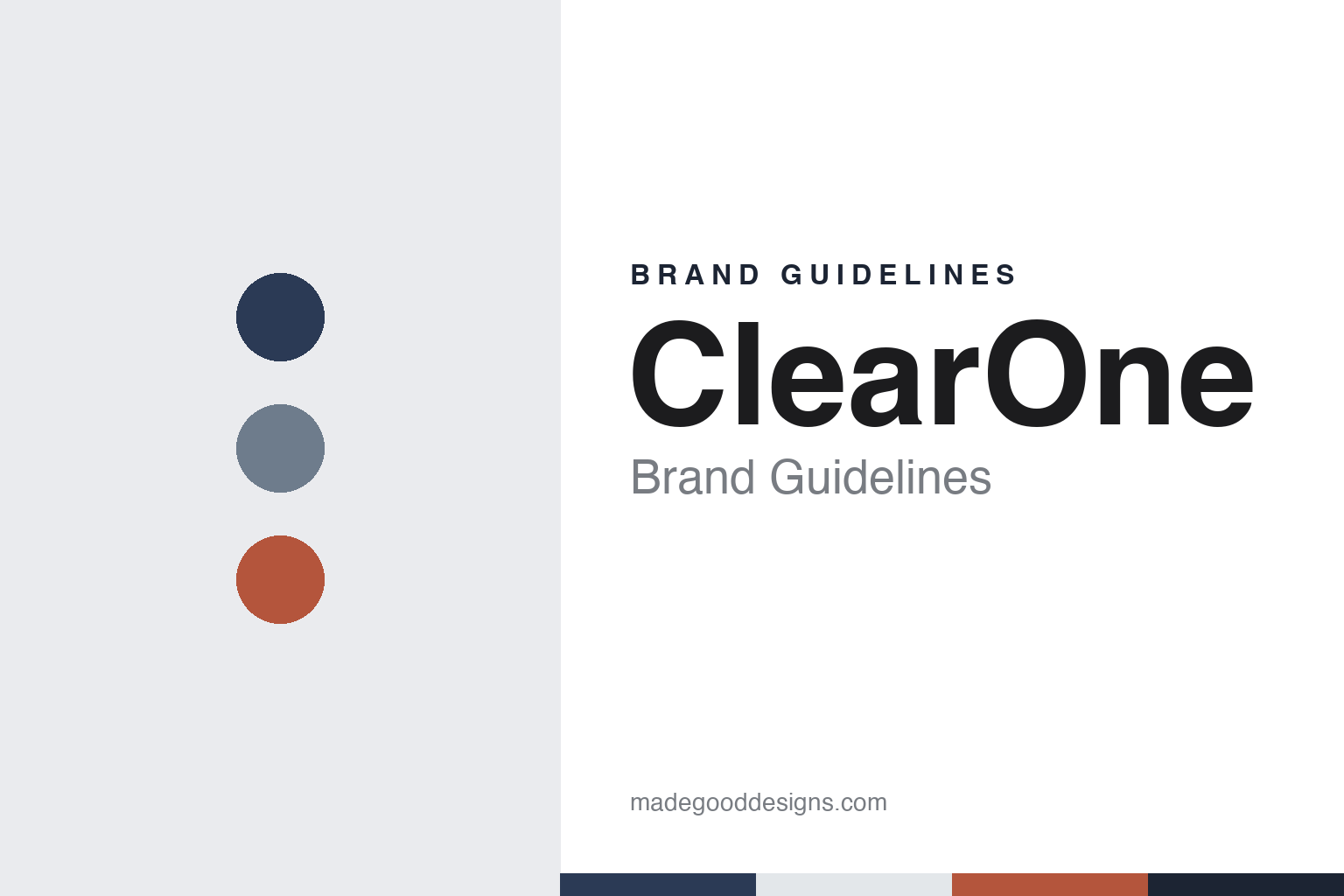
ClearOne Brand Guidelines
A Salt Lake City echo-cancelling pioneer whose designs passed to Biamp in 2025.
Aa
Two constants: a ClearOne slate navy, steel and coral palette and a Clean sans register. Abstract homage — not a ClearOne product or mark; no microphone, logo or nameplate is reproduced.
Gentner Communications
Radio roots in Salt Lake City.
ClearOne began under another name. Russell Gentner, who got involved in student radio at the University of Utah and later designed equipment for a Salt Lake City radio station, told the trade magazine SCN in 2014 that he started Gentner Communications, “now ClearOne.” The company, he said, began with telephone hybrids, moved into transmitter remote controls and audio processing, and then saw the need for acoustic echo cancellers for telephone and video conferencing. A company profile from S&P Global Market Intelligence dates the company’s incorporation to 1983; Gentner went on to co-found Listen Technologies, a maker of wireless assistive listening systems, in 1998. He later served on the board of governors of InfoComm, the audiovisual industry association, the same interview noted.
Conferencing became the core of the business. In January 1998 the Deseret News reported that Gentner had sold its GT724 group teleconferencers to IBM, which used them as the audio part of its videoconferencing room systems.
The new name arrived on 1 January 2002. Salt Lake-based Gentner Communications Corp. became ClearOne Communications Inc., the Deseret News reported, with its Nasdaq symbol changing from GTNR to CLRO after 15 March and subsidiaries in Ireland and Germany; the paper described it as offering voice, video and web conferencing products and services. At first ClearOne acted as a holding company and kept Gentner as a division and a product brand. In June 2002 the products, sold until then under the Gentner and VideoLabs names, were rebranded ClearOne and sold through a new ClearOne Conferencing Products division; they included the XAP and V-There audio and video conferencing systems, and VideoLabs, gained with the acquisition of E.mergent, added document cameras, voice-tracking cameras and conferencing furniture. The company said it wanted “a strong, consistent brand behind which all of our stakeholders can rally,” though the Gentner name stayed on its Distributed Echo Cancellation technology.
Colour
A hard year, then a ceiling.
Within a year the new name was under strain. On 15 January 2003 the US Securities and Exchange Commission filed a complaint in federal court alleging that ClearOne had overstated revenues, income and accounts receivable since early 2001, the Deseret News reported, through what the SEC called “channel stuffing”: recording shipments to distributors and resellers as sales when the transactions did not meet accounting rules for sales. The complaint also named two of the company’s executives, and the company declined to comment that day.
The rest of the year was difficult. Looking back in December 2003, the Deseret News listed the delisting of the shares by Nasdaq, the loss of its auditor, Ernst & Young, which withdrew its support for the 2001 and 2002 annual reports, the termination of the executives, a trading halt lasting several months and a shareholder class action. By the end of 2003, the paper reported, ClearOne had apparently settled the SEC and shareholder suits, pending court approval in early 2004.
The company went on making conferencing equipment, and its shares are again listed on Nasdaq under CLRO. By its own description it offered beamforming microphones, DSP mixers, USB speakerphones, video conferencing and software collaboration platforms. rAVe [PUBS] reported its DIALOG 20 USB wireless microphone system ahead of its debut at the ISE trade fair in Barcelona in January 2024, a non-exclusive patent cross-licensing agreement completed around the same time, and, in February 2025, the BMA 360DX, which combined a beamforming microphone array, a DSP processor with Dante networking and a multi-channel amplifier in a single ceiling tile.
Typography
Rooms, racks and integrators.
Conference-room and pro AV makers sell a room more than a gadget. Their catalogues and websites tend to show the same scene: a meeting table, a large display on the wall, a slim video bar mounted under the screen, microphones set into the ceiling, and a small touch panel on the table that starts the call, dims the lights and switches the source. The equipment that makes the room work is usually out of sight, in a rack in a cupboard or above the ceiling tiles.
That hidden layer is where much of the industry’s engineering sits: control processors, signal switchers and extenders, amplifiers and digital signal processors that shape the audio of a room. These are boxes with plain faceplates and model numbers rather than consumer-style names, and their brands live on the label, the rack ear and the software screen an installer sees when setting up a system.
Most of these products do not reach buyers off a shelf. They are specified and wired in by systems integrators and installers working for companies, universities, schools and public bodies, and many makers run their own training and certification programmes for those partners. The trade gathers at fairs such as InfoComm in the United States and Integrated Systems Europe (ISE), where new panels, cameras and processors are shown on stands built to look like finished meeting rooms.
For a design guide, the category shows identity working at two scales: a calm, uncluttered room for the people who use it, and a dense, technical system of labels, connectors and part numbers for the people who build it. The makers in this guide are set out with what can be checked about who founded them, who owns them and where their products are made.
Aa
A clean sans — a name chosen to unite Gentner and VideoLabs. (Specimen set in Manrope, a sans STAND-IN; NOT the ClearOne logo.)
ClearOne
Sold to Biamp in 2025.
ClearOne’s product business ended in 2025. On 24 October 2025 it signed and completed a sale of assets to Biamp Systems, the company announced three days later: Biamp took intellectual property, product inventory and customer data, while ClearOne kept its public-company listing and its warranty and support operations. In a letter to customers, Biamp’s chief executive Rashid Skaf wrote that Biamp was acquiring “the intellectual property, brands, and product designs” of ClearOne but was not committing to continue its product lines, and offered ClearOne customers an equipment swap programme to exchange their ClearOne equipment for equivalent Biamp equipment at a discount. rAVe [PUBS] reported on 27 October 2025 that the assets included patents on beamforming microphone arrays and that Biamp planned to use selected ClearOne technology in future Biamp products.
ClearOne’s chief executive, Derek Graham, said in the announcement that ClearOne “will continue to exist as a public company.” Distributors could go on selling the stock they held, the company said, but fulfilment was limited to existing inventory. A company profile from S&P Global Market Intelligence, carried by Stock Analysis in November 2026, describes ClearOne as having no significant operations, and its website now carries support contacts and the sale announcements rather than a product range.
For a design guide, ClearOne shows how a name chosen to unify a company’s products can outlast the products themselves. Compare Biamp, which now holds ClearOne’s brands and designs, and Shure, another American microphone maker. For this guide we use a slate navy, a steel grey and a coral with a sans, an unofficial interpretation; no product or logo is reproduced.
Explore & save
Keep ClearOne’s identity on hand — save it to a board in the Made Good inspiration library.
ClearOne identity set
Pin the ClearOne slate navy, steel and coral palette and the Clean sans register to your own board.


