Marie Bracquemond is a useful artist for designers because her work shows the scaffolding behind an easy-looking image. Her finished paintings of figures on terraces and in gardens read as quick, sunlit impressions, yet the drawings that survive in museum collections reveal careful planning: figures placed and re-placed, drapery worked out in chalk, faces modelled with a few strokes of white. She also designed for ceramics and made etchings, so her output crosses the line between fine art and applied design in a way that suits anyone who works in more than one medium.
This guide uses five public domain and CC0 works from the Metropolitan Museum of Art, the Cleveland Museum of Art and the Art Institute of Chicago. For more works like these, browse the MGD museum inspiration collection.
Who was Marie Bracquemond?
Museum records agree on the outline but not on every detail. The Met gives her biography as “French, Argenton-en-Landunvez 1841–1916 Sèvres”, while the Cleveland Museum of Art and the Art Institute of Chicago both give her dates as 1840–1916. Published biographies give her birth name as Marie Quivoron and her birth date as 1 December 1840, in Brittany. Cleveland describes her as a “French painter, printmaker, and ceramicist”.
According to published accounts, she showed paintings at the Paris Salon while still young and received some guidance from the circle of Jean-Auguste-Dominique Ingres. She married the printmaker Félix Bracquemond in 1869. The Cleveland Museum of Art notes that she met artists such as Claude Monet and Edgar Degas through her husband’s friendships with them, and that she was among the few women in the Impressionist circle.
Published accounts list her among the exhibitors at the Impressionist group shows of 1879, 1880 and 1886. Cleveland confirms the 1879 exhibition, where it says her drawings related to the Muses of the Arts were singled out for praise. Biographies state that she largely stopped painting around 1890. Much of what is told about her private life comes from an unpublished memoir by her son, Pierre, so this guide keeps to the work itself.
Key works and a short career outline
The works below are those that can be dated and attributed from museum records, plus a few paintings that published accounts date consistently.
- Self-portrait, ca. 1870 (the Met): a large charcoal, brown wash and white gouache drawing on toned paper, with a graphite study on the back.
- Muses of the Arts: Architecture, 1878 (Cleveland): a black chalk figure study on pale pink paper, linked by the museum to the Muses of the Arts design shown at the Exposition Universelle of 1878.
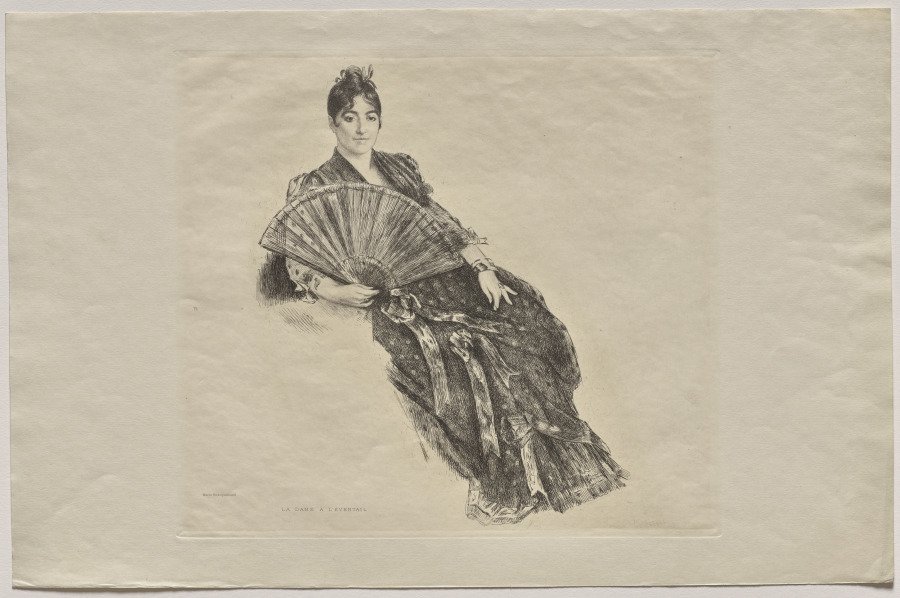
- Self-Portrait in a Spanish Costume, 1880 (Cleveland): an etching that the museum counts among about ten prints she made.
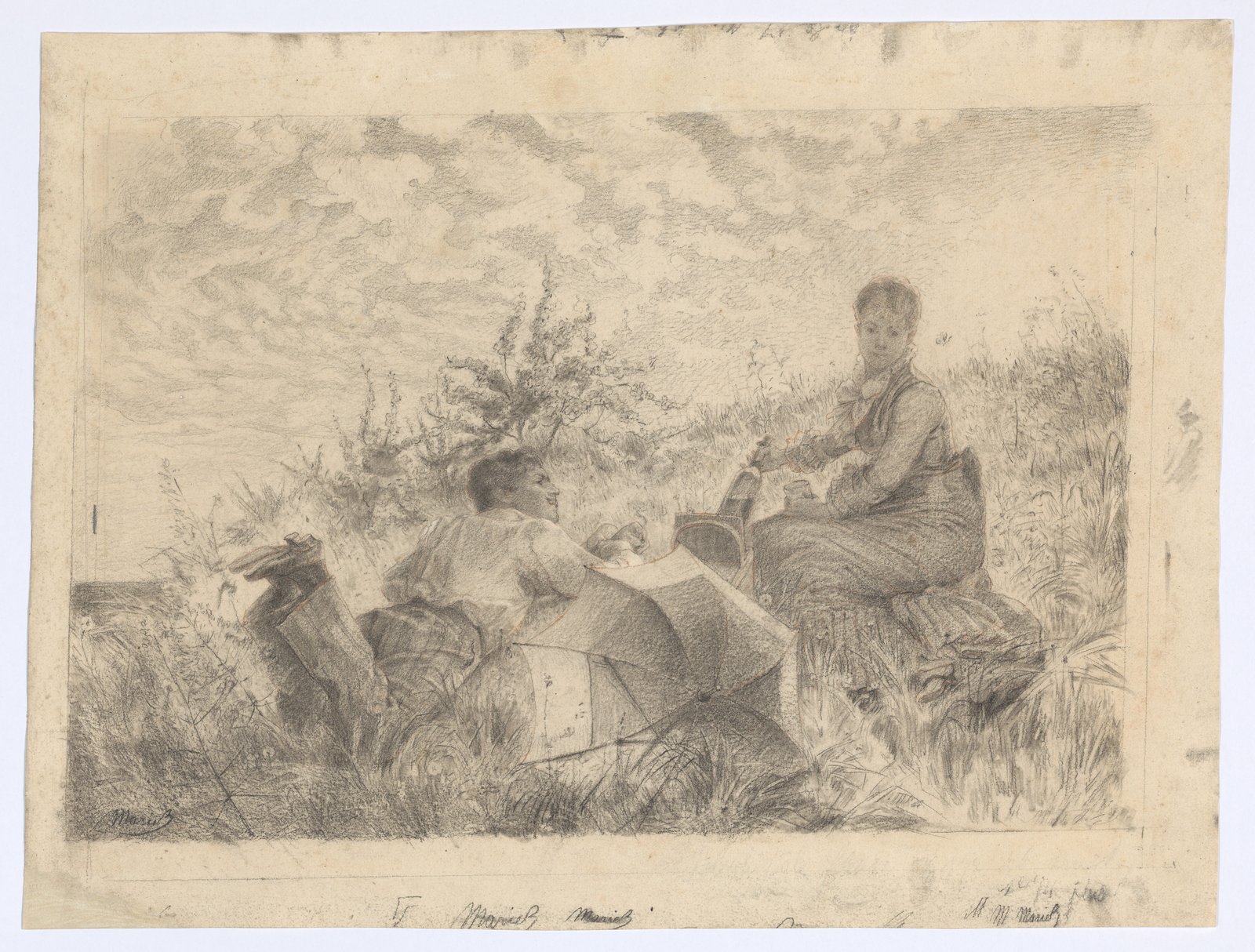
- Lunch in the Countryside, 1881 (the Met): a graphite, charcoal and red chalk drawing of an outdoor scene.
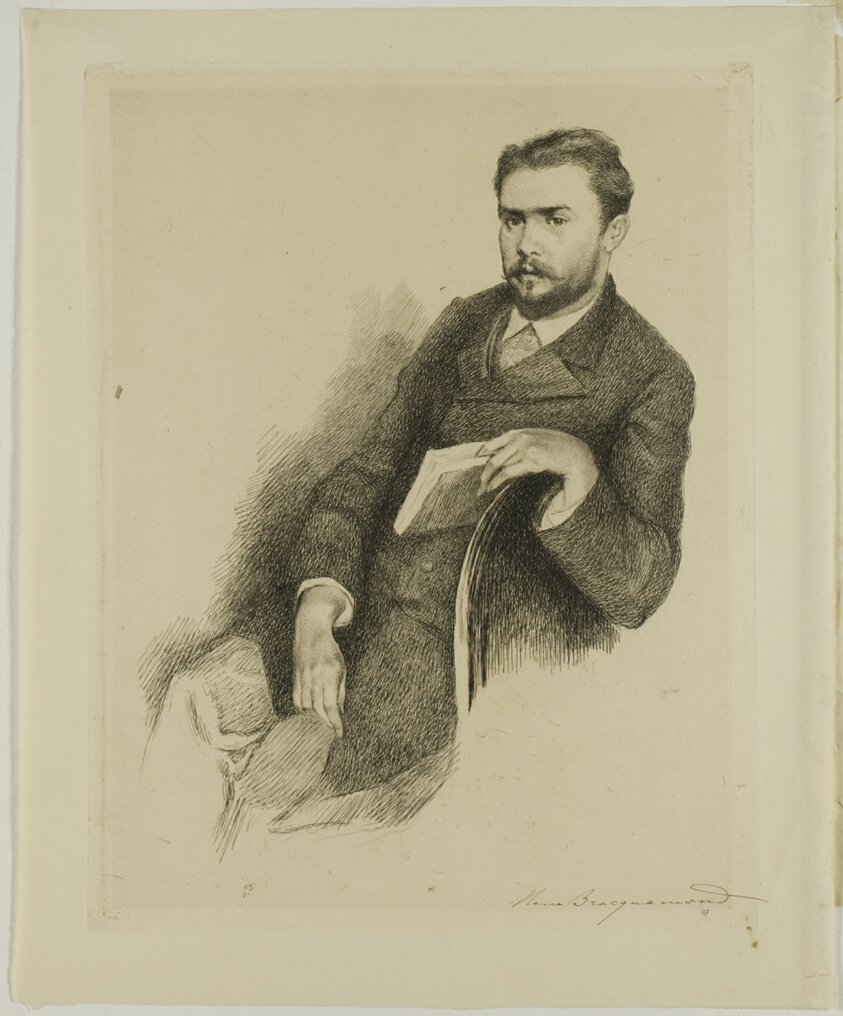
- Portrait of the Critic Gustave Geffroy, by 1890 (Art Institute of Chicago): an etching of the writer, seated with a book.
Paintings that published accounts date to 1880 include The Lady in White, On the Terrace at Sèvres and Afternoon Tea, with Under the Lamp dated 1887. These are not reproduced here; they are named so you can look them up in the collections that hold them.

What to look at in Marie Bracquemond’s drawings
Start with the Met’s self-portrait. The face is fully resolved and everything else is barely there. The hair is massed in dark charcoal, the eyes and brows are crisp, and small touches of white gouache sit on the forehead, nose and cheek to pull the face forward from the brown sheet. Below the chin the drawing dissolves into faint outlines. The effect is a strong focal point with a soft frame around it, the same hierarchy a designer builds when a hero image fades into its background.
Notice how much the toned paper does. Mid-tone paper lets an artist work in two directions at once: dark for shadow, white for light, with the sheet itself carrying the middle values. That is an efficient system, and it maps neatly onto a limited digital palette of a dark, a light and a single ground colour.
The Architecture study at Cleveland shows a different skill. A standing draped figure is drawn in long, light chalk lines, with fold after fold of fabric pooling at the feet. The construction lines are left visible. You can see where the figure’s axis was set and where the drapery was adjusted. For anyone learning to lay out a composition, it is a reminder that the guides are part of the process and need not be hidden in a sketch.

Composition and light
Lunch in the Countryside at the Met is a good lesson in horizontal layout. Figures rest low in a band of long grass, a parasol lies open in the foreground, and the upper half of the sheet is given to a broad, cloudy sky. The weight sits at the bottom, the space opens at the top, and the eye moves left to right across the grass to the seated figure. Wide banners, website heroes and landscape covers can borrow the same structure: anchor the content low and let negative space breathe above it.
Published accounts describe her later paintings as brighter and more broken in colour, made outdoors in the garden at Sèvres. The drawings already point that way. Grass is suggested with quick vertical hatching rather than outlined blade by blade, and light is left as untouched paper. Restraint does the work.
Technique: etching, chalk and ceramic design
The Cleveland Museum of Art says she made about ten etchings and presumably learned the medium from her husband. The two prints in this guide show how far a limited printed line can go. In the Self-Portrait in a Spanish Costume, the open fan becomes a graphic device: its ribs fan out in a crisp radial pattern that contrasts with the dense, dark hatching of the gown. The figure sits on a diagonal, so the whole image tilts and feels relaxed rather than posed.
The Geffroy portrait at the Art Institute of Chicago is tighter. The sitter’s jacket is built from closely packed hatching, the face is left lighter, and the background is cross-hatched to push him forward. The artist’s name appears in a loose, flowing hand at lower right, a signature that sits comfortably inside the composition rather than being stamped on it. If you work with etched or engraved textures, our guide to etching for designers covers the process in more depth, and the printmaking theme collects more public domain prints.
Her applied work matters too. Cleveland connects the Architecture drawing to the Muses of the Arts, shown at the 1878 Exposition Universelle, and published accounts describe that work as a large panel of painted tiles made for the Haviland studio at Auteuil, where Félix Bracquemond worked. Those accounts also say she designed decoration for dinner services. The tile panel itself is reported as lost. Browse the ceramics theme for public domain pottery and porcelain from the same period.
How designers can borrow from Marie Bracquemond
Plan, then loosen. Her drawings show that a relaxed final image often rests on structure. Block out your layout with guides and grids, then let the final rendering soften the edges so the structure is felt rather than seen.
Use a toned ground. Try a three-value system on a mid-tone background: one dark for shadow and type, one light for highlights, and the background colour carrying everything in between. It produces depth quickly and keeps a palette tight. Our collection of vintage colour palettes includes warm paper tones that suit this approach.
Give one object a pattern job. The fan in the 1880 self-portrait is a single prop that adds rhythm and direction. In a poster or packaging design, one patterned element against plain areas can do the same.
Cross between fine and applied art. She moved between painting, drawing, printmaking and ceramic decoration. Designers who carry one visual idea across print, packaging and screen are working in the same spirit. Published accounts also connect Félix Bracquemond with the Paris taste for Japanese prints in these decades; our overview of Japanese art gives background on that wider taste in Paris at the time.
Frequently asked questions
Was Marie Bracquemond an Impressionist?
Yes. The Cleveland Museum of Art describes her as one of a few women artists in the Impressionist circle, and published accounts list her among the exhibitors at the group shows of 1879, 1880 and 1886.
When was Marie Bracquemond born?
Museum records differ. The Met gives 1841, while the Cleveland Museum of Art and the Art Institute of Chicago give 1840. Published biographies give 1 December 1840. All agree she died in 1916, and the Met records Sèvres as the place of death.
Did Marie Bracquemond make prints?
Yes. The Cleveland Museum of Art counts about ten etchings by her, including the 1880 Self-Portrait in a Spanish Costume, and the Art Institute of Chicago holds her etched portrait of the critic Gustave Geffroy.
Are Marie Bracquemond’s works public domain?
She died in 1916, and the works shown here are flagged public domain or CC0 by the Met, the Art Institute of Chicago and the Cleveland Museum of Art. Always check each museum’s object record and terms before reuse.