Richter Spielgeräte Brand Guidelines
The Bavarian family firm that builds play equipment from mountain larch.
Aa
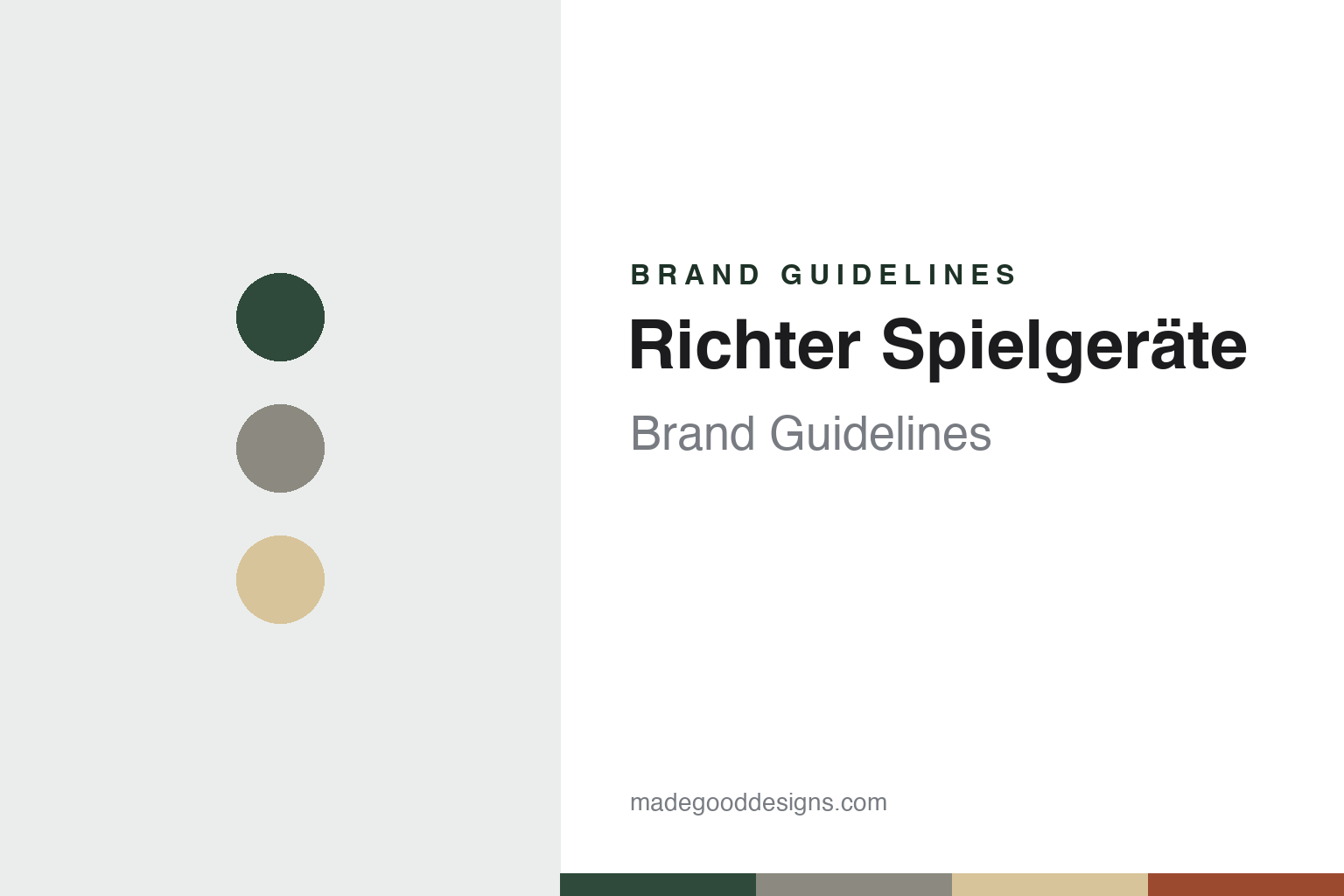
Two constants: a Richter alpine pine, silvered larch and rope hemp palette and a Craft serif register. Abstract homage — not a Richter Spielgeräte product or mark; no equipment, logo or snail figure is reproduced.
Hilde Richter
Sketches from Hamburg, a forge in Bavaria.
Richter Spielgeräte, whose name means “Richter play equipment,” began with Hilde Richter of Hamburg. The company’s own history says that she had the idea of building wooden play equipment at a time when playgrounds were dominated by steel poles, and that her son Julian Richter built the first prototypes from her sketches in a small forge near Frasdorf, in Upper Bavaria. The Norwegian magazine Park & Anlegg, reporting a study visit in its June 2025 issue, adds that she ran an orphanage in Hamburg after the war and watched how children built their own small playgrounds among bushes and trees from gravel, cones, stones and pieces of wood.
The founding date comes in two versions, and both are defensible. The company’s timeline lists the foundation of “Hilde Richter Spielgeräte” in 1966, and then, in 1967, a workshop in Bavaria, the start of its own production and what it calls the actual company launch. Its text and press page use 1967, as does Park & Anlegg; a company profile by the German business magazine Wirtschaftsforum, whose English version in European Business is dated February 2024, gives 1966.
The business did not start out wholly in Frasdorf. According to the timeline, operations moved in 1970 into the Buchauer sawmill there, while the sales office stayed in Hamburg until 1975. The premises were bought in 1976, and in 1977 the firm became a GmbH, with Hilde and Julian Richter among its managing directors. That same year, the company says, it designed a playground for the blind at Borgweg in Hamburg. Its first catalogue came in 1980, and the first “Frasdorfer Fachgespräche,” the specialist talks it still hosts, in 1981.
The family stayed in charge. The company says Julian Richter Jr., Hilde’s grandson, became managing director in 2009 and sole managing director in 2019. Wirtschaftsforum described the firm in 2024 as wholly family-owned, with 130 employees.
Colour
Larch, rope and a long list of designers.
Wood is the core of the brand. Richter says that since 1989 its wooden equipment has been made from untreated mountain larch, a timber it sources from certified forestry in the Lungau mountains of Austria. Park & Anlegg reported that most of the timber is mountain larch from a nearby Austrian sawmill, and that the company treats knots, cracks and irregularities as design features rather than faults. The magazine also noted the silver-grey patina that larch develops. Slides and much of the water play equipment are stainless steel, and some pieces are concrete; ropes and nets are processed in a rope workshop on the premises.
The catalogue changes slowly. The company says it holds about 1,000 items, and that equipment from its early years still shapes it. Park & Anlegg reported that the range barely changes from year to year and that classics stay in place, because the firm values long-lived products over new designs. It also described stylised farm animals as among the bestsellers; the website’s popular items include a Wobbly Sheep and a Wobbly Wild Boar alongside see-saws.
Richter also credits its authors. It says its equipment is drawn by a wide range of designers, each bringing an individual approach, and lists them by name. The timeline records a licence agreement with Hugo Kükelhaus in 1973, work with Günter Beltzig from 1977, and the rights to Wolfram Graubner’s “Spielstationen zur Entfaltung der Sinne” equipment in 2005, after cooperation with the Graubner company began in 1989.
The project list reaches well beyond Germany. The company dates the start of British exports to 2000 and the Diana, Princess of Wales Memorial Playground in Kensington Gardens; Park & Anlegg names that project and the Gathering Place in Tulsa, Oklahoma, among its work, and showed equipment being made at Frasdorf for a further phase in London. The Royal Parks said in August 2026 that the London playground would reopen on 5 August after a renewal that included a new 17-metre by 12-metre galleon and timber from sustainably managed European forests. In Tulsa, the Chapman Foundations Adventure Playground at Gathering Place was named Best Public Playground in the USA Today 10Best awards for 2026.
Shopping centres are another line of work. The trade fair FSB’s magazine lists Richter play areas at the Mall of Arabia in Cairo, malls in Ferrara, Arese and Bari, and the BørneLund Playville in Osaka, opened in 2019.
Typography
How playground makers present themselves.
Playground equipment is sold to people who will never climb on it: parks departments, school boards, housing associations and landscape architects. The makers’ brochures speak to those buyers. Their catalogues tend to lead with an installed site rather than a single object, often a town square, a schoolyard or a housing estate with the equipment in use and the setting in view.
The visual language comes largely from the materials. Steel frames and posts arrive powder-coated in strong primary colours, set against panels in black, sand or a muted green. Timber ranges, in species such as robinia and larch, read differently: greyer and more irregular, closer to the trees around them. Rope nets add a third texture, and rubber surfacing, poured or laid beneath the equipment, adds a field of colour that can run across a whole site.
Geography is part of the presentation too. Several makers come from small towns rather than capitals, and a Nordic catalogue image can be a park in a modest town under low light, with the equipment as the brightest thing in view. Others present a works, a family name or a date on a timeline.
Installers are part of the product too: this equipment reaches its users only after a crew has dug footings, fixed posts and laid the surface. This guide sets out what can be checked about each brand: who founded it, who owns it now, where it says its products are made, and which of those statements rest on the company’s word alone.
Aa
A warm craft serif — a workshop voice. (Specimen set in Fraunces, a serif STAND-IN; NOT the Richter Spielgeräte logo.)
Richter Spielgeräte
A snail as a coat of arms.
The brand’s emblem is a snail, and the company documents its history itself. Richter says Hilde Richter’s design for a play figure called the “Dorothea Snail” dates from as early as 1964, and that Dorothea Richter later used it as the inspiration for the logo of Hilde Richter Spielgeräte. It says the mark has been protected by copyright since 1981, and that the animal’s slow pace stands for the company’s philosophy. Wirtschaftsforum called the slow but persistent snail the firm’s heraldic animal, and Park & Anlegg’s reporter closed her 2025 article by calling the snail logo a fitting symbol of the company’s considered approach.
Manufacturing is the other pillar, and the phrase “Made in Germany” appears on the company’s homepage. Wirtschaftsforum reported that the equipment is made exclusively at the Frasdorf headquarters, with smaller joineries, sawmills and a metalworking firm in the region supplying raw material and parts. The company says its pieces are made “piece by piece” in craft steps, with no industrial manufacturing characteristics. Park & Anlegg offered an outside view: the workshops did not look like a modern factory, and modern machinery sits beside traditional hand tools. Julian Richter also told the visitors that custom work demands considerably more time, material and testing than standard products.
The workplace forms part of the brand story too. The company traces a “social model” of co-determination and non-hierarchical working back to its founder, and Wirtschaftsforum reported low staff turnover. Sales in Germany go through commercial agencies and abroad through exclusive partner firms; the company says it is represented in more than 40 countries. Wirtschaftsforum reported that municipalities still make up about 80 per cent of its customers, with more architects, private investors and hotels than before, and that more than half of its projects are in Germany, Austria and Switzerland.
For a design guide, Richter Spielgeräte shows how one material, one slow animal and a named list of designers can carry a brand for six decades. Compare Proludic, another European play equipment maker, and Playmobil, whose Funpark at Zirndorf took its first Richter ship in 1999, the company says. For this guide we use an alpine pine, a silvered larch and a rope hemp with a serif, an unofficial interpretation; no product or logo is reproduced.
Explore & save
Keep Richter Spielgeräte’s identity on hand — save it to a board in the Made Good inspiration library.
Richter Spielgeräte identity set
Pin the Richter alpine pine, silvered larch and rope hemp palette and the Craft serif register to your own board.


