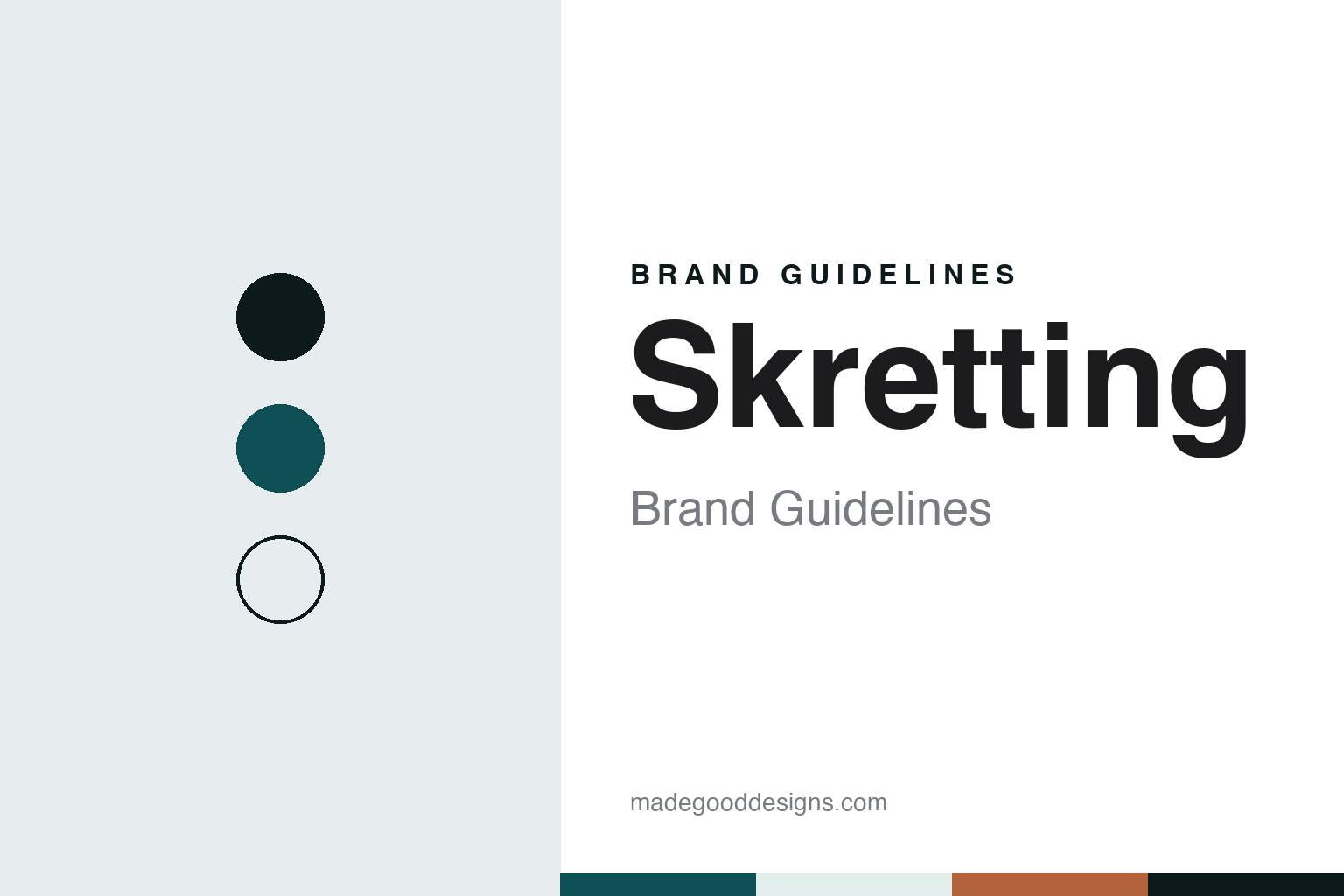
Skretting Brand Guidelines
An 1899 Stavanger farm-supply firm turned fish-feed name.
Aa
Two constants: a fjord teal, deep ink and copper palette and a sturdy old-style serif register. Abstract homage — not a Skretting product or mark; no feed bag, logo or label is reproduced.
Stavanger Landbrugsforretning
A farm-supply firm in Stavanger.
Skretting began in Stavanger, on Norway’s south-west coast, in 1899. Store norske leksikon, the Norwegian national encyclopaedia, says the business was set up that year as Stavanger Landbrugsforretning, an agricultural supply firm, and later traded as Stavanger Maskin- og Landbrugsforretning. Norwegian Wikipedia says it supplied machinery, tools, fertiliser and concentrate feed to farmers; the company’s own history describes a family business “selling feed and equipment to the agriculture industry.”
The Skretting family came in early. Norwegian Wikipedia dates the family’s involvement to 1913 and the change of name, to T. Skretting, to 1925; Store norske leksikon says the firm took its present name after Torgeir Skretting became sole owner in 1925, and that Skretting AS was formed as a limited company in 1950. The sources read for this guide do not describe the business during the German occupation of Norway from 1940 to 1945.
Fish feed came in the 1960s. The company says its first aquaculture trial, in 1960, was on rainbow trout raised in wooden cages; English Wikipedia says the first ten tonnes of fish feed were produced in Norway in 1963, and Norwegian Wikipedia says the firm began making dry feed for fish during that decade. In 1973, according to English Wikipedia, Skretting set up its first research farm for the sea farming of Atlantic salmon, and in 1983 extruded salmon feed reached the Norwegian market. The company dates its aquaculture research centre and the Lerang research station to 1989.
Ownership then passed to the British oil company BP, and sources differ on the timing. Store norske leksikon says Skretting became part of BP Nutrition, BP’s food division, in 1981; Norwegian Wikipedia says BP bought in gradually through the 1980s and owned the whole company by 1990. From 1990, Norwegian Wikipedia says, Skretting supplied fish farming alone.
Colour
One name for a whole group’s feed mills.
In 1994 BP’s nutrition business was bought by its management, with private-equity backing according to Nutreco, and the new company took the name Nutreco — drawn, it says, from “nutrition,” “ecology” and “economy.” Nutreco set up its headquarters at Boxmeer in the Netherlands, it says, and was listed in Amsterdam in 1997. From 2004, by Nutreco’s account, it changed from a group active in feed, fish farming and meat processing to one focused on animal nutrition and fish feed.
Skretting was then one fish-feed company among several inside the group, which, English Wikipedia says, also included Trouw businesses in countries such as France, Spain, Chile and Ireland, and Moore-Clark in North America. In 2003 Nutreco put all of its fish-feed companies under the one name, Skretting; Store norske leksikon records the same change. Yamaha Nutreco Aquatech, a Japanese joint venture with Yamaha Motor set up in 1997, took the Skretting name in 2005, according to English Wikipedia, and Nelson and Sons, the American maker of Silver Cup feed bought in 2008, became Skretting USA in 2012.
Shrimp feed came next. The company says it entered that market in 2010 with its first plant in Vietnam, made acquisitions in Egypt and Nigeria in 2013, and has since opened plants in Ecuador, Vietnam, India and Nigeria — at Surat in 2023 and Ibadan in 2024. Its company-facts page, updated in May 2026, lists production in 18 countries, from Norway, Chile and Canada to Japan, Egypt and Honduras, and feed for more than 60 species. In Norway, Store norske leksikon says, the feed is made at three plants, at Averøy, Stokmarknes and Stavanger; the company says they make feed for Atlantic salmon, seawater trout, cod and halibut, among other species.
Named products include Nutrace, the quality and food-safety system the company dates to 2003, and the ORI-GO live-feed range launched in 2007. Nutreco says MicroBalance, which Skretting brought to market in 2016, was the first aquaculture feed made entirely without marine raw materials.
Typography
Pens, pellets and the people who farm.
Aquaculture suppliers sell to fish farmers and other professional buyers, and their brands are shaped by the places their equipment works. The pictures that recur across the sector are aerial views of circular pens floating in a fjord or a sheltered bay, rows of plastic rings linked by mooring lines, and a feed barge moored beside them. Seen from above, a fish farm is a set of simple shapes on dark water, and many suppliers lean on that geometry in their photography and graphics.
Closer in, the imagery turns to working detail: net cages lifted at the edge of a pen, feed pellets and silos, hoses carrying feed out to the rings, cameras and sensors lowered into the water, and divers or remotely operated vehicles inspecting nets below the surface. Land-based farming adds a different picture, of tanks, pipes and filtration halls indoors. Service boats and workboats appear in many catalogues, because service and maintenance at sea are part of what these suppliers sell.
In many identities colour follows the setting: blues, greens and greys stand in for sea and coast, and a brighter accent, often orange or yellow, echoes the buoys, floats and safety gear that make equipment visible on the water. Type is often a plain sans, chosen for technical documents, product sheets and dashboards as much as for advertising.
Trade fairs remain an important stage for these brands. Aqua Nor in Trondheim and conferences such as AquaVision bring farmers, feed makers and equipment suppliers together, and stands there carry the same mix of pen models, barge cut-aways and screens of feeding software. The guides in this series look at how individual suppliers present themselves within that shared visual language.
Aa
A sturdy old-style serif for a family name that became a group brand. (Specimen set in Fraunces, a serif STAND-IN; NOT the Skretting logo.)
Skretting and SHV
A Stavanger head office inside a Dutch family group.
Nutreco itself changed hands in 2015, when the Dutch family-owned investment firm SHV bought it; Nutreco says the purchase led to its delisting in April 2015, and Store norske leksikon also dates SHV’s purchase to 2015. Skretting now describes itself as the aquafeed division of Nutreco, a subsidiary of SHV, with its global operations based in Stavanger, where the Norwegian business also has its head office. Its chief executive is Maarten Bijl.
The company has also given the industry one of its meeting places. In 1996, it says, it launched AquaVision, a global aquaculture conference held every two years in Stavanger. Its company-facts page lists the standards each plant is certified to, and the company says its Chilean business became the first salmon-feed mill certified to the ASC Feed Standard in 2024, with plants in other countries following in 2025.
For a design guide, Skretting shows how one family’s name, taken by a Stavanger farm-supply business in 1925, became the single brand for a whole group’s feed mills across five continents. Compare BioMar, the Danish feed maker set up by trout farmers in 1962, and Cargill, the American agribusiness company that began with an Iowa grain warehouse. For this guide we use a fjord teal, a deep ink and a warm copper with a serif, an unofficial interpretation; no product or logo is reproduced.
Explore & save
Keep Skretting’s identity on hand — save it to a board in the Made Good inspiration library.
Skretting identity set
Pin the Skretting fjord teal, deep ink and copper palette and the sturdy old-style serif register to your own board.


