Svetruck Brand Guidelines
The Ljungby heavy-forklift maker founded in 1977.
Aa
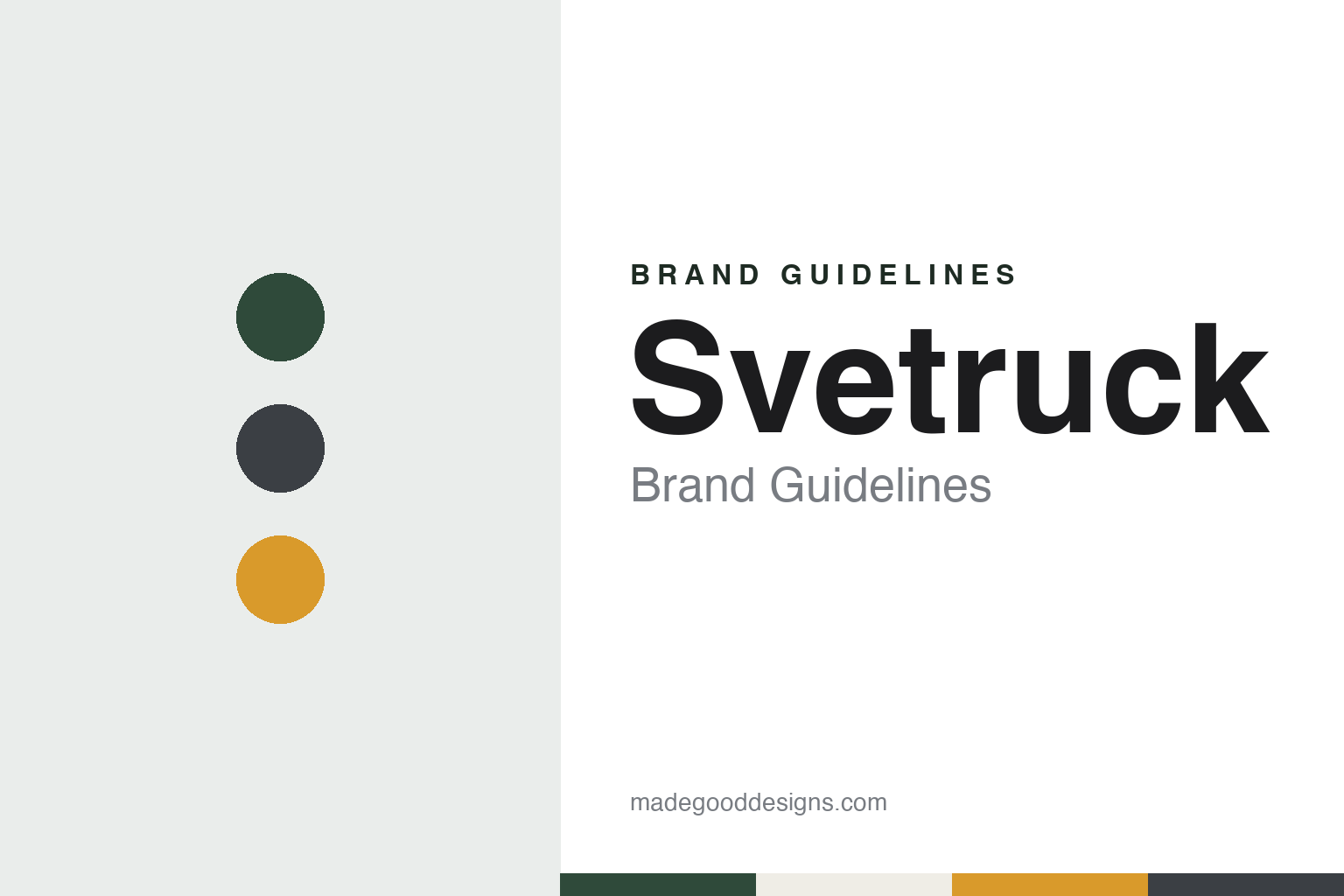
Two constants: a Svetruck pine green, grey and amber palette and a Condensed industrial sans register. Abstract homage — not a Svetruck product or mark; no machine, logo or nameplate is reproduced.
The barn at Bäck
Three brothers and a full-scale drawing on a barn floor.
Svetruck’s story starts before Svetruck. In January 2002 the Swedish engineering weekly Ny Teknik told how three brothers, Rune, Holger and Sture Andersson, made the small Småland town of Ljungby a centre for heavy forklift trucks. They began by refurbishing scrapped machines and selling them on. Rune and Holger then went into business together, buying old vehicles from the Swedish road administration and lifting masts from the armed forces, and, for scrap iron to use as counterweights, a railway bridge from the state railways.
The brothers were not trained designers, Ny Teknik wrote, so they drew the parts at full scale on the earth floor of the barn at the family farm at Bäck, outside Ljungby. The business there was called Br. Anderssons Mek. Verkstad. Its first forklift was delivered in 1961, according to Ny Teknik (Swedish Wikipedia gives 1960), and it carried the serial number 21, Rune told the magazine, so that the customer would not realise it was the first machine they had built.
About thirty trucks were built in the barn before the brothers opened a factory in Ljungby in 1966; Swedish Wikipedia says the business was renamed Ljungbytruck that year. Around a thousand machines followed. The firm was then sold to the state-owned Kalmar Verkstad, which had bought the Lidhult forklift maker LMV in 1974: Kalmar’s own history and Swedish Wikipedia date the purchase to 1975, Ny Teknik to 1976. The combined business became Kalmar LMV, a forerunner of today’s Kalmar.
Rune and Holger stayed on under the new owners, Ny Teknik reported, but left when they learned that Kalmar preferred its own name to Ljungby’s for selling the trucks worldwide. Rune went on to build small diesel trucks and later large wheel loaders at Ljungby Maskin.
Colour
A second start in the same town, in 1977.
Svetruck was founded in Ljungby in 1977. The trade site Forkliftaction.com, interviewing the company at the CeMAT fair in Hannover in October 2005, wrote that Sture and Holger Andersson established it, with more than ten years of forklift experience between them; Swedish Wikipedia gives the same pair. Ny Teknik’s 2002 profile credits Sture, the youngest brother, who it said was not bound by any promise to Kalmar to stay out of forklift making. Either way, the result was that Ljungby became home to two heavy-forklift makers, Kalmar and Svetruck. Ny Teknik added that the two businesses the brothers started then accounted for well over half of world production of heavy forklifts, a figure it gave in 2002.
Svetruck built its name on big, customised machines. In November 2002 Forkliftaction.com reported that it had delivered its biggest container handler to that date, the S1150, to Alaska Marine Lines, built to stack 53-foot containers five high for a rail and barge service between Seattle and Whittier, Alaska. In the 2005 interview the company said it had supplied eight custom-built forklifts for that customer, machines weighing 90 tonnes, and named as one of its earliest innovations what it called the world’s first full-visibility mast for heavy forklifts; it said the entire machine was assembled at the Ljungby plant and that its forklifts worked in about 100 countries.
The machines kept growing. In August 2021 Forkliftaction.com reported that the British dealer Cooper Specialised Handling had sold an 80-tonne Svetruck, the model 80100-75, to the Danish steel company Dansteel to handle billet, with a Volvo engine, a ZF transmission and a Kessler axle.
Svetruck’s current range, as its website sets it out, has three families: forklifts in classes from 10 to 52 tonnes, for sawmills, concrete works, steelworks, ports and terminals; container handlers, including the CS and ECS models for empty containers, which the company says stack five and eight high respectively; and the TMF logstackers for sawmills, paper mills and pulp plants. It also sells a telematics service, SveCare.
Typography
Design and documentation.
Port and terminal equipment is sold to a small, specialist audience: port authorities, terminal operators, shipping lines and the logistics firms that move containers inland. The makers’ own websites and brochures tend to show the machines at work rather than on their own, because scale is the point. A ship-to-shore crane is pictured with its boom reaching out over the stacked deck of a container ship; a gantry is shown against the quay it serves.
The smaller machines are presented in the same working settings. Straddle carriers appear in long rows between container stacks, reachstackers lift boxes at the edge of a yard, and terminal tractors pull trailers and chassis between the quay and the gate. Forklift trucks and empty-container handlers are photographed in timber yards, steel mills and inland depots as well as in ports, since the same makers sell to heavy industry and distribution.
Automation has added a second kind of picture. Alongside the machines, the pictures now include control rooms and screens, and a maker such as Kalmar lists automation systems and charging solutions as products in their own right. Kalmar says the first fully automated straddle-carrier terminal opened in Brisbane in 2005, and ZPMC lists automated terminals in Xiamen and Shanghai among its projects.
Delivery is part of the story too. Large cranes are often moved fully assembled by sea: ZPMC says its own fleet carries large products whole, and English Wikipedia says it ships cranes in a fully erected state, so a crane standing upright on a heavy-lift vessel is a familiar image in the trade. The guides in this group follow makers across Finland, Sweden, the Netherlands, Germany, France, the United States and China, and set out what each company says about itself alongside what independent sources record.
Aa
A condensed industrial sans — “True Quality.” (Specimen set in Barlow Condensed, a sans STAND-IN; NOT the Svetruck logo.)
Svetruck
“Trust. Strength. Performance. True Quality.”
Svetruck has stayed in Ljungby. Its website says that design, construction, manufacturing and the head office are all under the same roof there, with subsidiaries in Germany, Belgium and the USA and dealers and agents elsewhere. The company describes itself as Sweden’s largest privately-owned forklift manufacturer, with about 200 employees at the Ljungby plant, and says around 95 percent of its sales are made within Europe. Its “facts” panel gives about 250 employees in 2020 and more than 6,000 heavy forklifts and 350 logstackers delivered to over 70 countries, and it says it keeps 55,000 original spare parts at its main warehouse in Ljungby. These are the company’s own figures.
Its language is short and repeated. The website runs the line “Trust. Strength. Performance. True Quality.”, and in 2005 the company told Forkliftaction.com that “true quality” was its motto. It says each Svetruck is built to suit the conditions in which it will work, and that it builds to “the highest standards, not to the lowest price.” It calls its TMF logstacker the world leader in log handling, a claim we give as the company’s. Model names are plain: classes by tonnage, TMF ratings such as 32/22 that pair the grapple capacity with the telescope in and out, and the CS and ECS container handlers.
The town’s forklift history did not stop with the brothers. Ny Teknik noted in 2002 that a group from inside Kalmar had broken away to run SMV Lifttrucks in neighbouring Markaryd, another maker of heavy forklifts; the magazine credited the brothers’ own success to listening to the drivers who use the machines and to the specialist suppliers of engines, hydraulics and drivelines.
For a design guide, Svetruck shows how a family firm can build an identity on one place and one heavy product. Compare Kalmar, which grew in part from the brothers’ first business, and Hyster, another maker of big lift trucks. For this guide we use a pine green, a forge grey and an amber with a condensed sans, an unofficial interpretation; no product or logo is reproduced.
Explore & save
Keep Svetruck’s identity on hand — save it to a board in the Made Good inspiration library.
Svetruck identity set
Pin the Svetruck pine green, grey and amber palette and the Condensed industrial sans register to your own board.