SWARCO Brand Guidelines
Glass beads from Amstetten, a head office in Wattens.
Aa
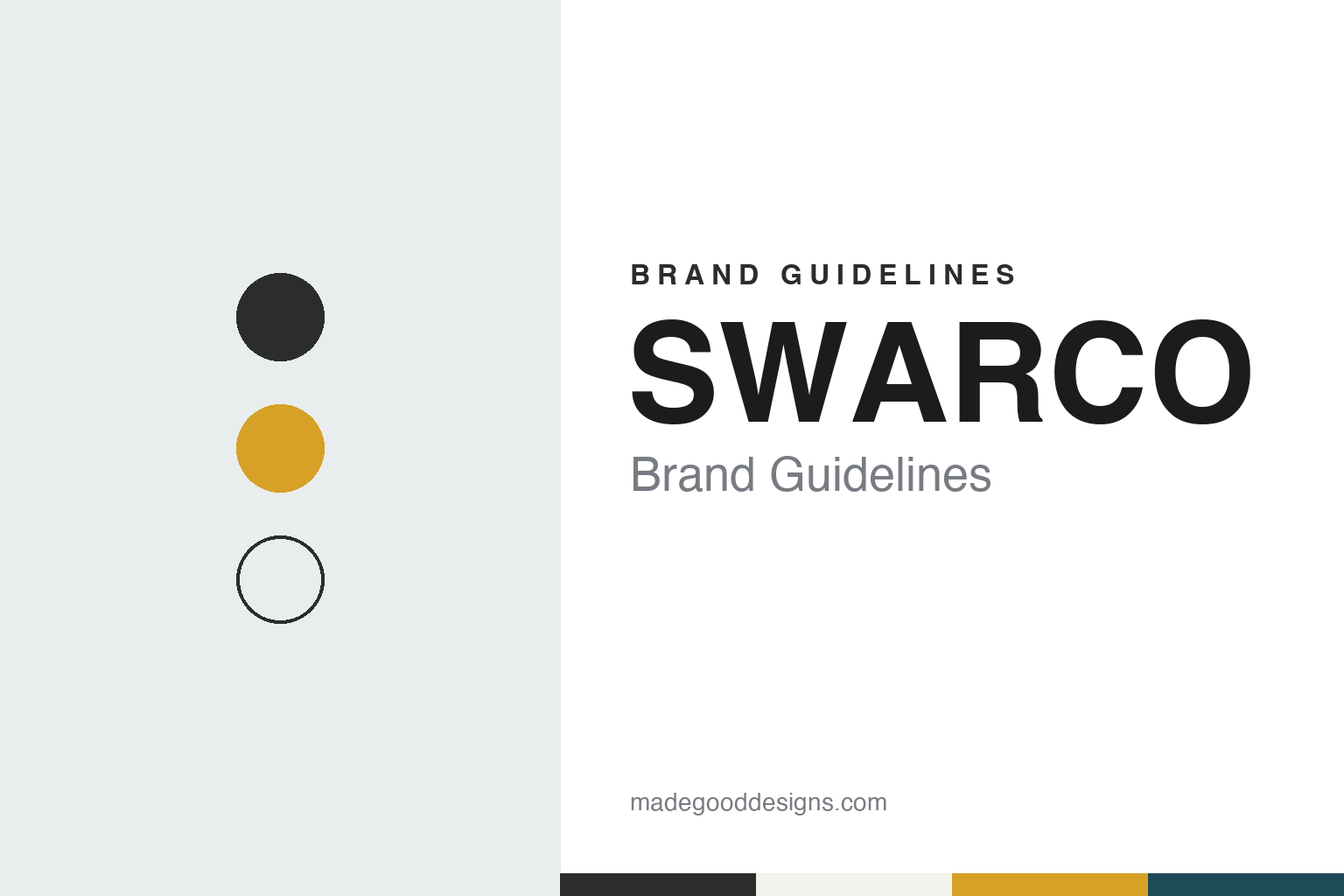
Two constants: an asphalt, marking white and amber palette and an engineered grotesque register. Abstract homage — not a SWARCO product or mark; no signal, sign or logo is reproduced.
Glass beads
A bead factory in Lower Austria.
SWARCO began with something very small: the glass beads that are scattered into road markings so that lines catch headlights at night. The Austrian business magazine trend reported in March 2024 that at the end of the 1960s the owners of the Swarovski crystal company considered making these tiny reflective beads, then dropped the idea as a poor fit for their brand. Manfred Swarovski, a member of the Swarovski family, then started an independent company for them in 1969.
German Wikipedia places that first factory, called M. Swarovski, in Amstetten in Lower Austria, and the company’s own timeline calls Amstetten “the birthplace of today’s SWARCO Group.” trend reported in 2024 that glass beads are still made at Neufurth near Amstetten, among other places. An anniversary article published on the Intertraffic website in June 2019 tells the company’s own founding story: Manfred Swarovski met an American, Gene Autry, by chance in a bar in Mexico in 1969, and the two planned a bead factory in Austria. The same article gives the beads’ size as between 0.1 and 1.5 millimetres.
The group’s head office is in Wattens, the Tyrolean town also home to the crystal company, but the two are separate businesses; trend described SWARCO in 2024 as the company of one branch of the Swarovski shareholder families.
Colour
From road paint to traffic lights.
The company’s timeline shows how a bead maker became a traffic technology group, mostly by buying other firms. It says HEOSCONT Chemie joined in 1973, bringing a road-marking contracting business; business in the United States began in 1974 with glass beads, later followed by tape and thermoplastic production; and Vestische Strahl- und Reflexglas of Recklinghausen, in Germany, was bought in 1978 and is now SWARCO VESTGLAS.
The decisive step into traffic signals came in 1986, when SWARCO acquired FUTURIT-Werke, now SWARCO FUTURIT, the timeline says. It lists the opening of a new traffic light and variable message sign plant in Austria in 2000, along with the FUTURLED range of LED signals; acquisitions in traffic management in Scandinavia in 2003; and in 2007 a majority stake in M. TECH, with the German signal makers Signalbau Huber and Dambach. Later purchases named there include the British parking and charging specialist APT Group and Germany’s Transver in 2014, and the American signal company McCain in 2016, a deal German Wikipedia dates to 31 August 2016.
The pace rose in the 2020s. trend reported in 2024 that SWARCO made seven acquisitions in 2021 alone, including the largest in its history, and that the purchase of the Dutch company Dynniq Mobility lifted its workforce to about 5,300. The company’s timeline also lists Supalux of Australia and Hitex International of the United Kingdom in 2021, FOL Tape in the United States in 2024, and the LACROIX City businesses in France and Spain and Germany’s Heusch-Boesefeldt in 2025.
Road marking remains a core business, trend said. The product pages today run from glass beads, solvent and waterborne paints and thermoplastic systems to the ECO-LINE range and markings for bike lanes, airports and race tracks, with traffic systems presented on a separate site.
Typography
Junctions, gantries and control rooms.
Traffic system makers sell to road authorities, cities and motorway operators rather than to the public, yet their work is some of the most visible equipment in any town. The signal heads at a junction, the gantries that span a motorway, the cameras mounted on poles and the white and yellow lines painted on the road surface all come from a small group of specialist companies, and most drivers pass their products without ever seeing a brand name.
That makes the way these companies present themselves unusual. Their brochures and websites tend to show the infrastructure in use: a junction at dusk with the signals lit, a motorway gantry carrying message signs, a tunnel portal, or a road-marking crew laying fresh lines at night while traffic is diverted. The other recurring picture is the control room, where operators sit in front of a wall of screens and maps showing the road network in real time.
Much of the business is built on long contracts, technical standards and acquisitions. Many of today’s groups were assembled by buying smaller signal makers, detection specialists and software companies, so one group may carry several older brand names in different countries, and a product range may run from glass beads and road paint to controllers, sensors and traffic management software.
The industry meets at trade fairs. Intertraffic, held in Amsterdam, with related events in the Americas, Asia and China, is one of the places where makers set out stands of signals, cameras and control-room displays for road authorities and contractors. This guide sets out what can be checked about each brand: who founded it, who owns it today and what it says about where its products are made, marking clearly what rests only on the company’s own word.
Aa
An engineered grotesque for a company of beads, paint and signals. (Specimen set in Archivo, a sans STAND-IN; NOT the SWARCO logo.)
SWARCO
A family group in Wattens.
SWARCO is not listed on a stock exchange. German Wikipedia describes SWARCO AG as an unlisted Austrian holding company in family ownership, holding all or a majority of the group’s roughly 80 subsidiaries, and records that the listed subsidiary Swarco Traffic Holding was taken private through a squeeze-out on 23 July 2015. trend reported in 2024 that the family decided to continue as a purely family-run business, with the majority held through a private foundation and the family company MS Management GmbH. The magazine reported that Michael Schuch was appointed chief executive and that Günther Apfalter, formerly head of Magna Europe, became chairman of the supervisory board in 2019.
German Wikipedia gives 1999 as the founding year of the AG, and the company’s timeline says SWARCO was organised as an Aktiengesellschaft that year; the business itself dates from 1969. The company calls itself “the traffic technology group SWARCO” and says it has an international network of production facilities, offices and partners, with one of the most complete portfolios for road marking, signage, urban traffic management, parking, highway and tunnel management, public transport and street lighting. It uses the line “The Better Way. Every Day.” and says it employs about 5,300 people. Since 2013 the Wattens head office has housed the SWARCO Traffic World showroom, German Wikipedia says, extended in 2015.
Its systems run in some public places: trend reported that the traffic control centre for the 2024 Paris Olympic Games was converted to SWARCO’s software platform, as were systems for the 2022 football World Cup in Qatar. The magazine also reported that the company was expanding glass bead and road-marking production in the United States and studying options for a plant in India.
For a design guide, SWARCO shows how a company built on an almost invisible material, a glass bead in a painted line, can grow into a group whose name appears on signal heads and control-room screens. Compare Yunex Traffic, the former Siemens traffic business, and Econolite, another maker of traffic signal systems. For this guide we use asphalt grey, a deep teal, marking white and an amber with a sans, an unofficial interpretation; no product or logo is reproduced.
Explore & save
Keep SWARCO’s identity on hand — save it to a board in the Made Good inspiration library.
SWARCO identity set
Pin the SWARCO asphalt, marking white and amber palette and the engineered grotesque register to your own board.